

Responsible Recovery: Blood Tracking Big Game with Versatile Dogs
Trained tracking dogs help hunters recover wounded game ethically and effectively
This article originally appeared in the spring 2023 issue of Hunting Dogs Confidential.
“Hey, do you know anyone in your area with a dog who can track a deer? Some friends of mine shot one yesterday and can’t find it.”
I looked at the message on my phone, then glanced at our dog, who was lazily spread across the couch and engrossed in a bird dog’s dream. Piper, our oldest Deutsch Langhaar, was trained in blood tracking and had earned top points in the subject at her VGP (German utility dog test). Unfortunately, her handler was on a business trip to Europe and entirely out of play for this request. I knew a dog who could find a deer, but wasn’t sure if she knew a human who was up to the task.
Then I thought about the dozens of training tracks I had laid for them in the woods and the countless miles spent following behind them and watching their every move as they worked together to follow the invisible trail. Blood tracking is a team sport between dog and handler—you have to trust each other completely and work together to solve the puzzle—but I’d had a front row seat for their entire journey. I knew Piper’s style and I’d seen the difference between her confidence and her uncertainty on a track. I wondered if she might accept a stand-in on the other end of the lead.
In a rare wave of self-assurance, I called the hunters and gathered information about their situation. The deer had been shot with an arrow the day before; he’d been picked up by two trail cameras but was nowhere to be found in the dense rainforest of western Washington. They confirmed they had access permission for the surrounding properties. I was honest about my experience level and stressed that if they had any other options, they should pursue them first. They didn’t. The weight of being their only hope for the recovery felt heavy, but my heart also pounded with excitement. This was the first season that leashed blood tracking was legal in the state of Washington and so it would be Piper’s very first real recovery scenario. All the training in the world doesn’t stack up against a real-life situation with a completely unknown outcome.
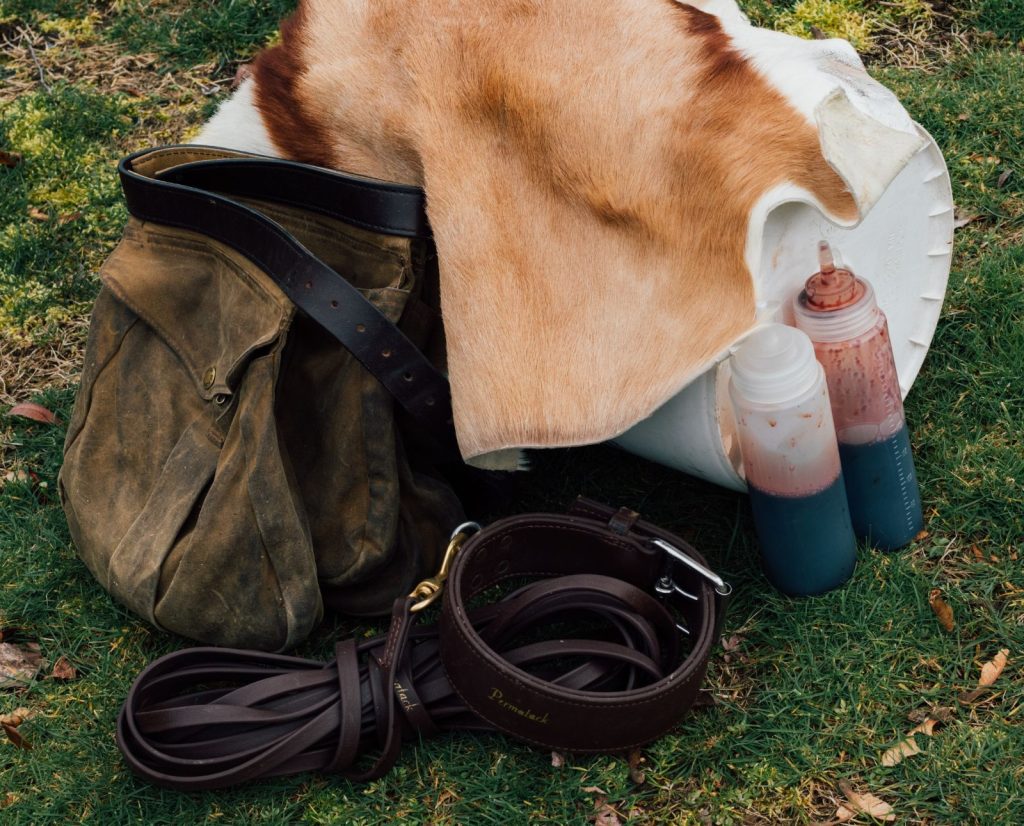
As I gathered all of my husband’s tracking equipment—special collar, long lead, gear pockets, water bottles, surveyor’s tape—I could feel Piper’s quizzical look drilling into me before I even saw it. Of course this was weird. I begged her to use her imagination and pretend we’d done this together a hundred times. I asked for her forgiveness for the mistakes I would make and to just trust her nose when she was uncertain. Then, we drove off to the woods.
Tracking the Deer
When we arrived at the site, wildfire smoke hung thick in the air from a nearby fire. The temperature was pushing 85 degrees, the usually damp forest floor was dry and dusty, and the trail was now nearly 20 hours old. It was about as far from ideal scenting conditions as you could get. I tried not to think about what 85 degrees would be doing to a deer carcass in the sun. I squeezed my eyes shut to steady my nerves and hoped the expectant hunters didn’t see how badly my hands were shaking. This was it.
For her part, in contrast to my quavering voice, Piper put on a show of confidence bordering on cockiness. She pranced up to the site of the shot and assessed the situation while I fumbled with the gear. She laid down on my command and waited while I swapped out her collar and lead for the tracking set—a visual and tactile indication of the task at hand which, judging from her cool stare at the deer’s initial trail, was entirely superfluous. She knew what we were there to do.
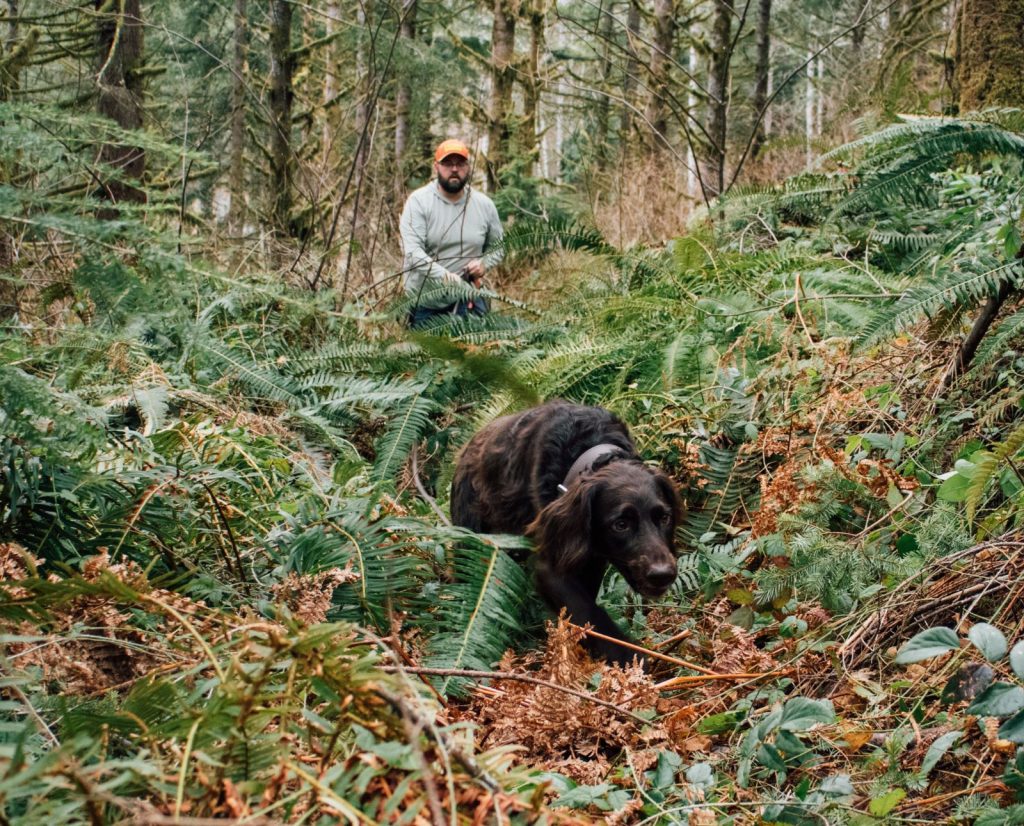
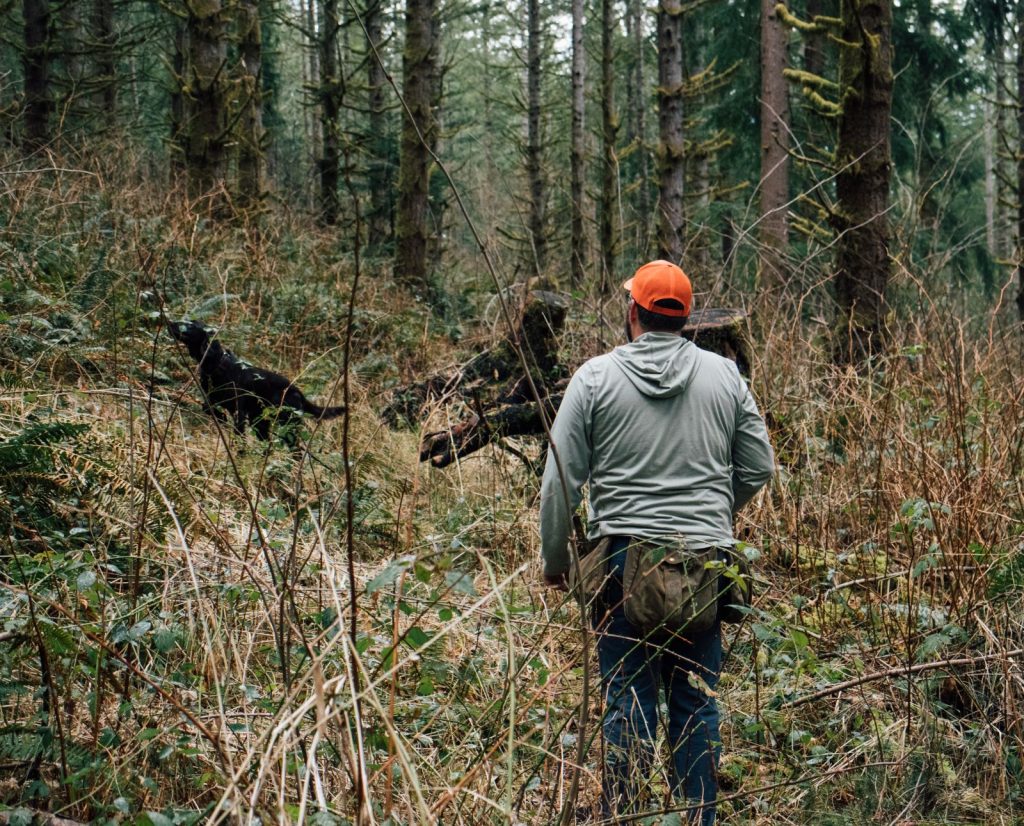
Piper confidently worked the first two switchbacks that the wounded deer had taken up the steep hillside. The hunters whispered with joy as they acknowledged that her track matched the one they’d seen. After nearly an hour of steadily pulling me along the trail, the lead suddenly went slack. Piper turned and looked at me with a cocked head and a telltale question written across her face. What now, boss? I swallowed hard and looked around. We were at an intersection of a couple of game trails. She’d initially driven forward on the middle trail, but then questioned herself and came back to investigate the others. The hunters caught up to us and looked around while I laid Piper down for a water break.
“We’re long past the last trail cam where I picked him up last night, so we don’t have any clues from here. But if I had to guess, he’d go downhill. There’s a creek down there and a good place to bed for the night.” The hunters walked around on all of the game trails ahead of us in search of drops of blood or hoof prints. By the time they’d entirely trampled any remaining scent, they’d convinced themselves that downhill was the only right answer at this intersection. I restarted Piper and guided her on the downhill path.
After a minute or two, though, I could feel her uncertainty transmitting through the lead. She was going this way because I’d said so, not because she believed there was any deer scent here. I stopped, gave her some more water, and took her back to the decision point. I buried my face in her neck and whispered, “You’re the only one with the tools to do this. You’ve got this. I’ll go whichever way you think is best.” With all the bold confidence I could muster, I asked the hunters to step aside and remain behind us for the rest of the track. “She’s the one with the nose; we follow her.”
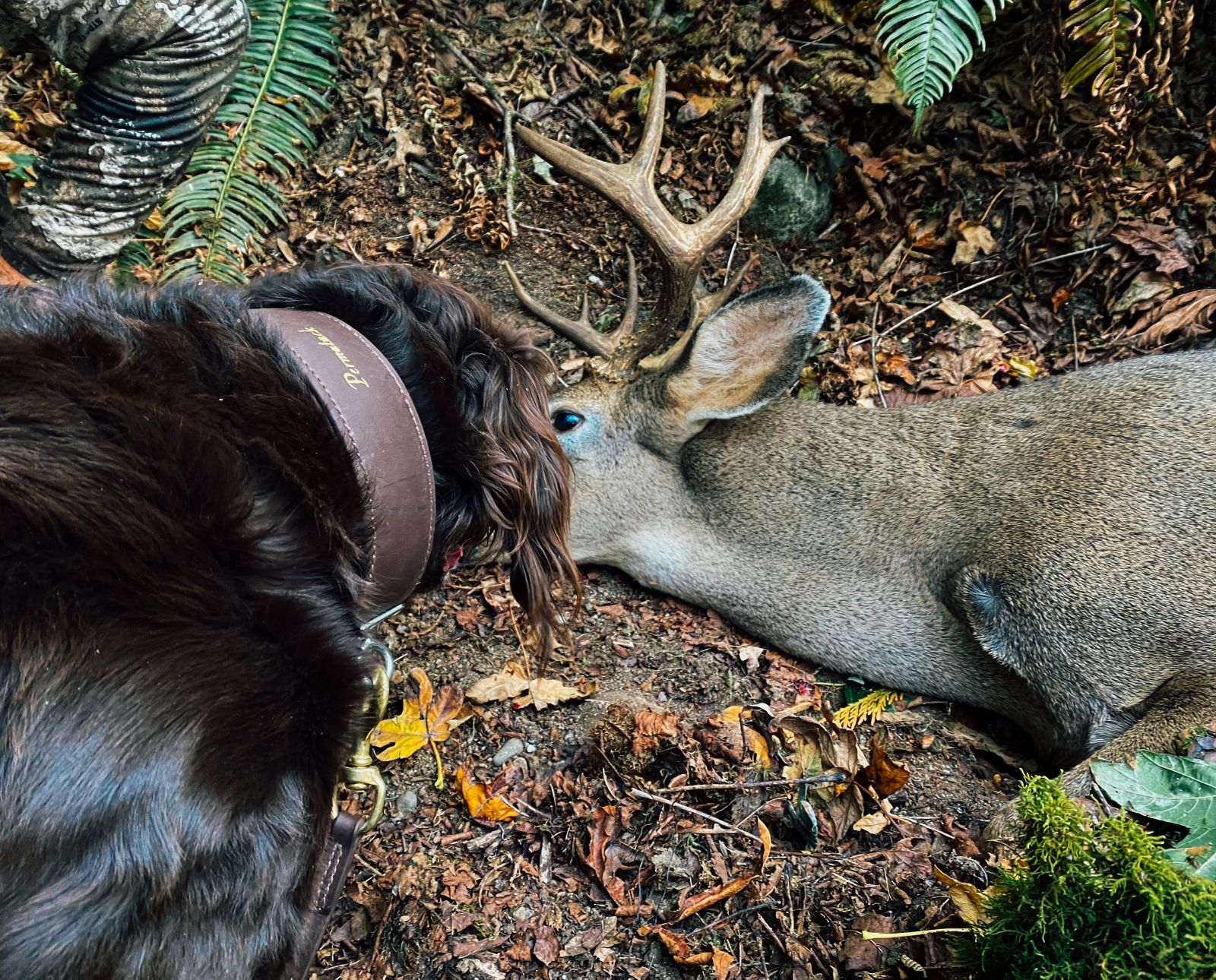
Piper conducted a brief investigation of the uphill path before selecting the straight-ahead path that she’d initially taken. I could feel her speed pick up and I tripped along behind her, crawling over logs and under blackberry vines. Without warning, the line went slack again—but this time she was frozen on top of a huge log, staring straight ahead. I caught up to her and my eyes adjusted to take in the scene of a large buck sitting in the bushes, head held high and staring straight back at us. I yelled for the hunters and picked up Piper in my arms before either she or the buck might try to make a move toward each other. As we collapsed onto the ground on the other side of the big log, relief washed over me. My hands finally stopped shaking for the first time since we’d left home. My breath caught in my throat. We did it.
The deer was mortally wounded and, though it was sad to think of the suffering he’d endured all day long, his fight to stay alive kept the meat from spoiling in the unseasonable heat. The grateful hunter dispatched the deer as tears welled up in all of our eyes. Gratitude, relief, excitement, sorrow…all of the emotions associated with hunting came over us all at once. I was thrilled that Piper and I had completed the task together, but also aware of the deep emotions of the hunter who had just taken a life. My heart had never felt more full of feelings than it did in that moment.
Piper, though, didn’t have any existential feelings or profound reflections on her place in the universe. She’d been given a task and she’d completed it—this time with a real, live deer at the end instead of a hide and a bowl of treats. She’d managed to overcome extremely difficult conditions and placed her trust in someone she wasn’t used to having at the other end of the lead. She’d told me when she was confused and I’d told her that I believed in her. And that was that.
The Legalities Of Blood Tracking With Dogs
This is where the record scratches and I back up to tell you how I’d gotten myself into that situation in the first place. The truth is that while I basically stumbled my way into that first successful deer recovery, the work that went into it stretched back for many years—and not just with my family and our dog. Long before we ever thought about training a hunting dog, volunteers were hard at work, lobbying to legalize the practice of recovering big game with leashed dogs in states across the country. It seems almost unfathomable to think that the responsible recovery of wounded or dead game could be illegal, but often it was an overlooked component of wildlife laws meant to protect deer populations.
According to United Blood Trackers (UBT), blood tracking was outlawed in most of the northern states in the late 1800s when laws changed to prohibit the use of dogs during all aspects of deer hunting. It wasn’t until 1986 that state laws began to change, starting when New York became the first state to enact legislation specifically permitting a leashed tracking dog program. Thanks to the efforts of organizations such as UBT and dedicated individuals across the country, more and more state agencies have come to understand the value of leashed tracking dogs. As of 2023, leashed blood tracking is legal in all but six states in the US, although specific laws vary by state. Some dictate which species can be recovered with this method—for example, using a dog to recover a bear is not always legal even if dogs can be used to track deer or elk. Some states have a licensing program that controls who is allowed to track with dogs. But most importantly, the idea of using a skilled dog to prevent the waste of an animal is catching on and more hunters are learning about this valuable recovery option.
Training A Dog To Blood Track
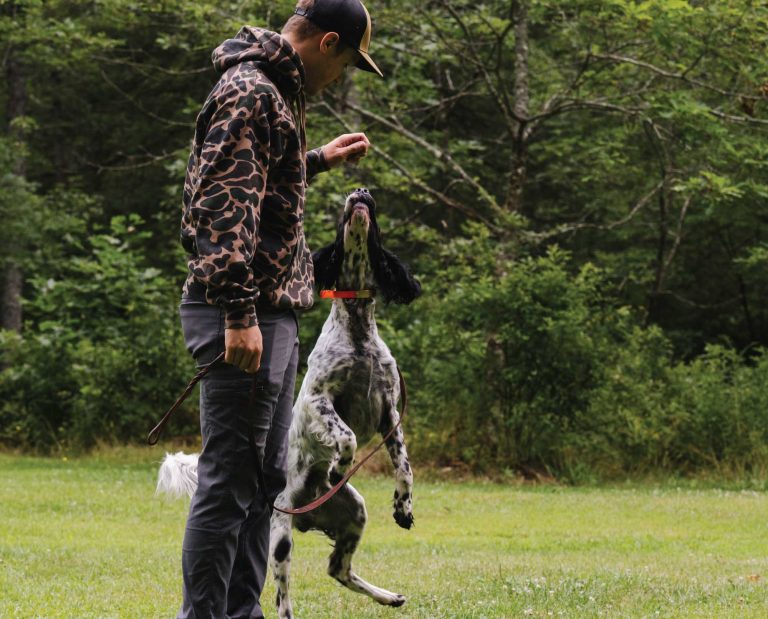
For those who are interested in learning how to recover big game with their hunting dog, I should stress that it’s unwise to just show up, give it a try, and hope for the best. Even in my case when I was completely green, I knew that my dog was very experienced in the task and had demonstrated the ability to successfully work difficult blood tracks while in training. I had also spent many hours as a training assistant so that I understood how to guide the dog and how to read her body language. This is equally important because blood tracking is truly a team effort between the dog and the handler. There are points along the track where the dog might lose confidence or the scent trail goes cold. At these times, the dog must rely on the handler for direction or encouragement and the handler must know how to maintain the dog’s trust and guide them to success.
Training is also important because the dog needs to have some successes under her collar in order to build the confidence necessary to work more difficult blood tracks. This can be accomplished with an artificial track laid with deer or cow blood or with an actual, freshly shot deer whose location (and status) is known to the handler. In either scenario, success can be guaranteed because the handler can ultimately help guide the dog to the “prize” at the end.
The difficulty of a blood track depends primarily on three things: distance, age of the track, and the quantity of blood. Scenting conditions also matter, but they are harder to control in a training situation. As you train, slowly increase the difficulty of the training tracks by changing these three factors just a little at a time. You can start with a nearly-continuous path of fresh blood drips which is simple to follow and clearly illustrates the concept to your dog. The next time, you can use the same amount of blood for twice the distance, or leave it to age for an hour or two. Incremental adjustments to the difficulty will keep your dog—and you—confident in your combined ability to successfully follow a blood track.
There are a few testing options if you wish to validate your training efforts or if you need to demonstrate proficiency to qualify for a tracking license in your area. Both UBT and the JGHV (German versatile hunting dog association) offer tests for blood tracking proficiency, and it is a component of the JGHV’s finished utility dog test, the VGP. Eligibility for JGHV tests is limited to dogs who are registered with a JGHV-affiliated club (typically Deutsch Drahthaar, Deutsch Kurzhaar, Deutsch Langhaar, Deutscher Wachtelhund, Kleine Münsterländer, etc.) while UBT tests are open to any dog, purebred or not.
While success in training is critical to building your and your dog’s confidence, it’s important to understand that not every “wild” recovery will end successfully. Sometimes hunters overestimate the accuracy of their shot and their memory of the event is clouded by wishful thinking. Sometimes the deer will survive, or at least survive long enough to leave an indistinguishable trail behind. Sometimes conditions just might not allow the dog to follow the trail to its conclusion. Worse, sometimes permission cannot be obtained to continue a track onto private property, at which point the effort must be terminated.
The Value Of Trained, Leashed Tracking Dogs
Not long after Piper’s successful recovery, we received another call from a hunter who was unable to locate his deer. Thankfully, Joe was home that time and was able to work Piper on the track as they had so many times before in training and testing. He knew from interviewing the hunter that the shot was unlikely to be a fatal one, but the hunter really wanted to exhaust all of his options. After three hours of focused work and over two miles of tracking, they bumped a buck matching the description out of his evening bed and watched as he walked away, unharmed. While it wasn’t the successful ending that the hunter had hoped for, it was ultimately satisfying to know that the deer had survived and wasn’t suffering or going to waste.
If we as hunters are serious about being ethical when it comes to the game animals that we pursue, then there’s no reason not to use every tool available to recover every animal and prevent needless suffering or waste. For big game hunters in all but six states, that toolbox includes the use of a trained, leashed tracking dog. For hunters in the remaining states, your efforts to educate your state representatives and wildlife agencies can go a long way in making this valuable option a reality.