


Pudelpointer Podcast: The Dog That Challenged the Breeding World
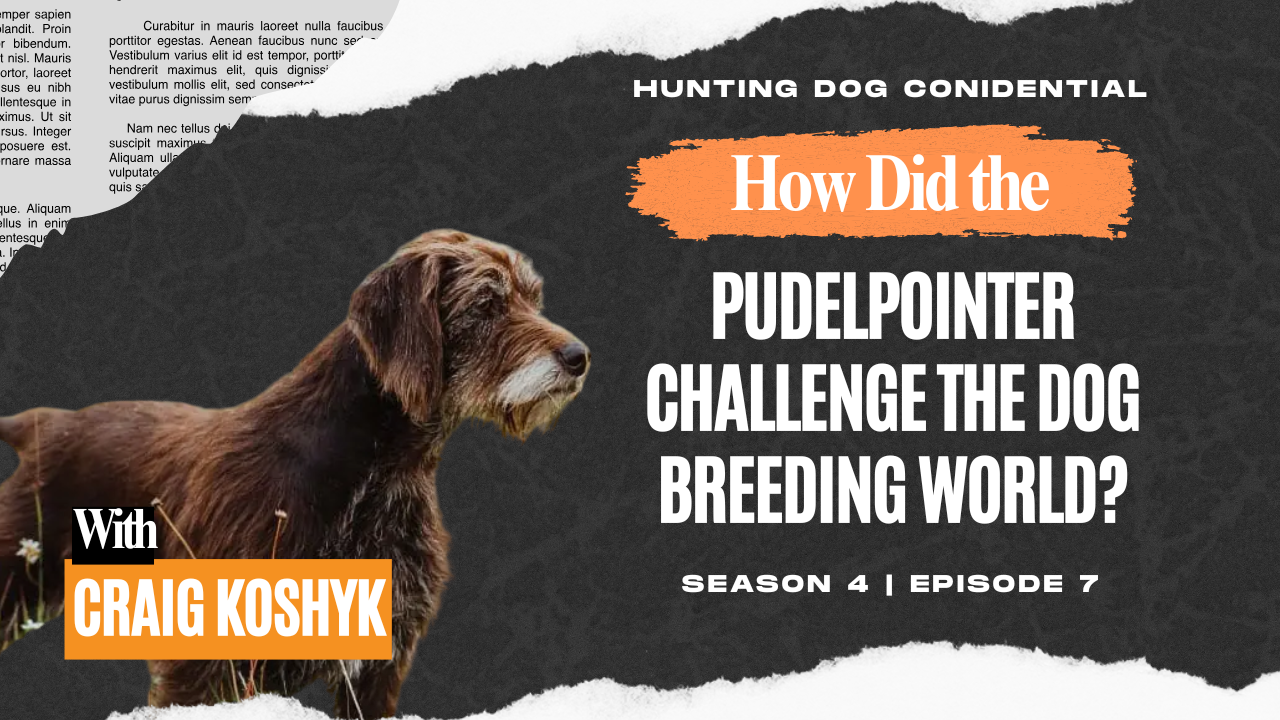
Discover how a one-night cross between a Pudel and a Pointer in 19th-century Germany sparked a revolution in dog breeding.
In this episode of Hunting Dog Confidential, host and dog historian Craig Koshyk unravels the unlikely origins of the Pudelpointer—the world’s first true “designer dog” that actually worked. From the ambition of German hunters seeking the perfect versatile gun dog to the barons, breeders, and field trials that defined a generation, Craig traces how this bold experiment challenged tradition and reshaped the very idea of what a versatile hunting dog could be. Along the way, he explores the breed’s enduring success, its contrast with modern designer dogs, and why the Pudelpointer remains a symbol of purpose-driven breeding done right.
Listen to past episodes here: Hunting Dog Confidential Podcast
Podcast Episode Transcript
Hey everybody. Welcome to the Hunting Dog Confidential podcast. My name is Craig Koshyk. I am your host and resident gun dog nerd. In this episode, we’re gonna find out what happens when a pointer and a poodle have a one-night stand and end up setting off a revolution in the gun dog breeding world—a revolution that reverberates across fields around the world to this very day.
And as always, if you wanna know when these episodes are gonna drop, hit the subscribe button. And if you want more details than what I’m giving in this podcast, check out my books Pointing Dogs Volume One and Pointing Dogs Volume Two, available from Project Upland and from me at dogwilling.ca.
When I first started writing my first book, Pointing Dogs Volume One, I had a heck of a time trying to figure out exactly how all the various rough-haired breeds actually developed.
Then one day at a local off-leash dog park, I saw something that helped me a bit to understand one of the central truths about all of the rough-haired breeds. It was a medium-sized black dog with a distinctive mustache, beard, and a rough coat. Judging from its overall shape and its thick, uncropped tail, I knew it wasn’t a Drahthaar or a Pudelpointer, and it was black, so I knew it couldn’t be a Griffon, a Český Fousek, or a Slovak Pointer.
To my eye, it appeared to be a mixed breed—probably some sort of Labrador cross—and I was right. When I asked the fellow what kind of dog it was, he said, “Well, it’s a Labradoodle.”
That dog represented the results of an intentional crossing of Labradors and Poodles that began in the 1980s in Australia. The program caught on very quickly and kicked off the designer dog trend that has given rise to a whole range of breeds with catchy names like Schnoodle, Goldendoodle, and Puggle.
Naturally, these new hybrids, as they’re called, have created a storm of controversy in purebred dog circles, and they’ve attracted plenty of fast-buck operators hoping to cash in on the latest fad. However, despite the cries of “heretic” or “shame” from some purebred dog circles, there’s nothing inherently immoral or unethical about creating designer breeds—nor is it anything new.
Crossing two existing dog breeds to create a new one is a time-tested technique. It’s been used over the centuries to develop many breeds, and blending their names is nothing new either. Way back in 1881, German hunters began the systematic crossing of Poodles and Pointers, and what they ended up with was the world’s first designer dog with the first designer name: the Pudelpointer.
Okay, let me make a quick side note here because I can understand why Pudelpointer owners might be upset with me at this point. I mean, Labradoodles are now everybody’s punching bag for what’s wrong with the designer dog breeds. But there are some valid parallels to be made between the two. I mean, both breeds are a combination of a smooth-haired breed and a curly-haired breed, and both generally produce rough-haired or wire-haired pups.
And both breeds’ names are also a combination of the names of the two breeds that they were created from. But most importantly, both started off as a great idea, and that’s where the parallels end, because the Pudelpointer succeeded in gaining purebred status and a hardcore following of dedicated, focused breeders in Europe and North America.
The Labradoodle did not. Even the man who created the Labradoodle eventually disowned it. His program to develop hypoallergenic guide dogs for the blind—well, it ended up falling victim to our modern dog breeding culture, which is, let’s face it, dominated by the almighty dollar.
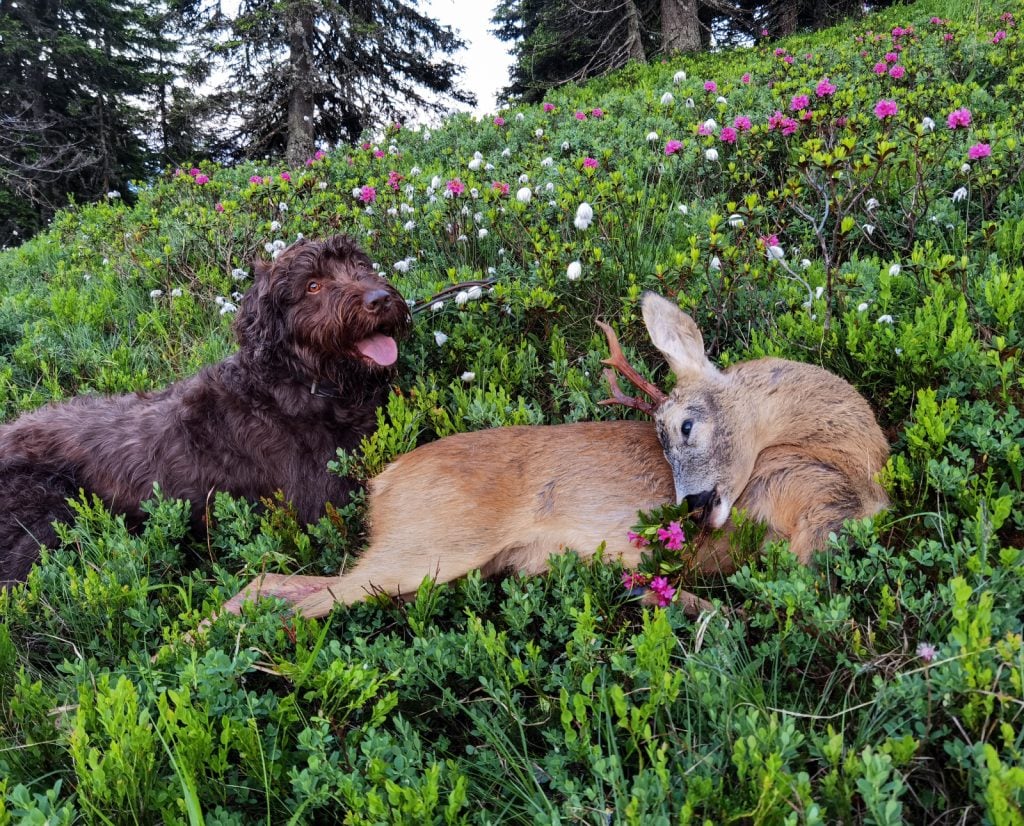
The Pudelpointer, on the other hand, was developed during the golden age of dog-breed creation, when there was still a sense of honor and purpose among many of the leading dog breeders. And it flourishes today as a fantastic pointing breed, bred by and for hunters.
Okay, let’s get back to the history of the Pudelpointer specifically, because if we really wanna understand it, we need to take a look at the zeitgeist—or the spirit of the times—in which it was created. We need to go back to the 1880s, during a period of rapid growth in just about every sector of the newly unified German Empire.
Industry, economy, and population were booming in Germany, and there were improvements in travel, communication, science, and education. Germany was becoming a rival to England as Europe’s leading industrial nation. Spurred on by a heady mixture of romantic nationalism and conservatism, Germany began to move closer to the center of the world stage.
One of the areas that best reflected the new Germany was where the newly liberated sport of hunting intersected with the growing interest in dog breeding. Like the Industrial Revolution, the sport of purebred dogs actually came to Germany a bit later than it did in many other countries. But when it did—boy, oh boy—progress was made at a tremendous pace.
By the 1880s, the rush to standardize and stabilize the German-developed dogs was in full swing, and by the 1890s it was a free-for-all bordering on chaotic. During this time of national awakening, an influential sporting press promoted the growing German hunting culture and encouraged hunters to develop their own breeds of dogs for their own ways of hunting.
One of the most influential writers of the time was a German baron who used the pen name Hegewald. In many published histories of the Pudelpointer, Hegewald is credited with the breed’s creation, but that is actually misleading. Hegewald did not create the breed, but he was instrumental in convincing others to cross Poodles with Pointers to create a new one.
He wrote, “We need the Pointer’s excellent nose and fiery temperament paired with its enormous drive and speed. We need, however, to lose its single-mindedness of purpose. There is only one way to achieve this—through the admixture of Poodle.”
But Hegewald wasn’t the first person to come up with that idea, and he freely admitted as much.
n 1897, he wrote, *“The idea of using the intelligent, eager-to-learn, easily trained, precocious, good-retrieving Poodle for purposes of breeding hunting dogs by no means came from me. In Italy, long before me, the Italians successfully bred the Spinone. In France, the French bred their various Barbets and Griffons.
In our own homeland, our German masters of the stag hunt, of which we must cite in first place the classics Fleming and D. Ba, these authorities and their contemporaries alone deserve the credit for having first created, by using Poodle blood, the famous Polish Water Dog.”*
In Hegewald’s time, Pointers were enjoying tremendous popularity across Europe.
But what exactly were the water dogs? What the heck was a Polish Water Dog that Hegewald was writing about? Well, today, Poodles and Schicks, Poodles and Polish Water Dogs, Hessian Rough Beards, and all those obscure types of dogs that people wrote about in the day—well, they’ve all disappeared, and no one seems to know much about them.
But in Hegewald’s time, everybody knew what they were. In fact, as far back as 1621, Gervase Markham wrote that, “The water dog is a creature of such general use that it is needless to make any large description of him, since not any among us is so simple that he cannot say when he sees him, ‘That is a water dog,’ or, ‘There is a dog bred for water.’”
Well, come on, Markham. Give us a little bit more! That doesn’t really help us when you just say everybody knows it when he sees it. What if we don’t see it? What if they’re not around? Fortunately, Markham then goes on to actually describe the water dog. He wrote, *“It may be of any color and yet excellent, and his hair in general would be long and curled, not loose and shaggy. His head would be round and curled, his ears broad and hanging, his eyes full, lively, and quick. He’s rough-bearded, his chops with a full set of strong teeth, and the general features of his whole countenance being united together would be as lion-like as might be, for that shows fierceness and goodness.
His pasterns are strong and dewclawed, and all his four feet are spacious to the claw like a water duck. In other words, they’re webbed, for they, being his oars, can row him in the water. Having that shape, they will carry his body away all the faster.”*
The dogs Markham described were probably descendants of dogs used for herding. They had a long, thick coat to protect them from the elements, and they had the strength and agility to work in the toughest conditions, including cold water. Everywhere those water dogs were found, they crossed to other breeds—either intentionally or accidentally—and some of the types of dogs they crossed to would have been short-haired.
Hans Friedrich von Fleming gives us further details in a book called The Complete German Hunter, published in 1719. He wrote, *“The shepherds have small or medium driving dogs which have shaggy hair. Such Poodles are now covered with a hound, so the offspring fall with long ears and shaggy hair in order that they swim better.
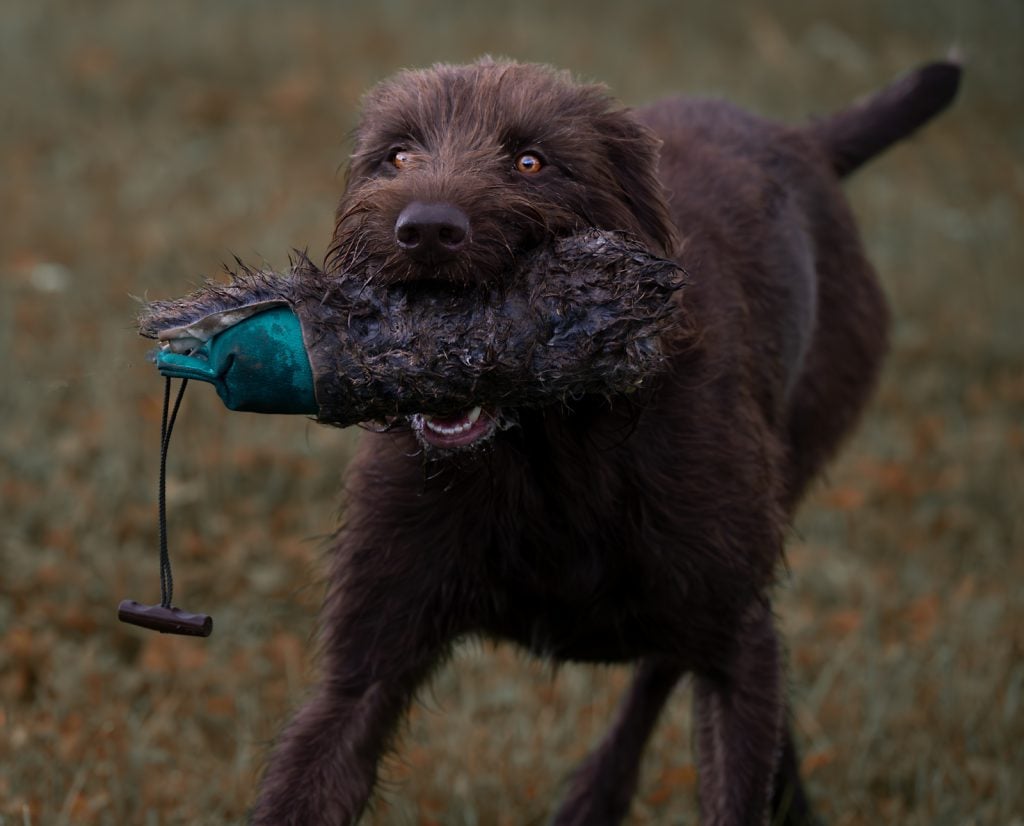
Their thick hair is taken off; a good beard and eyebrows remain, and the tail is docked. These water dogs, from the gray color of the shepherd and the red hair of the hound, are mostly brown, though often white with brown spots or sometimes even black. They are brisk and faithful. They hunt gladly and like by nature to swim. They retrieve well in reeds and fast rivers. They also hunt foxes, otters, and wildcats from the reeds. Such a water Poodle is of great service to the fowler.”*
The rough-coated water dogs Fleming described went by different names in different regions. They were often said to come from Russia or Poland or Bohemia—basically anywhere “out east” somewhere. In all likelihood, they didn’t develop in just one region; they were found across much of the continent, and some of the names they were given were based more on stereotypes than their actual origins.
Jean Castaing, in his book, suggested that the English called them Russian for the same reasons the Germans called them Polish—because they had a rough, unkempt appearance that was considered typical of Eastern European people at the time.
Until the mid-1800s, no one deliberately set out to create rough-haired breeds systematically by crossing different types of dogs. Most of the time, they simply occurred naturally as dogs and their owners let nature take its course. It wasn’t until about the 1880s that people started really thinking about a systematic program of crossing various types of dogs to come up with a stable, rough-haired breed or type of dog.
In 1825, another baron—a guy named Borsch—wrote in the Yearbook for Foresters, Hunters, and Friends of Hunters: “It is noteworthy that crossing the Poodle and the Pointing Dog would unite and maintain the excellent drive by the virtues of both types.” That seems to be the earliest mention of somebody actually pointing out the Pointer and the Poodle as a good cross.
In 1848, a Frenchman, the Marquis of Guerlain, might have been the first to actually undertake such a systematic approach to breeding rough-haired dogs. He crossed rough-haired Griffons that he already had with Pointers. Then a man named Guerlain in Thiry continued the Marquis’s work after him by selecting only white and orange dogs from the Ville line. He then crossed them back to Pointers and eventually established his own breed called the Guerlain Griffon, which was more or less like a Pudelpointer, except it was white and orange.
Side note: the next time you’re in a department store, go to the makeup and perfume section and see if there are any Guerlain products. Guerlain is spelled G-U-E-R-L-A-I-N. It’s pronounced “Glan” in French, but “Guer-lain,” I guess, in English. My wife’s favorite perfume is made by Guerlain, and that perfume was actually created by the same Mr. Guerlain who created his own line of Griffons in the late 1800s in France.
Whenever she puts a little spray of that perfume on, I love it because, first of all, it smells great, but also it just kind of reminds me of the great old times in the golden age of dog breeding, when a rich perfume dude could set about creating his own breed of dog. Unfortunately, the Guerlain Griffon died out, and we might take a look at it in a future episode—but the perfume still lives on to this day.
Anyway, let’s get back to the story. As Guerlain was creating his own breed up in Thiry, there was another French guy, a man named Emmanuel Boulet. He tried a slightly different approach. Instead of starting with those rough, shaggy-coated dogs known as Griffons at the time, he crossed to other types of dogs—a water dog called a Barbet, which had a soft, curly coat. Even Korthals was active at that time, trying to develop his own breed of Griffons.
So by the 1870s and 1880s, all of the various German authorities on gun dogs would have known about these breeding programs. Hegewald was surely aware of them. Hegewald also knew that there had been a mating between a Poodle and a Pointer that had already occurred in Germany by accident. He actually wrote about that accidental breeding, saying that the mother of the litter was a heavily ticked brown Pointer, and the father was a strongly built Poodle.
Apparently, the mating took place near Magdeburg while an army unit was on maneuvers in the area. It is said that an officer with one of the battalions owned the Poodle and that the dog somehow ran off and managed to get it on with a Pointer bitch owned by a local landowner. That one-night stand produced a bitch named Juno, who must have been an impressive performer. She ultimately inspired Hegewald to urge other breeders to repeat that exact same cross of a Pointer and a Poodle.
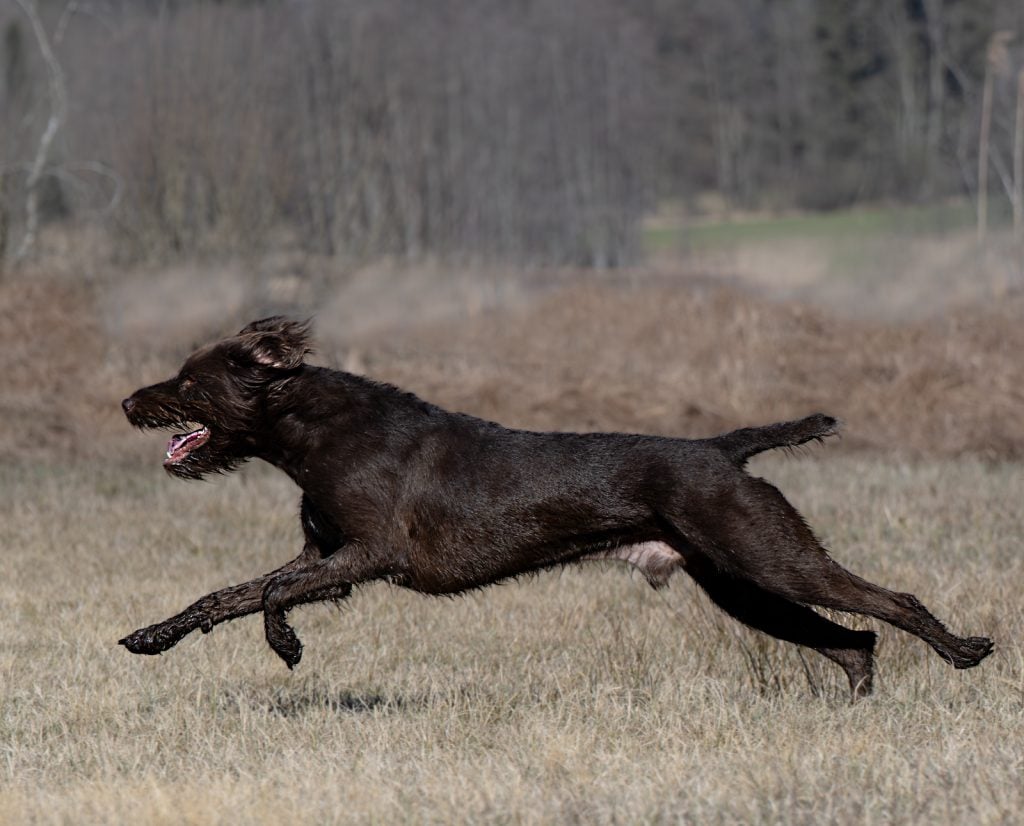
The first official litter of Pudelpointers was whelped in 1881. A forester by the name of Walter Waldorf is said to have bred one dog named Molly. She was a Poodle–Pointer cross already. Well, Molly was bred to a white Pointer named Tell, who was owned by Emperor Frederick III, the King of Prussia. That litter produced at least one pup—a dog named Cora von Waldorf—that possessed all of the abilities of the Poodle and the Pointer that breeders were looking for, and it had the kind of rough-haired coat Hegewald advocated for the breed.
Encouraged by the success of the first litter, breeders began to produce more litters of Poodle and Pointer crosses. However, they soon realized that dogs from that first generation should not be bred amongst themselves, since they tended to produce offspring that were either Pointer or Poodle, and not the blend of the two.
So, a program of what they called back-breeding was established. Dogs from the first and second generations of crosses were bred to white and brown Pointers. It is said that a total of eighty-seven of these crosses to Pointers were done around this time, but there were no additional crosses to Poodles—well, none that were reported, anyway.
The back-breeding program really worked. It helped to stabilize the look and the character of the breed, and it eventually allowed breeders to breed Pudelpointer to Pudelpointer in subsequent generations. A breed book was created in 1892, and in 1897 a full-fledged club—the Verein Pudelpointer—was established under the direction of Hegewald and another well-known authority named Oberländer.
The club’s breeding program was based on a system of field, forest, and water tests—the forerunners of the testing system still used in Germany today. In the early years of the Pudelpointer Club, a number of prominent members and their dogs were lost to the breed as they and other renegade Stichelhaar and Griffon breeders moved to create yet another new breed, the Drahthaar, which we’ll take a look at later.
Those who remained in the Pudelpointer Club held firm to the conviction that by breeding only within Pudelpointer lines, they could develop and maintain a rough-haired breed of gun dog that had excellent all-around hunting abilities.
In 1924, they joined with other purists from the Griffon and Stichelhaar clubs to form a new club, the Rough-Haired Pure Breeding Club, and they began to hold performance tests for just those three breeds.
As with many of the German breeds, Pudelpointers eventually made their way out of Germany. H.D. Hume and Bodo Winterhelt—one of the founders of NAVHDA—are credited with introducing the breed into North America in the 1950s.
Today, the Pudelpointer enjoys a good reputation as a solid, dependable hunting dog among German and European hunters. But it remains a pretty rare breed, even in its homeland. With just over 150 pups a year, it’s more popular than the Griffon or the Stichelhaar in Germany, but it’s a very distant third to the Drahthaar.
In North America, on the other hand, the breed has become one of the top performers in NAVHDA, and it has successfully managed to avoid the ravages of the show ring and pet market. Its popularity has been growing steadily, and its future in the U.S. and Canada looks really, really bright.
Compared to other breeds of gun dogs, Pudelpointers are relatively rare, yet Lisa and I have seen them in Germany, France, Slovakia, the Czech Republic, the U.S., and Canada—and we’ve even hunted over them right here in our own province of Manitoba.
But there’s an easy explanation for that. Our frequent contact with the breed is simply due to the fact that when we travel to photograph dogs or to hunt, we meet up with people who are just as passionate about hunting as we are. And since the breed is—and always has been—in the hands of hunters, well, it stands to reason that we would see more Pudelpointers in a couple of seasons than the average dog walker at a local park would see in a lifetime.
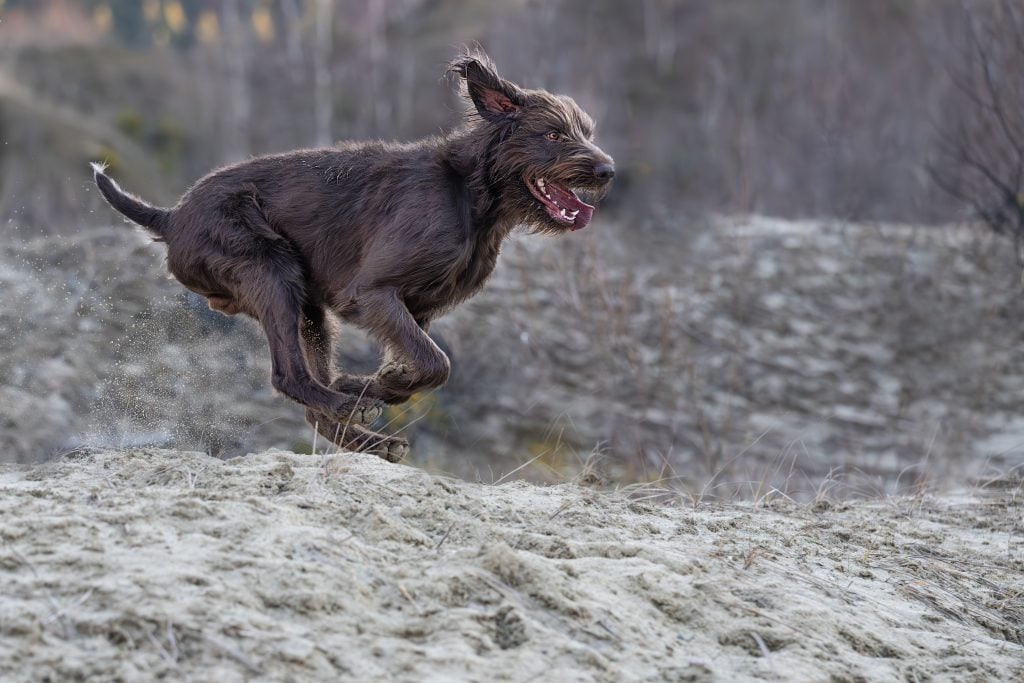
And in all of these encounters, I’ve never felt the least bit intimidated by any of the dogs. Every Pudelpointer I’ve ever met has been an easygoing, friendly dog—whether it was in the house, in a camper, or staked out beside a truck somewhere in the Dakotas. In the field, every single one of them hunted hard.
Yeah, some were faster or maybe bigger-running than others, and some had better coats than others, but not a single one of those dogs left me with any doubt about their hunting desire. Pudelpointers are, on average, hardcore hunting dogs for hardcore hunters.
It’s easy to find a Pudelpointer that will hunt. Find a pup from almost any litter of Pudelpointers being bred today in Europe or in North America, and you have an outstanding chance to get a dog with all the requisite desire you require as a hunter in the field.
There are only two issues with the Pudelpointer right now in terms of finding and getting a pup. One—you’re probably gonna be on a waiting list. Every breeder I’ve ever spoken to in Pudelpointer America has a waiting list, or most years will have a waiting list.
The other is just a word of caution to anyone who only hunts a few days a year. Let’s say you get out two or three weekends a year and you want a hunting partner that’s gonna be good for that little covert in the back forty that takes you half an hour or an hour to hunt. Well, a Pudelpointer might not be the best dog for you.
Pudelpointers can be a lot of dog. Breeders select for the kind of hunt-all-day, every-day dog with a lot of fire in the belly. Sure, Pudelpointers can chill at home with the kids—they’re super friendly and nice dogs. I’ve loved every one I’ve ever met—but in the field, in the water, and in the forest, they can be a lot of dog.
So for some folks out there, they might be too much dog, and you might be best looking at another breed.
In any case, the bottom line for me about the Pudelpointer is this: they are the real deal. They are dynamic hunting dogs, bred by and for hardcore hunters.
Hey, everybody—that wraps up the episode on the Pudelpointer. I hope you enjoyed it. I really liked putting it together because the Pudelpointer’s history is basically the beginning of the history of all of the German wire-haired breeds. It’s a fascinating trip into some obscure places in Germany and some really cool and revolutionary ideas.
And, oh, by the way, that is not a green screen. I am actually on the Canadian prairies. We’re out here chasing roosters, and we’re having a great time—we’re having some luck. I hope you’re out there as well. I hope you’re out there chasing birds. And if you’re on a long-distance trip like we just took, well, listen to a podcast at Hunting Dog Confidential.
We’ve got you covered. Our next episode, coming very soon, is about a breed you’ve probably never heard of. It’s a German breed with a wire-haired coat—but most people have never heard about it because of what we call the “War of the Wirehairs” in Germany. That happened in the 1890s and 1900s.
It basically ended up putting this breed in the obscure pile—or the sort of forgotten pile—of wire-haired breeds. Hey, it’s still around today, but very obscure. Most people have never heard of it, so we’ll check that out in the next episode.
After that, it’s the German Wirehaired Pointer, i.e., or a.k.a., the Deutsch-Drahthaar. And then, after that, we’re going east—we’re gonna go to the Czech Republic, Slovakia, Hungary, and further south to Italy to check out their wire-haired breeds.
We’ll be dropping episodes on a regular basis, so check it out on Hunting Dog Confidential.
And happy hunting, everybody—may you shoot straight and often.

Outstanding episode. Very well layed out and very thorough on the subject. Great information on a rare but outstanding hunting dog.