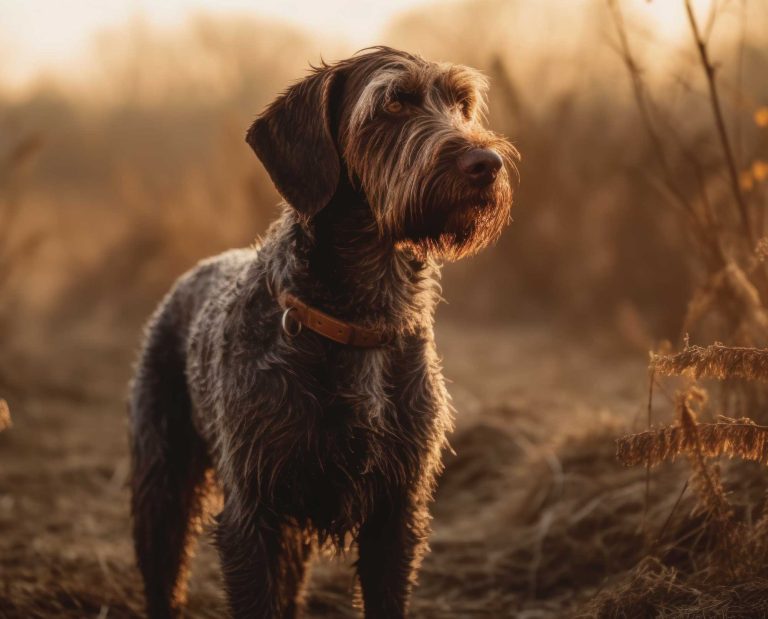


How the German Wirehaired Pointer Put Performance Over Pedigree

An exploration of the breeders, ideas, and historical forces that turned the German Wirehaired Pointer into a benchmark for performance-based breeding.
In this episode of Hunting Dog Confidential, host and dog historian Craig Koshyk explores the remarkable history of the Deutsch-Drahthaar, known in English as the German Wirehaired Pointer. Tracing the breed’s origins to turn-of-the-century Germany, Craig explains how a small group of forward-thinking breeders broke with convention by opening the studbook and prioritizing performance over pedigree purity. Against the backdrop of nationalism, war, and strict dog breed politics, he follows the rise of the Drahthaar from a controversial experiment to Germany’s most dominant versatile gundog. Along the way, Craig examines the philosophy of “form follows function,” the breed’s survival through two world wars, its spread to North America, and the enduring debate over names, systems, and identity that still surrounds the breed today.
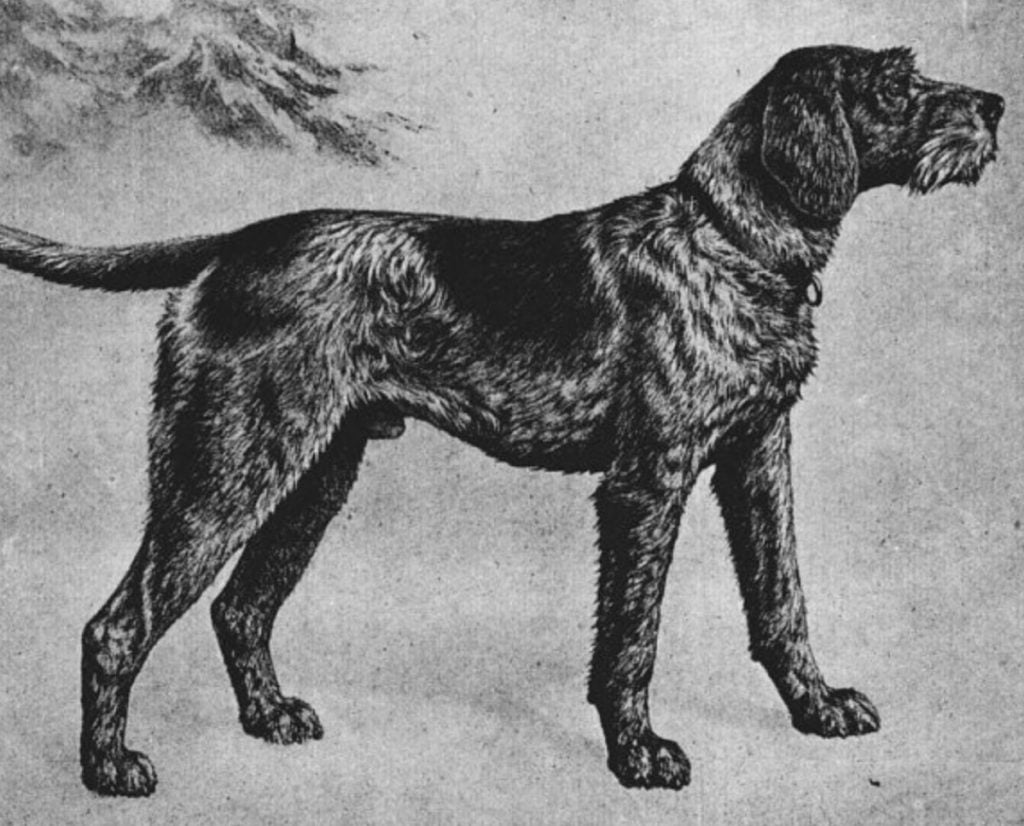
Podcast Episode Transcript
Hey everybody. We are back, and this is the last in our series on the wire-haired pointing breeds from Germany. We’ll be looking at some other breeds after this episode, but in this episode we’re looking at the big dog, the top dog, the number one pointing breed in Germany, the number one sporting breed in Germany, and the number one pointing breed in a lot of hunters’ hearts outside of Germany.
Yeah. Today we’re gonna be looking at the Deutsche Drahthaar, or the German Wirehaired Pointer. But before we do, let’s remember that we’ve already seen the Griffon and the Pudelpointer. Those three breeds contributed a great deal to the Deutsche Drahthaar. And one more: the German Shorthaired Pointer. Yeah, there was a shorthaired pointing breed bred into the Deutsche, and that is what really separates it from the other three wire-haired pointing breeds in Germany.
They chose to remain within the wire-haired camp, the Drahthaar people. Well, they decided to add that extra oomph, that extra ingredient, known as the German Shorthaired Pointer. And what they came up with was a recipe that ended up dominating and conquering the German hunting dog world.
Now, one last note before we get onto this episode. I just heard from some very kind German people, listeners to this podcast, and they indicated that I was actually pronouncing some things not correctly. Even I, I tend to pronounce German words with a French accent, strangely enough. I mean, English is my first language, but I also speak French at home. So for some reason, when I try and pronounce a German word, I give it a little bit of a French inflection.
So to clarify, they indicated that, number one, that S-T-I-C-H sound is not a, as I was saying. It’s not “kohar.” It is like a “kh” sound, almost like, um, there’s a breed called a Korthals Griffon. It’s that sound.
So if you really want to sound like a German pronouncing it, you have to get that right. I can’t do it perfectly, but it’s better than what I was saying. So thank you to all my German-speaking friends who, you know, sort of pointed that out to me. I appreciate that. I always wanna do my best to pronounce these fabulous names of these fabulous breeds as correctly as possible.
And the other one is the “th.” Now, um, in the episode I will, you know, be pronouncing the Drahthaar here and there in different ways, again with my sort of French accent. But in reality, the “th” really sort of throws a lot of English speakers off, because we say “th” as in the, or this, or that. For the “th” sound, and there’s a couple of Ts in haar, but the Germans don’t say it like a “th.” They say it like a “t.”
The other one, and this is what I tend to do again with my French accent, is I kind of pronounce the R at the end. I say “haar,” but most Germans don’t. They kind of leave that R alone. So when you hear them speaking and when they talk about their breed, they will say “Drahthaar,” with maybe a little bit of an R at the end in certain regions of Germany, but generally speaking, your average German hunter is gonna say “Drahtha.”
So there you go. We’re gonna take a look at the German Wirehaired Pointer, the Drahthaar, and it is top dog. So let’s get into this episode.
Well, so far we’ve had a look at some pretty cool breeds. We started off with Korthals Griffons developed in Germany, and then finally finding their home in France and spreading around the world. Then we looked at the Pudelpointer and the Stichelhaar.
So here’s the question for you. What happens if you start breeding all of those breeds together? Pudelpointers with Griffons, Griffons with Stichelhaars, and you add in a little bit of extra stuff in there? You add a secret ingredient called the German Shorthaired Pointer, the Deutsche Kurzhaar.
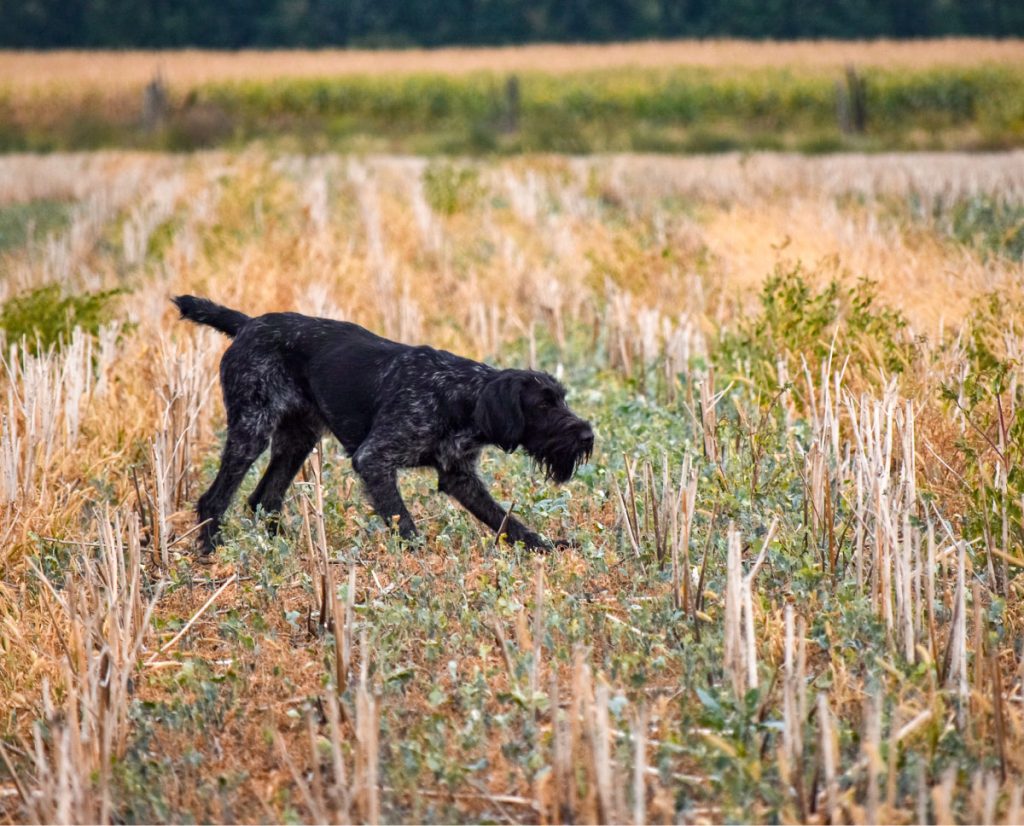
Well, what do you get from that stew? From that French and German and Pudelpointy, Griffy, Stichelhaar mix of ingredients? Well, you get the most successful wire-haired breed in the world, the dominant breed in Germany today, and it’s called the Deutsche Drahthaar. In English, we call it the German Wirehaired Pointer.
And those two names carry with them a little bit of baggage and/or controversy, which I will try and explain later on. But for now, let’s get into the Drahthaar, the number one wire-haired pointing breed in the world.
But let’s start with an anecdote, shall we? Just a personal recollection of my own, because I’ve been around Drahthaars for a long time, and I’ve seen them just about everywhere we’ve traveled. This story starts with a friend of mine who was born and raised on the other side of the world, in New Zealand.
He moved to Canada many years ago to pursue his life’s passion, which is falconry. He breeds, raises, trains, and hunts with peregrine falcons. He used to fly other types of birds of prey in New Zealand over Springer Spaniels and German Shorthaired Pointers. But when he moved to Manitoba to focus mainly on peregrines, he wanted a sturdy pointing dog.
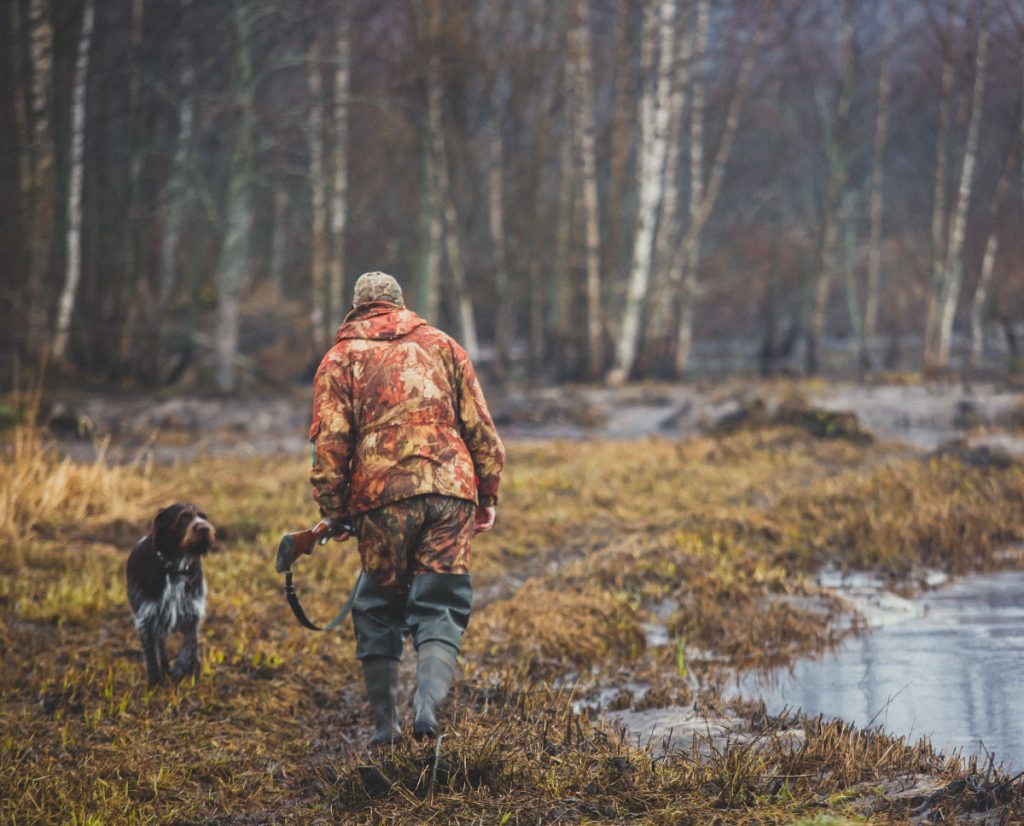
And yeah, there were a lot of breeds that he could have chosen from, but he wanted one specifically to handle the tough cover and the harsh climate of central Canada. So after weighing the pros and cons of several breeds, he finally chose the German Wirehaired Pointer, or the Drahthaar. He acquired two males, and he hunted over them for several years.
They were great dogs. I hunted over both of them, and they were both fantastic. Then one day he decided to add a female to his kennel, and I was there on the day that she arrived by plane from Germany. Now, despite having spent over 14 hours in a crate with various stopovers from Germany to Toronto to Winnipeg, well, the minute that pup got out of her travel crate, she jumped into her new owner’s arms, she licked his cheek, and then she spotted a pond behind him in which was a family of ducks swimming around.
Well, then she leapt out of his arms and bolted towards that pond. Once she was there, she dove in and she gave chase to that family of ducks. That pup was four months old, and that young pup eventually grew up to be an absolutely superb gun dog.
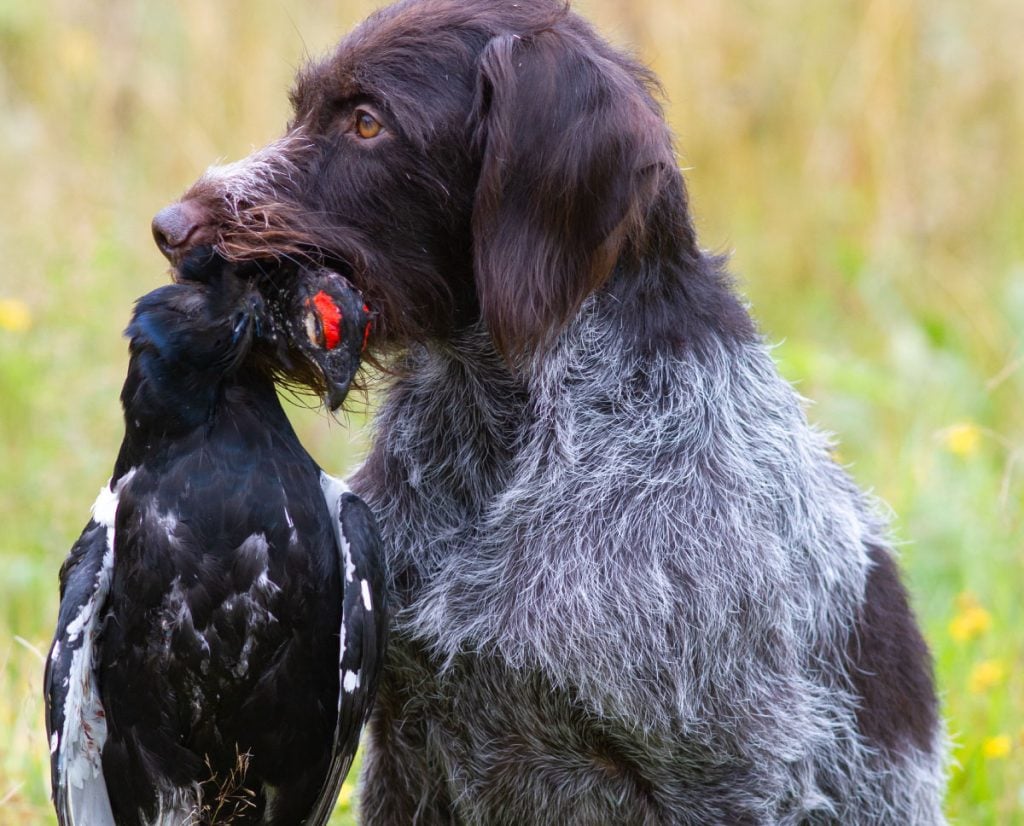
I have some photos of her in my first book, Pointing Dogs, Volume One. You could check it out. Her name was Liesel, and she was great. And to me, that dog will always represent the very essence of the German Wirehaired Pointer. A rough-and-tumble, intensely loyal, hardworking gun dog.
And the fact that a falconer from New Zealand, living in Canada, could get a pup from a breeder in Germany and then have it start hunting the minute its feet hit the ground, well, that’s testament to the incredible achievements of a small group of people who had the courage to follow a revolutionary idea nearly a century ago in Germany.
Now, in order to really understand that group of people and what that revolution they sparked really was, well, we’re gonna have to fire up our trusty time machine once again, and we’re gonna have to set the dial to Germany around, I don’t know, let’s say 1900, 1905.
When we arrive and we open the door, well, what we’re gonna find is a gun dog world that is coming out of an experimental period. It’s coming out of the period from, let’s say, about the 1860s to about 1900, when all the different German breeds were created and then developed and then standardized.
By the time we arrive in Germany, well, they all have breed standards. They’ve got breed clubs. There’s various organizations, more or less, overseeing the breeding of these breeds. And they’ve also come up with a comprehensive testing program, and that’s because all of the German breeders at that time, they agreed on a couple of core principles.
One, the dogs should look like what they’re supposed to look like. If you’re gonna call a dog a Wirehaired Pointer, well, it better have a wirehaired coat. And a Pudelpointer should look like a Pudelpointer. A Weimaraner should look like a Weimaraner with its unique gray coat, right?
They also agreed on the fact that in order to make sure that all of these dogs that look like they should look like, all of those dogs should also hunt like they’re supposed to hunt. And the only way to do that, well, is the same way as you control the way they look.
You examine it with the looks. It’s your eyeballs. You take a look at the dog. You might use a measuring stick. You might measure to make sure they’re the right size. But you check the coat, you check the eye color, you check all of those things that go into the overall look of the dog, and you say, right, it is an X, whatever breed.
But they were also sticklers for the idea that a dog, no matter what it looks like, no matter how good-looking it is or how close to their breed-standard ideal, well, it also has to prove itself in the field. It has to pass a series of comprehensive tests before it is allowed to breed.
And that way, we can have a predictable, reproducible pool of dogs to choose from, and then our breed will be on solid ground. Fine. It worked then. It still works to this day.
But there was also one other really important idea that everybody held to back in that day, and that was the idea of purity. Not only just in Germany, but around the world at that time, as it is today, the idea of purity really reigned.
Once your breed was fixed, once your studbook was closed, once you had a standard and a club and all the rest that goes into a breed, you said, right, that’s it. No more foreign blood in our breed. Only within our breed shall we mix our dogs. We will keep our breed pure.
Well, not everybody agreed with that idea. Remember I mentioned that there was a period of time when all of the rough-haired breeds were bred together? Well, that’s because they were thought of as being in the same family, so it wasn’t considered crossbreeding.
Well, some of those people in that particular group, they thought they would go one step further. What if you bred Pudelpointers to Stichelhaars, and Stichelhaars to Griffons, and the results of all those back to each other, and then you added a Shorthaired Pointer, the GSP? What would you get as an end result?
A few people had actually tried that in prior years, but they were quickly kicked out of any club they were a member of. They were seen as absolute heretics. But that was just the occasional individual doing that. There was no group of people getting together and putting down a program of actually putting that in place.
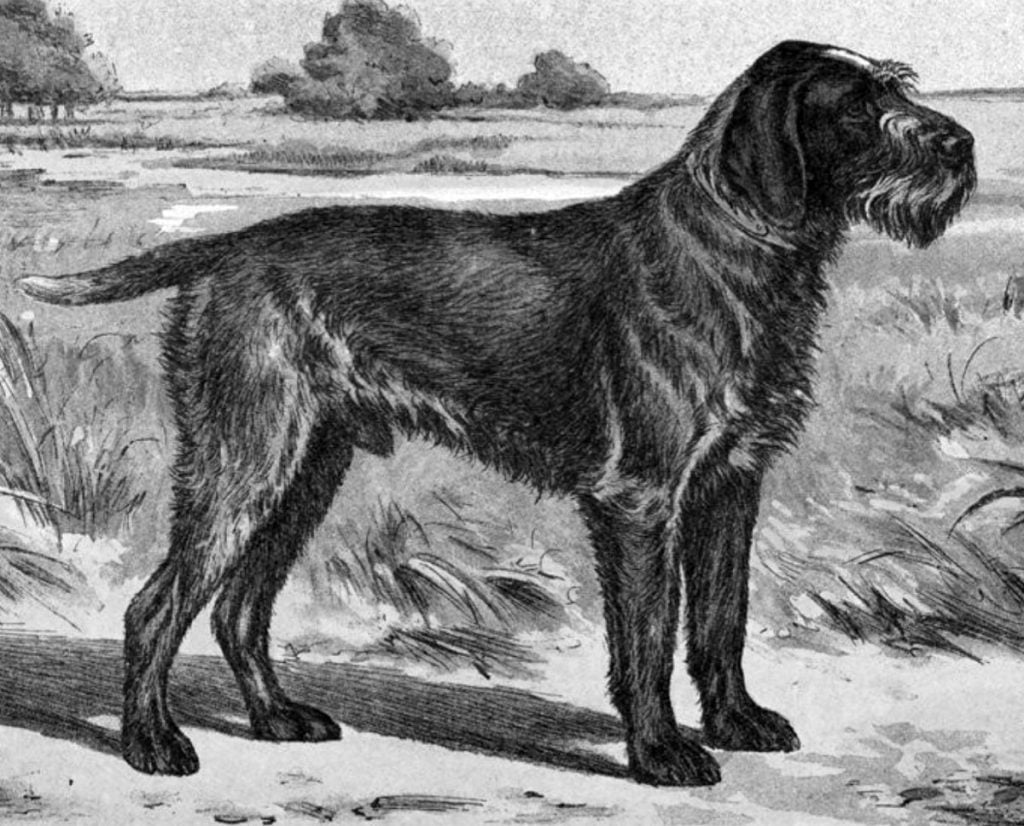
Until, of course, there were several people from the Pudelpointer camp, a lot of people from the Stichelhaar camp, and even some people from the Griffon camp that got together and agreed that they would take that one final step.
They would break that one primary rule of all dog breeding at that time, and they would actually work within an open studbook, a revolutionary and heretical idea. At that time, people freaked. They were outcasts from all their various clubs. They were outcasts from the German hunting community in a lot of ways because people thought it was an absolutely crazy idea.
No, you must keep your dogs “pure.” You cannot mix and match as you wish, because then you won’t have pure dogs, and that will defeat the whole purpose of this whole organization.
Well, that small group eventually formed a club because what they were shooting for was a dog they would eventually name Drahthaar, meaning wire-haired pointer. And so they simply formed a club called the Drahthaar Club, and they went about their merry way of breeding whatever they wished to whatever they wished, because their main goal was to produce a dog that did the job.
After all, one of the ideas that was central to the entire German dog breeding organization at that time was this idea of “form follows function.” In other words, the way a dog looks is based on what the dog does. And because a dog does X, Y, Z, well, that’s why it looks like it looks.
It’s a great phrase in German, and I’m gonna try it. I’m gonna say it in German. It’s a tough one, so please, my German listeners, forgive me for this, but I’m gonna try and say it. It’s awesome. It literally means “from performance to type,” or “by performance to type.” We would say in English, “form follows function.”
In other words, the overall look of the dog is determined by the performance of the dog and not the other way around. You don’t build a dog in a way that you think will perform and then hope it performs that way. They tried that. It didn’t work.
In the early years in Germany, that’s exactly what they did. Simply by selecting for dogs that looked like those dogs they saw in old paintings, or imagined that their granddad hunted with, or imagined in some sort of old King Arthur–type time people used to use these dogs. Well, if we could only get dogs that look like that, well, they’re gonna perform like that.
So, no. Function doesn’t follow form. It’s the other way around. Form is created, or dictated, by the function of the dog.
And so that’s what the Drahthaar people said. They said, look, if we are really looking for performance in our dogs, then we shouldn’t be caring so much about their overall look. Of course, we want it to be a particular size, and that wire-haired coat is great. We want to get a wire-haired coat, but let’s mainly focus on getting good-performing dogs, and let’s not obsess over pedigrees.
Let’s not go back and comb through every pedigree to make sure every one of these dogs is “pure.” No, we’re going to use dogs that work. We’re simply going to open the studbook.
We’re gonna tell every breeder—and they literally had this as a motto of their club—they said, “Use what you wish, but make sure you test and prove the results,” which is a brilliant strategy.
It’s the strategy that a lot of different sports use. It’s the idea behind NASCAR, or it’s the idea behind the Iditarod. It’s the idea behind a lot of different sports in that we don’t care what pieces you use to make a better mousetrap. We are going to judge your mousetrap on whether or not it is a better mousetrap, period, end of story.
And so they simply carried on with that idea.
And in order to get an even deeper reading on this particular point in Drahthaar history, I reached out to a friend of mine in Germany, and he’s a real fan of the history of the breed. He’s a Drahthaar owner and a breeder, and he really dug deep into all of the old articles and all of the old writings in all of the old books in Germany for me, and he gave me some fascinating insights.
I’m gonna read to you some of the stuff that he sent to me. All right, here we go. His name is Wilhelm Heinrich, and this is what he wrote to me.
He said, quote:
“When the VDD—that’s the name of the club that was founded back in the day, the Verein Deutsch-Drahthaar, which just means the Drahthaar Club—when the VDD was founded, most of the members were renegades from the Pudelpointer Club that was founded in 1897.
The most important of them was a guy named Alexander Löns. He was the VDD president from its founding in 1902 to 1934. He was obviously an impressive personality, and he was very influential in many aspects, particularly in the selection of his comrades-in-arms for this cause.
Another important founding member was Mr. Bürklin. He was also a Pudelpointer renegade. In 1927, when looking back on the wild days of breeding at the turn of the century and on the battles that Drahthaar people fought, he wrote in the Drahthaar Club newsletter in 1927 the following quote:
‘I was still convinced that for breeding Pudelpointers, I would need one pointer and one poodle. I finally succeeded in acquiring a splendid pair of poodles. Even the renowned cynologist Dr. Stephanitz agreed, upon presenting him my poodle Arapo in the hunting field, that one would hardly find a better poodle for breeding.
So Arapo was bred to some beautiful and talented purebred pointer bitches. The offspring were, of course, not half bad, but not quite phenomenal. According to Oberländer and others, this crossing should have been superior to everything else bred at that time.
So was the conclusion that for a good versatile dog, the mixture of poodle and pointer alone was not enough, not a natural mix, and that some sort of third blood, namely that of the Deutsche Kurzhaar, would be useful, if not essential, for that purpose.
I first spoke out about this opinion in the sporting magazine Hund und Sport. I received countless approvals. Eminent breeders, such as Birk, Busch, and Löns’ uncle, agreed. And from this idea, the VDD was soon founded.’”
Now, I’ll go back to quoting Wilhelm Heinrich and what he sent to me.
“In the early years, Drahthaar breeders used mainly Stichelhaars and Pudelpointers in their programs. Griffons were also used, but less frequently. Soon, crosses to German Shorthaired Pointers were undertaken as well, but this led to some difficulties in breeding a proper wire-haired coat. But rapid progress was made in field ability.
In 1904, perhaps reflecting the patriotism of the club members, the VDD, the Wirehaired Club, was renamed Verein Deutsch-Drahthaar, which means German Wirehair Club. After all, Germany had developed its own long-haired pointer, the Deutsche Langhaar, and its own short-haired pointer.
So the VDD’s mission was to give Germany its own national wire-haired pointer. But at first, the club grew very slowly. At the outbreak of the First World War in 1914, for example, there were only a few dozen members and only a total of 56 entries in the club’s studbook.”
But after the war, the club saw phenomenal growth. In 1921, the VDD passed the 1,000-member mark, and by 1926, these dogs had become so popular that they made up nearly half of all dogs in the German Versatile Dog Registry. In 1928, the breed was finally recognized by the Delegate Commission, and by the middle of the 1930s, it had almost achieved the status of Germany’s national dog.
In the difficult years that followed, the German Wirehaired Pointer, like all of the other German breeds, suffered tremendously. After the war, the breed stock was strongly diminished. For example, my mother gave our dog away in late 1945 because we didn’t have enough food. We could barely feed my three little brothers.
However, the first post-war meeting of the VDD took place in 1947. In 1949, Germany was divided, but the VDD still remained as one club because the borders were open. It is said that breeding during the first years after World War II was quite chaotic, and that they used almost everything that had a tail.
In fact, Weimaraners were used, as well as German Longhaired Pointers and German Shorthaired Pointers. Breeders after World War II were also faced with a difficult problem. They were allowed to breed dogs, but they were not allowed to have guns. Those regulations only remained in place for a few years in the West, but for over a decade in the East.
So in an East German hunting magazine from 1956, it was noted that the eastern dogs were quite good, but they were not used to the sound of gunfire.
The first Hegewald tests after the war took place in 1949. Eighty-three dogs were entered. In 1954, just five years later, 200 were nominated for the Hegewald in the next test. The last Hegewald test with combined western and eastern groups was in 1959. After that, East German hunters were not allowed to attend.
In 1961, the wall was built, and because of the Cold War, all contact was cut, and that wasn’t reestablished until 1989. In 1992, the eastern and western clubs were reunited. Unquote.
Prior to the Second World War, very few Drahthaars were exported from Germany, and very, very few made their way to North America. But in the 1950s, decent numbers of them started making their way to the U.S. and to other European countries.
In 1959, there were enough of them in the U.S. that the German Wirehaired Pointer Club of America was formed, and the breed was quickly recognized by the AKC. Through the 1960s and seventies, the breed’s popularity grew steadily in North America, and in 1971, Group North America, a chapter of the German club, was formed in the U.S.
Members of that club test and breed their dogs according to the regulations set out by the VDD, the parent club in Germany. In 1974, a similar group in Canada was formed, and in 1984, they became a fully affiliated chapter of the VDD in Germany.
Today, it’s clear that the goals of that small group of forward-thinking, revolutionary-type people, well, their goals have been achieved. And their approach to breeding, which was hotly contested in the early years, well, it’s been completely validated by the presence and the dominance of the Drahthaar, or the German Wirehaired Pointer, on the gun dog scene today.
The Drahthaar is among the most successful pointing breeds on the planet. Few can rival its versatility, and none of them come close to its popularity in Germany. And it keeps gaining supporters around the world every year.
Now, I should probably take a minute or so just to explain why I use the terms Wirehaired Pointer and Drahthaar throughout this episode almost interchangeably. I figured I would do so because they’re used kind of interchangeably in a lot of cases, and some people may get upset that I use them interchangeably, because there are some people who insist on calling their dogs German Wirehaired Pointers, and others that call their dogs Deutsche Drahthaar.
When I was writing my first book, I had to figure out what name to use throughout the chapter. I had to figure out what name I was going to use for the title of the chapter. At the end of the day, I chose German Wirehaired Pointer because my book is written in English, and I chose German Shorthaired Pointer, German Longhaired Pointer, et cetera, throughout those other breeds.
Other breeds, like the Bracke, I chose Bracke. But let me just say that there was a bit of debate in my own head and among my colleagues and editors in terms of what we were gonna standardize on throughout the book.
Even the American club for the German Wirehaired Pointer, way back in the day when they first got some dogs in in the fifties and were first forming the club, they had to figure out what to call their dogs. At first, there were people who advocated calling the dogs Deutsche Drahthaar, and I believe in the very earliest days of the club, that was the name they bandied about.
Eventually, however, they decided on German Wirehaired Pointer for the same reason as they decided on the German Shorthaired Pointer and the German Longhaired Pointer. And others—they just translated the name to English.
But curiously, for the German Wirehaired Pointer Club of America, have a close look at the logo of that club. Even to this day, if you look at the logo, it’s a circle with “German Wirehaired Pointer.” If you look in the center of it, you see the word “Drahthaar.” So that’s a nod to the original name of the breed.
And again, it just goes back to a struggle that they had. They had to figure out what to call it.
Nowadays, we have to understand that there are two groups of people who are really sort of representing the breed in North America. One group calls their dogs German Wirehaired Pointers. Just like the AKC club, a lot of them are actually associated with the AKC. They might run their dogs in AKC trials. They might show them in AKC shows. They might be members of various local AKC clubs, and they do their thing with their dogs that they call German Wirehaired Pointers.
There is another group of people, however, that are not associated with the AKC, but are associated with the VDD, the original German club for the Deutsche Drahthaar in Germany. There is an affiliated chapter of the actual German club right here in North America. In fact, there are two. There’s one in the U.S. and there’s one in Canada.
And those folks produce dogs based on the German system. They test them, they breed them, they do everything that the German club requires of them. And they even sometimes take them to Germany and get great scores, even compared to German-bred dogs in Germany.
So they are tightly associated with the VDD group, and those people prefer to use the name Deutsche Drahthaar because they wanna make sure that when people talk to them about their dogs, they understand that they are part of the German system.
If you ask anybody about their German Wirehaired Pointer and they correct you and say, “Oh, well, I have a Deutsche Drahthaar,” what they’re saying is they are members, and probably active, in the VDD system. That their dogs come out of the VDD system, that they might even be a breeder in the VDD system and/or test their dogs within that system.
If, on the other hand, you look at somebody’s dog and go, “Wow, what a nice German Wirehaired Pointer,” and they thank you for the compliment, well, they’re probably associated with the AKC or the non-German side of that breed.
Now, the sticky part in all of that is when people ask, are they the same breed? Or even worse, is one better than the other?
I’m not gonna go there in this particular episode. If you wanna listen to a deeper dive on that entire question, well, listen to the episode that Jennifer Wapenski and I did back in 2022. It’s episode 32.
We take a look at that question. We take a look at how do we go about defining what is a German Wirehaired Pointer. What is a Deutsche Drahthaar, and how do the two compare? What are the differences between them, and why do certain people use one name and other people use the other name, and a bit of the bones of contention between the two.
We take a deep dive. We take a neutral point of view, although Jennifer is on the Deutsche Langhaar side. She calls her dogs Deutsche Langhaars. She doesn’t call them German Longhaired Pointers, and she explains her reasons why in that episode. So check it out, 2022, episode 32 of the Hunting Dog Confidential Podcast.
Well, I certainly hope you enjoy that episode, everybody. It was a ton of fun putting together, and I’ve never regretted any time I’ve ever spent in the field with a Drahthaar, or a Pudelpointer, or a Griffon, or any of the wire-haired breeds that we’ve covered so far.
And that also goes for the breeds that we’re gonna look at next, because from Germany, we’re gonna go east. We’re going to the Czech Republic, Slovakia, and Hungary. In the Czech Republic, we’ll take a look at a great breed called the Cesky Fousek, and then to Slovakia to look at the Slovakian Roughhaired Pointer. And then we’re going to Hungary. We’re gonna check out the Hungarian Wirehaired Pointer.
So stay tuned. And if you want more information on all these breeds, check out my book. And if you hit the like and subscribe button, well, apparently it does something to the YouTube algorithms that helps us reach a wider audience. So go ahead, ring that bell, hit the like button, do whatever all the kids are doing nowadays to get those algorithms all jazzed up.