

How White-Winged Doves Are Outsmarting Extinction
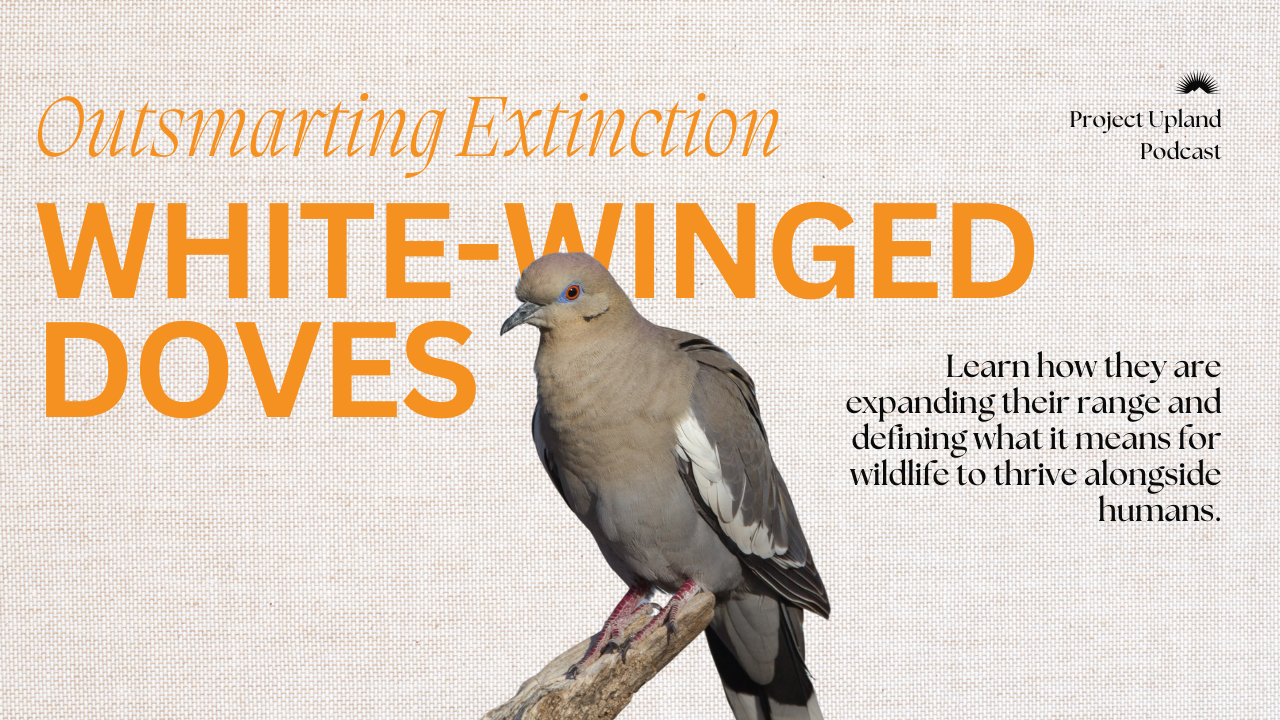
Listen in to how white-winged doves are expanding their range, interacting with mourning doves, and defining what it means for wildlife to thrive alongside humans.
In Texas and Arizona, white-winged doves are culturally significant and a part of each state’s hunting heritage. Biologists are actively studying these unique migratory birds; in fact, the first research project to ever outfit white-winged doves with GPS transmitters is currently underway in Texas.
In this episode, AJ and Gabby talk to Owen Fitzsimmons, the webless migratory game bird program leader for Texas Parks and Wildlife. Owen, alongside Dr. Jennifer Smith of the Caesar Kleburg Wildlife Research Institute at Texas A&M University Kingsville, to learn more about the urban ecology, behaviors, and life history of white wings.
Tune in to learn how white-winged doves are expanding their range, interacting with mourning doves, and defining what it means for wildlife to thrive alongside people.
Get access to behind-the-scenes content and full, unedited guest interviews while supporting independent storytelling.
Podcast Episode Transcript
Gabby: So, AJ. One of our regular Project Upland magazine contributors called me recently. He was super excited to talk about an opportunity he had to join Texas Parks and Wildlife for a day of banding white-winged doves. There, he met this guy named Owen Fitzsimmons, and he told me all about how awesome this guy is. He was like, “You have to talk to him. I’ll introduce you to white-winged doves.”
AJ: Before this project, I had essentially no experience with these birds.
Gabby: Yeah, they live in a very small region of the southwestern United States and have definitely flown under the radar of most bird hunters. Also, that same contributor sent me a link to a Time magazine photo shoot of a white-winged dove hunt in South Texas in 1961. There are ladies toting side-by-sides and muddy dress shoes, kids butchering birds on the backs of fifties-era Oldsmobiles, men perched on ladders pointing shotguns at the sky, and feathers everywhere. Clearly, this was an annual event not to be missed.
AJ: I’m not gonna lie, I feel so sheltered in New England. Dove culture couldn’t even take root here. Most states up here have laws protecting doves as a species, laws passed at the turn of the century, most likely out of fear from the passenger pigeon extinction.
Gabby: Wow. I had no idea that dove hunting wasn’t legal in the Northeast. It is definitely alive and well in Texas. And on that note, not only is Owen highly knowledgeable about these birds, he’s a Texas native with a firm understanding of this bird’s cultural significance in the region.
“The white-winged dove is unknown to most Americans. It is a creature of the Mexican border, that romantic hiatus where cultures meet. More than any other bird, it is la paloma, whose languid cooing at midday from trees shading village plazas signals siesta time. It is as Mexican as tortillas, sombreros, and senoritas. But in my own Arizona, it is a familiar bird along the wooded valleys and in the saguaro cactus desert, and I know Texans are equally proud of it.
“The whitewing is an unusually valuable bird. We prize it for its beauty and for the way it adds to life in the Southwestern countryside. It is a great game bird that takes skill to bring to the bag and is mighty fine eating. Were it to disappear, a great void would be left in the pleasure of living along the border. So many of us are interested in its welfare—which is what this book is about.
“If we want to keep whitewings with us, there are things that must be done, and mostly they involve what conservationists and ecologists keep telling us—if man is to exist in peace, he must live in harmony with Nature and cease looking on Her as a subject to be subdued and exploited.” – Clarence Cottam and James B. Trefethen, 1968.
AJ: When Clarence Cottam wrote this book, white-winged dove hunting was open in Texas for afternoon shooting just two weekends out of the entire year. However, those two weekends added $3 to $7.5 million dollars annually to the local economy. In today’s dollars, that equates to about $28 to $70 million.
Gabby: White-winged doves continue to be both cultural symbols and revered game birds in the Southwest. According to Texas Parks and Wildlife, today, Texas leads the nation in dove hunting. The state accounts for “32 percent of the mourning dove and 87 percent of the white-winged dove harvest in the U.S. annually. More than 300,000 hunters take part each year, generating more than $500 million in economic activity.” Clearly, they are still very popular to hunt. Not only that, but scientific researchers have had a growing interest in these birds since the 1930s.
AJ: Cottam wrote in his book’s introduction that by 1956, only one scientific bulletin and a few local papers had been published about whitewings. Thankfully, both Texas and Arizona had been collecting data on these birds back then that helped support more modern “enlightened management,” as Cottam put it.
Gabby: And now, a study by Texas Parks and Wildlife and the Caesar Kleburg Wildlife Research Institute are conducting the first-ever whitewing study using GPS transmitters. Like I previously mentioned, AJ and I talked with Owen Fitzsimmons from Texas Parks and Wildlife to learn more.
Owen: My name is Owen Fitzsimmons. I work for the Texas Parks and Wildlife Department as the web-less migratory game program leader. And I always get the question, what is a web-less bird? And with migratory game birds, we basically break everything down into waterfowl and then all the other stuff that don’t have webbed feet, hence the web-less name.
And included in that is doves. Being that I work in Texas, and really Texas is where a huge portion of our dove harvest and dove hunting activity in the U.S. is, every year I focus a lot of my time on doves. And with that, you know, white-wings are a huge part of our heritage here, along with Arizona.
It’s more of a kind of a recent thing for me, shifting my focus more to white-wings. Because of their range expansion, we’re starting to get a lot more questions about how to manage the species, you know, what kind of interactions they have with mourning doves, how to manage the two species together.
It’s kind of forced me to shift my focus more to white-wings. In recent years—I’ve been in this position eight years—really just the past four or five that I’ve started to narrow my focus down on white-wings.
AJ: Now I know some of our listeners (and me) will find the topic of white-winged doves very different from the grouse and quail of North America. Or even our migratory outliers like the American woodcock. But if you live in Texas and Arizona you may be very familiar with these birds.
Gabby: If you’re unfamiliar with white-winged doves, they are a conspicuous subtropical dove species. True to their name, they have large white stripes along the edges of their wings.
Owen: They’re really unique in that they inhabit a lot of different ecoregions across North America.
Everything from forested areas to jungle, to highlands, to desert, all the way up into mountainous regions. So, uh, just a really, really cool bird that more and more people in the U.S. are starting to notice.
Gabby: Whitewings are also physically and behaviorally quite different from mourning doves. In fact, they are arguably most similar to the extinct passenger pigeon.
Owen: White-wings are about 20% bigger than mourning doves. They’re a little slower when they fly. They’ve got the big white patches in the wings. They’ve got a lot more coloration around the head and neck, especially during the breeding season—lots of iridescence, a big blue eye ring, and real red legs. So they look a lot different.
And as far as behavior, they’re just, in general, a lot more social and gregarious than mourning doves are. So you see a lot more social activity. Like when they’re at a feeding site, you see some aggression. You see birds kind of chasing each other around. They defend their nest sites quite aggressively—the males do. So you see a lot of this individual interaction that you don’t typically see with mourning doves.
Some other big differences: white-wings are historically colonial nesters. A lot of the big colony sites have disappeared for a number of reasons, mostly related to habitat loss over the years. But historically, you’d find these colonies in South Texas and northern Mexico that numbered potentially in the millions of birds, which is something you just don’t see with mourning doves.
Diet is another big difference. Mourning doves typically eat exclusively hard-coated seeds, small seeds. White-wings are more like what you think about with passenger pigeons or some of the other Columbid species, where they not only eat seeds, but they eat a lot of fruits. They eat a lot of mast. They even eat legumes in some places. So their diet’s a lot more varied in terms of the size and structure of what they eat.
The other big difference is just the range. They’re a subtropical species. They’re not nearly as cold-hardy as a mourning dove. So historically, they were really only relegated to the southern U.S. up until recently, where they’ve shifted a little further northward and across the rest of the southern U.S.
AJ: Similar to passenger pigeons, whitewings are colonial nesters. Although the eastern and western subspecies depend on different types of habitats, both of them exhibit this colonial nesting behavior. However, many of these colonial nesting sites have been lost.
Owen: The original thought was there were up to 12 subspecies across the entire range. Uh, but in the U.S., really, you can break it down into Eastern and Western subspecies. And so the Eastern is really mostly just Texas and northern Mexico. The Western is more like—there’s actually a pretty stark line if you look at band recovery data, where, like, El Paso, Texas and west is the Western subspecies.
We think there’s a lot more intermixing now, but historically, in the Eastern subspecies, these colonies were really found in riparian forest areas, like along the Rio Grande, some of the rivers down in northern Mexico. And a lot of those areas were cleared in the early 1900s just for agriculture.
We lost the habitat, and it’s kind of the same story in some ways with the Western subspecies as well. Although the Western subspecies, interestingly, is really tied to the lifecycle of the saguaro cactus. They nest on the cactus. They feed on the cactus heavily in the summertime. And their migration is really kind of based around the timing of the cactus blooms with the Western subspecies.
There’s been a lot of destruction of habitat, some riparian areas as well. But then, just again, clearing land for agriculture has been kind of the main driver of some of those losses of colony sites.
AJ: Up until about 30-40 years ago, whitewings were only really found along the US-Mexico border in Texas and Arizona, especially in the four most southernmost counties in Texas along the Rio Grande. Their range has expanded in the United States a bit, however, the bulk of this species’population lives in Latin America.
Gabby: White-winged doves live all throughout Mexico, into Central America, and as far south as northern Costa Rica. Owen mentioned that when we think about whitewing management, it has really only occurred along the northernmost edge of its range. He also told us about how different subspecies of whitewings migrate more than others.
AJ: Apparently, Central American whitewings are basically non-migratory. However, these birds living at the northernmost edge of their range in south Texas are definitely migratory. And their tendency to explore around has led to these northern birds expanding their range.
“Perhaps the most valuable lesson from this banding operation is that each important colony should be protected against overshooting; otherwise the overkill cuts into the breeding stock of the following year. This is especially important for each refuge. The basic reason for establishing a breeding ground refuge is to produce needed birds and to insure an adequate breeding stock. It is the height of folly to protect this refuge carefully during the nesting season and then allow hunting right up to its boundaries in September, with a resultant overkill of breeders and young.
“An equally important lesson from the trapping and banding program on the nesting grounds is that there is relatively limited interchange of doves nesting in Mexico with those of Texas. The two groups seem to be largely separate populations of the eastern white-winged dove.
Since Texans cannot expect their breeding stock of whitewings to be augmented appreciably by birds from Mexico, it behooves them to husband carefully their existing broodstocks. If Texas loses its breeding birds, either through overhunting, habitat destruction, or any other cause, it will be, for practical purposes, out of business so far as white-wing hunting is concerned.” -Clarence Cottam and James B. Trefethen, 1968.
AJ: Based on a combination of habitat loss and poorly regulated hunting practices, whitewing presence started shifting around on the landscape. Today, it’s estimated that more doves live in San Antonio than in their historical South Texas range.
Owen: With white-wings, it’s a huge range, and the migration strategies and timing vary widely.
So, like across the tropical portion of the range through a lot of Mexico, we think that they’re largely non-migratory. Historically, the birds in South Texas were pretty migratory, and we still regularly get band returns from birds that we banded in Texas all the way down to Central America. So we know that birds are still moving quite a bit.
But really, historically, their range kind of extended just into the southern U.S., and in the early 1900s, due to habitat loss and destruction, mostly from agricultural practices—and at the same time, there was a lot of, it’s like people all of a sudden keyed in on the fact that they could hunt these birds—there was a lot of unregulated, or at least very poorly regulated, hunting, primarily in Texas and Arizona in the early 1900s that drove those birds out of those areas, along with the habitat loss.
And so kind of from the early 1900s to, say, the ’60s, ’70s, ’80s, at least in Texas, there were a lot of conservation efforts trying to conserve the birds that we still had. And at some point in the late ’80s, early ’90s, the birds started to shift, and we started to find birds in these small cities and towns north of South Texas.
And what I mean by South Texas, I’m mostly talking about the Lower Rio Grande Valley. It’s like the very, very southern tip of South Texas. So these birds started to move north, and they’re starting to show up in more neighborhoods and cities and towns. And by the year 2000 or so, we think there were probably more white-wings in San Antonio than there were in that historical range down in the Rio Grande Valley.
And since then, just the past 30, 40 years, we’ve seen an explosion where they’ve just kind of rocketed across Texas and into other states. They’re now moving east into Louisiana, across the northern Gulf into Mississippi. There’s a population in Florida that’s starting to connect from the east side of the Gulf, but we’re also starting to see a lot more birds into Oklahoma and Kansas. There are even breeding records as far north as Nebraska and Colorado now.
And what’s interesting is the Western subspecies didn’t really go through quite the same loss of habitat, but at the same chronological period, you saw this exact same shift with them, where birds started to move north into southern Nevada, move into California, and across this whole range on this northern extent. It’s pretty generally true that everywhere they moved into, they’re now very, very closely associated with urban and suburban habitat.
And we think that’s probably due to the fact that they don’t have the native foods that they evolved with. And so they’re pretty heavily reliant on backyard bird feeders, municipal parks, and nesting in mature trees in city parks and people’s backyards and things like that.
Gabby: While scientists have been banding white-winged doves since the 1920s, only now have they begun to outfit birds with GPS transmitters. Texas Parks and Wildlife is working with Dr. Jennifer Smith from the Caesar Kleberg Wildlife Research Institute at Texas A&M University-Kingsville to track whitewings across their historical range, urban areas, and beyond.
Owen: This is the first study that has put GPS units on white-wings. There was some work 10, 15 years ago, maybe, putting some VHF telemetry devices—actually implanting devices—in white-wings in Texas for more local movements. But this is the first one with GPS tags, and really the technology has just gotten to the point where it’s small enough and reliable enough that we can do this.
It’s very, very exciting. And the project itself is federally funded. It’s federal funds that are passed through Texas Parks and Wildlife. And we’re working with a principal researcher, Dr. Jennifer Smith, out of the Caesar Kleberg Wildlife Research Institute at Texas A&M University–Kingsville, which is my alma mater.
We just kicked off this project a few months ago, but the idea is, as these birds have shifted into these urban areas, we really have no idea how they’re using these urban spaces at this point. This project’s kind of a first look at the urban ecology, the annual ecology of these birds in these urban areas, and just trying to get an idea of really how they use them throughout the year during breeding season.
Do they stick around all winter? When do they start breeding? You know, when do they stop breeding? What kind of movements do they have? How does their breeding productivity compare to the more historic range further south in Texas and north Mexico? Are they doing better in cities? I anticipate they probably are.
There’s typically less predation and definitely a lot less hunting pressure. If they don’t ever leave the city, they’re not really exposed to hunters. So this all kind of came about because we’ve seen this expansion across Texas over the past 30, 40 years. But based on our harvest surveys, we harvest a million and a half to two million, maybe sometimes a little more, every year, which is about 85% of the white-wings that are harvested in the entire country.
So it’s quite a bit, but we haven’t seen a concurrent increase in harvest with the number of birds that we’ve seen kind of explode across the state, which indicates to me that a lot of these urban birds probably don’t leave the cities, and they’re not exposed to harvest and hunters.
This all kind of brings up a much, much larger question right now. With their expansion across the range, across the Southwest and even into the Southeast, there really isn’t a nationwide or range-wide management plan for white-wings because they historically were just in a couple small areas in Texas and Arizona. There really wasn’t much of a need to manage harvest, or manage the birds from a harvest-management standpoint.
AJ: In addition to tracking their movements across the landscape, another thing these researchers are interested in learning about are juvenile movements. Are young birds exhibiting different behaviors or patterns than adult birds? Hopefully this project will be able to give scientists some answers to this question and many more.
Owen: Compared to mourning doves, white-wing males are a lot more defensive of territories. They actually are to the point where there are some historical records where they will leave the nest during the day while they’re incubating to chase another male off, which just leaves the nest open to predators like grackles and other nest predators.
So the dudes are kind of a little too macho in some cases, and that leads to failure of the nest. One thing that is becoming a little more evident—and I’m hopeful this project will sort of address this—is movements between adults and juveniles.
You know, with the range expansion, my thoughts kind of immediately, when I started working on this bird, went to the Eurasian collared dove. So Eurasian collared doves colonized essentially all of Europe in a couple hundred years, and they did the same thing in America. They showed up, I think, in Florida in the ’80s. I think the first record in Texas was like the mid-’90s. And now they’re essentially found everywhere from Alaska to Panama.
What was pretty well documented in Europe is that juveniles will disperse like four or five hundred miles, and so they just sort of leapfrog every generation across the landscape. I’m really curious to see if white-wing juveniles have the same sort of dispersal system and kind of how that works.
I know in Arizona, when the monsoon season comes in, the juveniles and adults kind of have different migratory timing. The juveniles will kind of stick around a little bit longer, and so I’m really curious to see if that’s the case here in Texas as well.
Gabby: Another question they hope to address is how are whitewings so adaptable? What makes them different from other species who are failing to adapt to a world that is becoming increasingly urban, and how can we continue to effectively measure their success when other monitoring methods like call counts might fall short?
Owen: We have these springtime dove surveys that we do in Texas.
The way that the Fish and Wildlife Service used to assess status on an annual basis, so that they could establish regulations for mourning doves, was they used to do these call-count surveys. And so these were done all over the U.S. In the early 2000s, they moved away from that, and we moved to a banding program and the Harvest Information Program.
So we moved to kind of a different way, more of an indirect assessment of abundance. But in Texas, we continued to do those call-count survey routes, and we added a distance-sampling component. And distance sampling basically is a way that you measure the distance to the birds you see, and you’re able to extrapolate that across the landscape and get densities. So it’s really a measure of true abundance.
What’s really interesting is we started doing that with mourning doves, and what we realized was we were not capturing white-wings very well at all. We knew that there were a lot more white-wings than we were seeing on these mostly rural call-count survey routes.
And so we created a similar survey that we call the Urban Dove Surveys to try to get at that. So now we’ve been doing this almost 20 years, and it has consistently been that about 85% of the mourning doves that we observe on these surveys, across both surveys, are in rural areas, and about 85% of the white-wings that we observe are in urban areas, and we haven’t seen any shifts in that.
And so, you know, white-wings are adapting to urban areas. Mourning doves are not. And so you start to think, what are the differences, and how does that work? That’s kind of where I started really shifting my focus into white-wings and thinking about a species like a white-wing dove. What do they have that these other birds don’t?
What can we learn from this that we can sort of apply to these other species that are not doing so well as we spread our urban footprint across the landscape?
AJ: Texas is working with other states included in the whitewing’s expanding range to put together a comprehensive management plan based on the data they’ve been collecting for decades.
Owen: Arizona is the other big state that historically had white-wings, the Western state. They have a Western white-wing status report or management plan that they’ve been working on. So one of the unique things about Texas is, because we’ve had white-wings for so long and a lot of expansion happened here, luckily my predecessors in my job over the past 20, 30, 40 years have put into place some monitoring programs.
We have our own banding program. We band 3,000-plus white-wings every year. Springtime dove surveys, distance-sampling–based dove surveys that we do—no other states really do that. So we’ve got this long history of these data streams.
One of my other projects right now, I’m working with Colorado State University on a population model to try to use these data streams and some environmental variables to kind of figure out what’s been driving the expansion, how harvest impacts these things, what’s going on in Texas.
And so I’m hoping that the research that we’re doing here and the work that they’re doing out west, that we can sort of integrate all that into more of a range-wide plan. And we’re actively working with really all the states across the Southwest.
I serve on a working group called the National Dove Task Force, which is a hardcore name for just a working group of biologists, but it’s representatives from each of the four flyways and the U.S. Fish and Wildlife Service. So we’re working collaboratively on all this stuff.
And I think that’s really what it takes, working with a migratory bird like this that has such a wide range. You really have to hold hands across state lines and work together to make these things happen.
“The white-winged dove is an interesting, attractive, and economically valuable international resource. Its value will increase as the population of North America mounts and as the demand for recreation grows. The whitewing occupies a unique hunting place among America’s game birds, and it also has a great appeal to nonhunting enthusiasts. In the United States it shares its habitat with a number of birds and mammals found nowhere else in the nation.
“Unless we plan and act now for the future, the white-winged dove almost inevitably will be reduced to a population level too low to allow annual hunting. If that happens, much of its recreational and economic value to nonhunters will be lost. We have an opportunity now to acquire the last bits of available nesting cover and to develop and maintain a program that will insure preservation of this international game bird. For those who would like to safeguard the future of the whitewing, now is the time to act. Tomorrow may be too late.” – Clarence Cottam and James B. Trefethen, 1968.
AJ: Let’s juxtapose the quote you just heard with the reality of today – whitewings are doing well, adapting to urban environments, and even expanding their range northward. New technology offers scientists and wildlife managers the opportunity to track these birds better than ever before, and something Owen mentioned is that these birds just seem to be winners.
Owen: I always kind of joke—and I hate to frame it this way—but with human expansion and urban expansion, and everything we’ve done to change the landscape over the past 150 years, in wildlife you see some winners and some losers. And I think white-wings are just one of those winners.
They’re rapidly adapting to live in areas that you never would’ve thought. I grew up in northeast Texas, in what would be considered kind of the extreme western portion of the southeastern forest. I never would’ve dreamed a white-wing would ever show up there. And now, when I go back home to visit my dad, there are white-wings sitting in pine trees.
So they’re just really, really adaptable and flexible. They’re taking advantage of food sources and water that other species just don’t seem to be able to do.
One of the really cool things about the history of white-wings—just more recent history, like the early 1900s through the ’50s—is it used to be almost like a pilgrimage for a lot of Texans and Arizonans, and it still is for a lot of folks going down to Yuma and South Texas. But really, the only place you could hunt these birds in the U.S. was right along the border.
So people would flock down to South Texas and literally park their cars. There are actually some cool pictures if you look on the internet—these old Buicks and Cadillacs parked on a muddy road right next to the Rio Grande River. And you’ve got the ladies out there in their cat-eye shades, and the dudes with their sleeves rolled up and their cowboy hats, and everyone’s got a shotgun pointed up in the air. And there are just these huge flights of white-wings going over.
I know the same thing happens in Arizona, in Yuma. Even today, it’s a huge cultural event. It’s a huge event for the area. The restaurants have all kinds of promotional stuff. I’m pretty good buddies with the former Arizona migratory game biologist and the current one, too, and they’ve told me there’s a restaurant down there that does a big breast contest—who can bring in the biggest breast of a white-wing that they shot that day.
So all kinds of really fun stuff. I think that’s one of the really cool things about white-wings. They’re just so unique that anybody who comes to hunt them, it’s such a different experience than shooting mourning doves, going on a mourning dove hunt.
The birds themselves fly roughly the same. It’s the same sight picture when you pull up your shotgun. But outside of that, the entire experience—you’re in the subtropical jungle of the Rio Grande Valley, you’re in the deserts of Yuma hunting along a canal—it’s just so different and so unique, and so much more fun.
Gabby: This should be good news for whitewing enthusiasts everywhere. These birds are a huge cultural symbol throughout their range, and Texas bird hunters clearly cherish being able to see, hear, and hunt these birds, and have for generations.
AJ: I love hearing about these cultural hunting phenomenons. Frankly, I’m jealous. The most I can remember in my lifetime is every bar and restaurant in the Berkshires of Massachusetts having “Welcome Hunters” signs up everywhere each deer season. I still hunt in some places that have that, but it’s been a lot more toned down over the years.
Owen: Over the years, I didn’t really grow up in an area that had white-wings, and growing up, we didn’t really go to South Texas to hunt.
But once I got to college—I went to college in Kingsville, Texas, which is pretty far south—that was kind of my first exposure to white-wings and just the South Texas culture, outside of just going to see my grandparents and my family along the border.
For me, in a lot of ways, it’s kind of like a connection to my grandfather, who passed away when I was a kid, who my family says I’m very much like—you know, a lot of similarities with him. And so I didn’t really get to know him very much growing up.
In a lot of ways, this is kind of my connection to that. And so for me, just being in South Texas and seeing this bird now, getting the chance to work with this bird—and, you know, just this morning I had several white-wings in my hands in the Rio Grande Valley—it’s just such a cool experience.
And I’m super excited about the fact that I get to work with this bird and some of the projects that we have going on right now, and that I get to kind of be a key part of moving conservation forward for the species.