

Wild Turkey Falafel-Spiced Schnitzel with Tahini Aioli
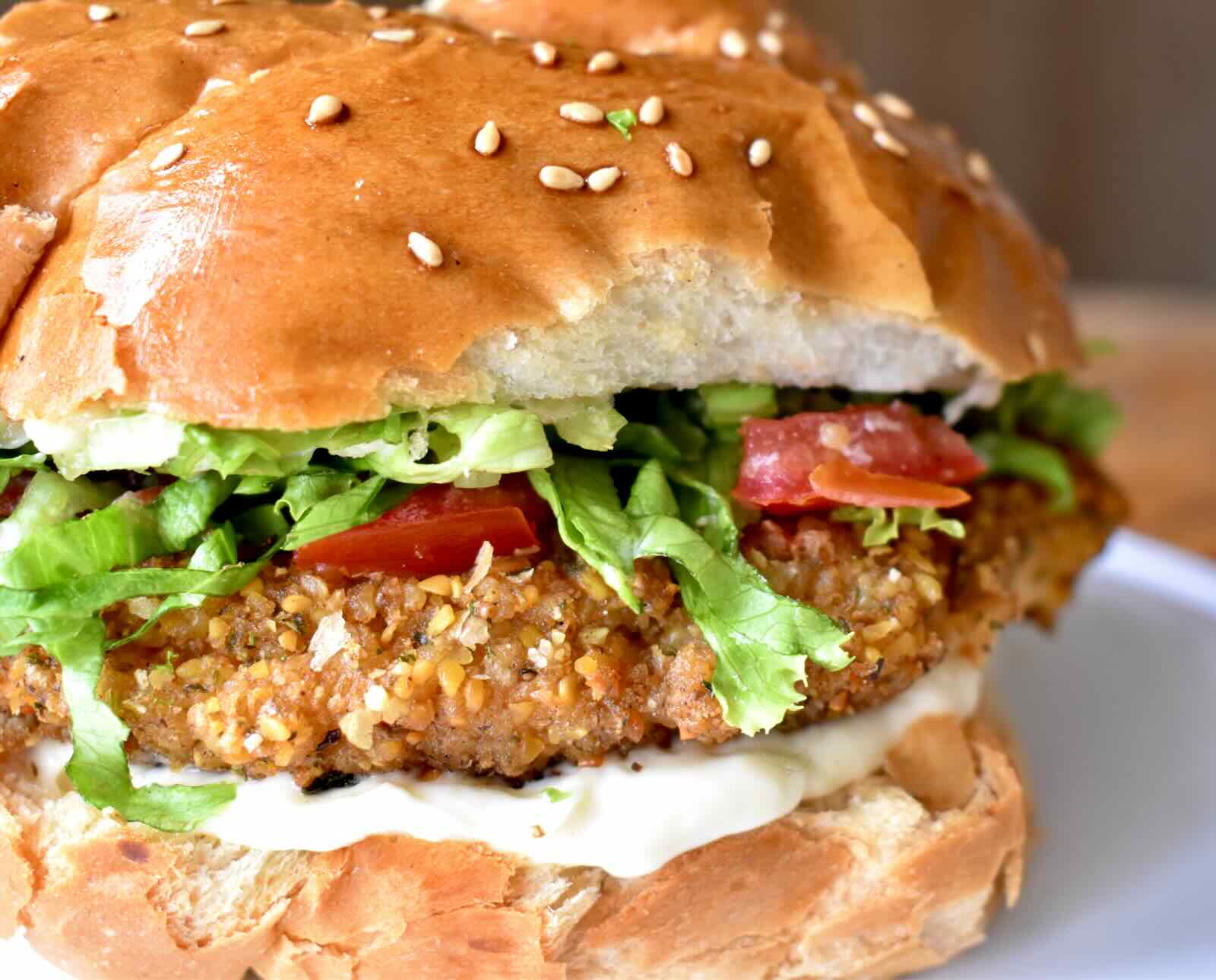
Crispy, flavorful, and satisfying, this sandwich borrows flavors and techniques from several cuisines
This recipe has been on my mind for a long time. I’ve always found the herbaceous crunchiness of falafel in a sandwich to be eminently pleasing, just like the rich crunchiness of a schnitzel on a sandwich. Why not combine the two into something bigger than the sum of its parts?
Since a flat cutlet seems to work much better inside a bun rather than on a wrap (which is best suited for round falafel balls), I decided to pair it with eggy, rich challah buns, studded with sesame. If you can’t find challah buns where you are, feel free to replace them with thickly sliced challah bread, or with a more standard sesame roll. To complete the flavor profile, a simple aioli made from tahini, lemon, garlic, and mayo really ties the whole sandwich together. Like a little bit of heat? Slather on some harissa paste and feel the burn!
Wild turkey breast is the perfect candidate for being turned into schnitzel, especially if obtained from a mature tom. The act of gently pounding slices of turkey breast flat with a meat mallet goes a long way to tenderizing what can be a pretty tough cut of meat. Breast meat from hens and jakes doesn’t necessarily need so much tenderizing, but still makes for great schnitzel.
The best way to do this is to take a large plastic zip-lock bag and use a knife to slice the sides open, leaving you with the bottom seam as a hinge. This plastic will keep the cutlet stationary and will also stop pieces of raw meat from flying all over your kitchen. You don’t want to be scraping goobers of desiccated turkey meat off of your kitchen ceiling with a razor blade… trust me. Thin plastic wrap, wax paper, and clean kitchen towels will also work, but tend to get chopped up and make a mess.
Open the aforementioned bag like a book and place a ½”-thick slice of turkey breast in the center of one side. Fold the other side over so that the turkey is sandwiched between the plastic. Use the flat side of a meat mallet (alternatively, you can use a rolling pin, wine bottle, or rubber mallet) to gently pound the breast, angling the strikes so that they push outwards. No need to wale on it, just consistent, firm strikes. Once the entire piece of meat is pounded to about ¼” thickness, flip it over to check for any thick parts that might be hiding ,and take care of them if necessary.
The beauty of this application is that it is relatively universal. The same technique can be used to great effect on any lean piece of meat—tough or not. I’ve “schnitzeled” grouse breasts, pheasant, goose, duck, venison, wild and domestic pork, chicken, beef, dove, and even sailfish!
You just have to be careful because some robust pieces of meat require a stronger hand, while others—like grouse and fish—need little more than a firm tapping. If the piece of meat you are using is decidedly tough and a little gnarly, you can use the toothed side of the meat mallet to really pound it into submission. The resulting cutlets come out like cube steak.
When purchasing a meat mallet, look for ones with a toothed side and a flat side on the head, and with good heft—you want gravity to do the work for you. Somewhere in the $15-30 range will probably do you well. They can also commonly be found in thrift stores, as most people who inherit them don’t know what to do with them anymore. I’ve seen them for sale for a mere buck or two.
Normally when making schnitzel, I’ll set up a three-stage system for breading. In the first bowl, I’ll have seasoned flour, then beaten eggs, then breadcrumbs. The pounded cutlet first goes into flour, then gets dipped into the beaten eggs, then finally gets coated in breadcrumbs. These three stages ensure a crispy coating that won’t slough off in the frying pan.
Since boxed falafel mixes are a bit floury and a bit breadcrumby, I altered my usual course of action and reduced it to a two-stage system. The raw cutlet first gets coated with the falafel mixture, then goes for an egg bath, and then goes back into the falafel mixture. This creates a coating that adheres nicely and makes for an extra crunchy end product.
My last piece of advice is to cook these schnitzel more gently than you would a typical schnitzel with breadcrumbs. The falafel mix tends to cook more quickly than breadcrumbs, so keep the heat to medium, and be ready to turn it even lower if the coating is getting too dark. You’re not allowed to walk away from this one!

Wild Turkey Falafel-Spiced Schnitzel on Challah with Tahini Aioli
Ingredients
Method
- Pound out turkey slices into ¼” thickness with a meat mallet or rolling pin. Sandwich the pieces of turkey between two pieces of plastic to do this.
- Dump the contents of the falafel mix onto a plate. Pour the beaten eggs onto a separate plate.
- Heat the oil in a skillet over medium heat. Dip the pounded turkey breasts first in the falafel mix on both sides, then in the eggs, then back into the falafel mix.
- Add the turkey cutlets to the oil (in batches of 1 or 2) and fry on both sides until golden brown. Careful not to burn!
- Add more oil if necessary to complete all of the schnitzel.
- Remove from the oil and set onto paper towels to drain.
- Mix together the aioli ingredients in a bowl.
- Warm the buns up in the oven, then split them in half.
- Spread the aioli on the bottoms and tops of the buns, then add the lettuce, chopped tomatoes, a piece of schnitzel, and the harissa if using. Serve immediately. Enjoy!