

Ring-necked Duck (Aythya collaris): Identification, Habitat, Diet, and Hunting
The overlooked ring-necked duck is one of waterfowling’s most interesting—and tastiest—diving ducks
The first ring-necked duck that I ever shot was actually misidentified as my first scaup. I saw the blue bill and couldn’t have been more excited about it, until someone on social media corrected me. By doing so, I got a quick education on a species of duck that, up until that point, I hadn’t been aware existed.
All for the better, because now much of my waterfowl season is spent in pursuit of flights of this small little diver species, not just because of how much they seem to enjoy a good spread of decoys, but because they are perhaps one of the best species for roasting whole.
That’s not to say that the pudgy ring-necked duck doesn’t deserve all the respect. After all, they’re a fascinating bird in their own right. They are sort of a diver, but tend to do a lot of dabbling on the surface. They are usually the first birds to arrive in my area during the autumn migration, but as soon as there’s a tiny skiff of ice on the water, they’re practically gone overnight.
The wondrous little “ringer” has a lot more going on with it than meets the eye. Let’s have a look at what makes the ring-necked duck special.
Ring-necked Duck Quick Facts
| Characteristic | Details |
| Scientific Name | Aythya collaris |
| Taxonomic Order and Family | Order Anseriformes, Family Anatidae |
| Average Length | 15 to18 inches |
| Wingspan | 24 inches |
| Weight | 1 to 2 pounds |
| Habitat | Small bodies of water, beaver ponds, marshes, bogs, wetlands, and other places with water 3-5 feet deep |
| Range | Parts of interior Alaska and the southern half of Canada, along the Pacific and Atlantic coasts, the Great Lakes region, and south into Mexico and Central America |
| Conservation Status | Least Concern |
| Conservation Concerns | Deforestation, degradation of winter habitat |
| Similar Species | Lesser Scaup, Greater Scaup, Ruddy Duck |
How to Identify a Ring-necked Duck
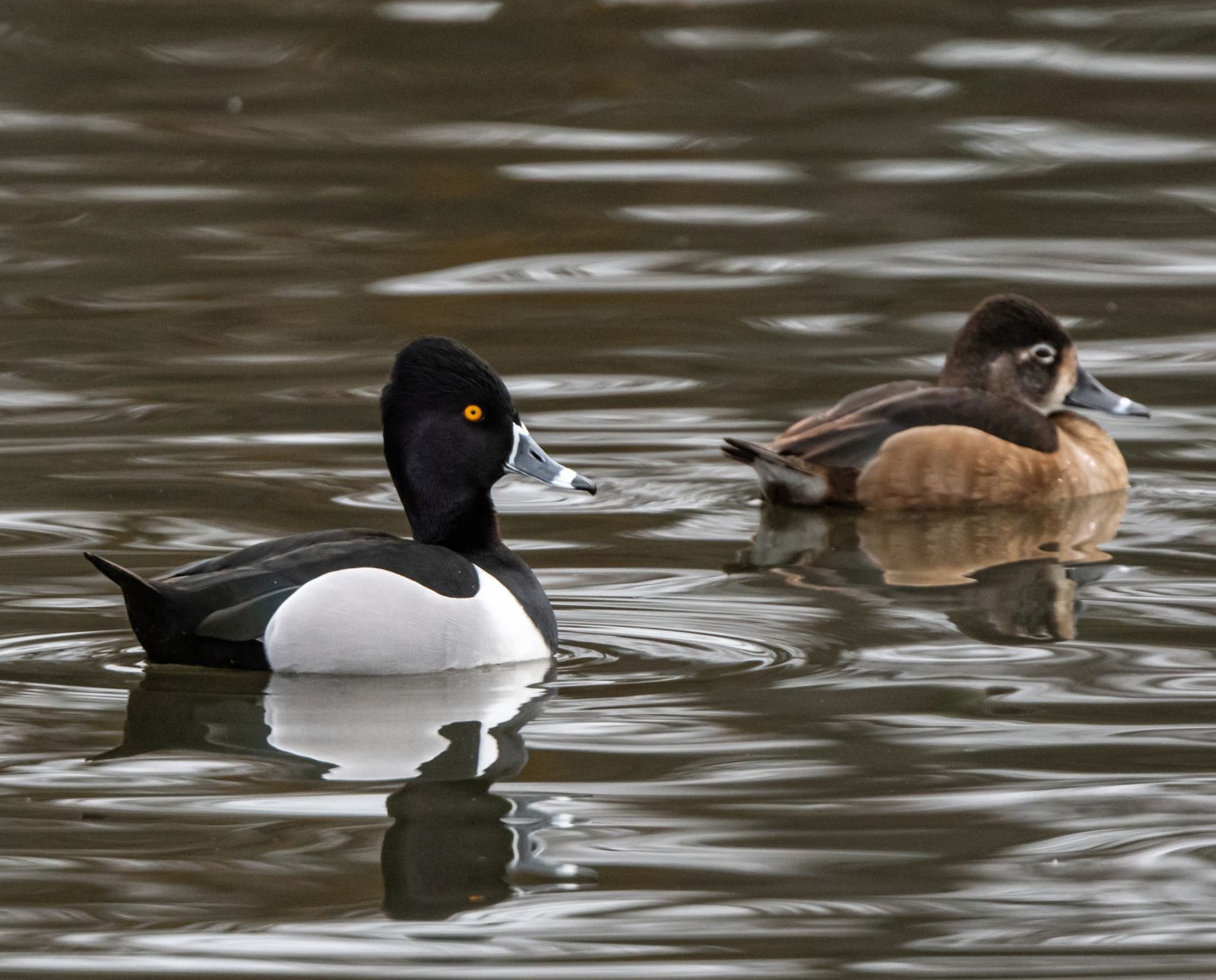
The ring-necked duck (Aythya collaris) is a small North American diving duck characterized by its peaked head, yellow eyes, and multicolored bill with white and black bands near the tip.
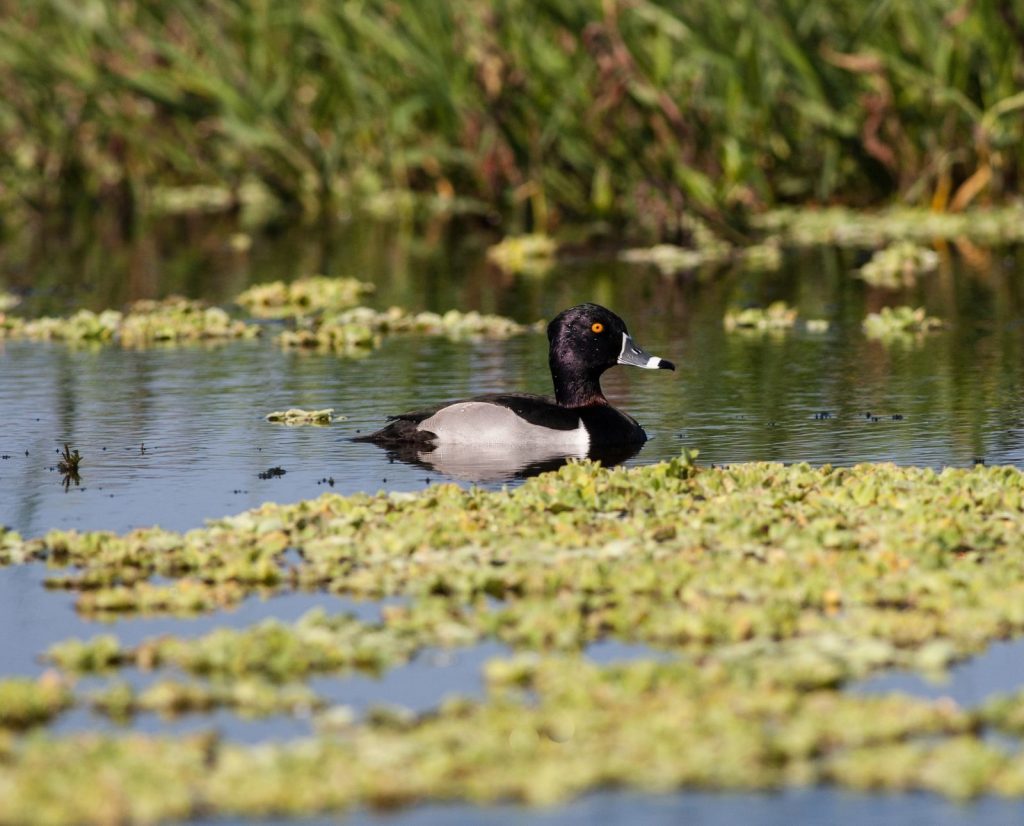
Ring-necked drakes have piercing yellow eyes under a slightly elongated head and subtle brown necklace around the middle of their neck. These drakes have a multicoloured bill, going from black where it meets the face, to slate bluish grey, then ends with a white stripe against a black stripe at the very end of the bill. The plumage on their head is black with a somewhat iridescent purple sheen when it catches sunlight. The back plumage is black with a white belly and barred flank feathers underneath the wings.
The hens of this species are a drab brown colour which serves as protective camouflage during nesting season, and a thinner white stripe two thirds of the way down the bill that is smaller than that of the drakes.
Ring-necked Duck Habitat
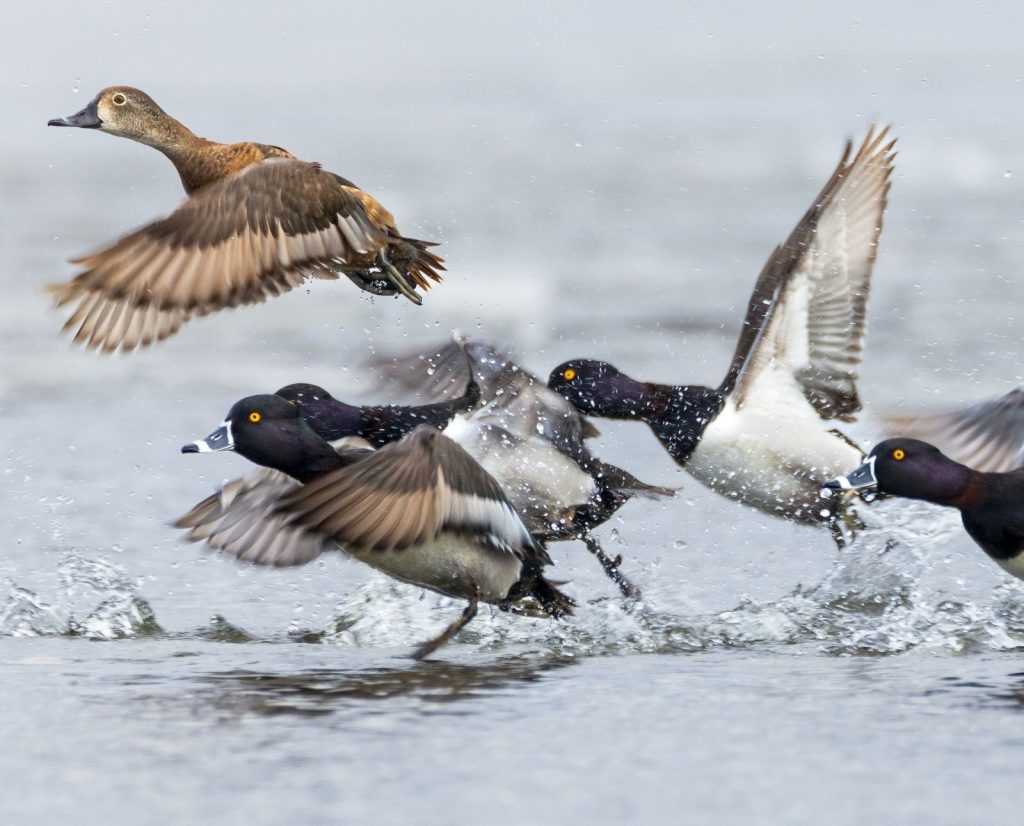
These are truly a backcountry duck, preferring densely wooded lakes, ponds, marshlands, small bogs, swamps in and around the boreal forest. Beaver ponds are especially preferred by the ring-necked duck. Though considered a diving species, these ducks prefer exceptionally shallow water where feeding doesn’t require deep dives, typically between three to five feet of water, according to the Audubon Society (AS).
Ring-necked Duck Diet and Food Sources
According to Ducks Unlimited (DU) and the Cornell Lab of Ornithology (CLO), during the breeding season, it is common for hens to take on a more carnivorous diet. Aquatic insects, snails, dragonflies and damselfly nymphs are targeted by female ring-necks. However, for the most part, these ducks enjoy a vegetarian diet of aquatic vegetation, various stems, seeds, roots and sometimes waterside flowers, which make up roughly eighty to ninety percent of their diet. Led by their mother, ducklings will eat mostly aquatic insects.
Ring-necked Duck Range and Migration
These ducks inhabit a wider range of habitat across North America, from the west coast and Rocky Mountains all the way to the waters of Chesapeake Bay. This duck spends its breeding season in the prairie pothole region, up into the boreal forests of Canada as well as the Great Lakes Region. Migration takes place from September through November (AS).
The ring-necked duck is a short to medium migratory species, meaning that it doesn’t take part in long-distance flights. Migratory specimens congregate in large flocks and are relatively slow to leave an area until it is absolutely necessary (CLO). On the west coast, there are known regional populations that are non-migratory and frequent the same home range throughout the year.
The autumn migration will see these ducks in destinations along much of the east coast as well as the Gulf of Mexico, down into Central America as well as the Caribbean. During migration, ring-necked ducks usually seek areas with freshwater where they can overwinter. Migration back to their breeding grounds takes place very early in the spring (DU, CLO).
Ring-necked Duck Breeding and Nesting Behavior
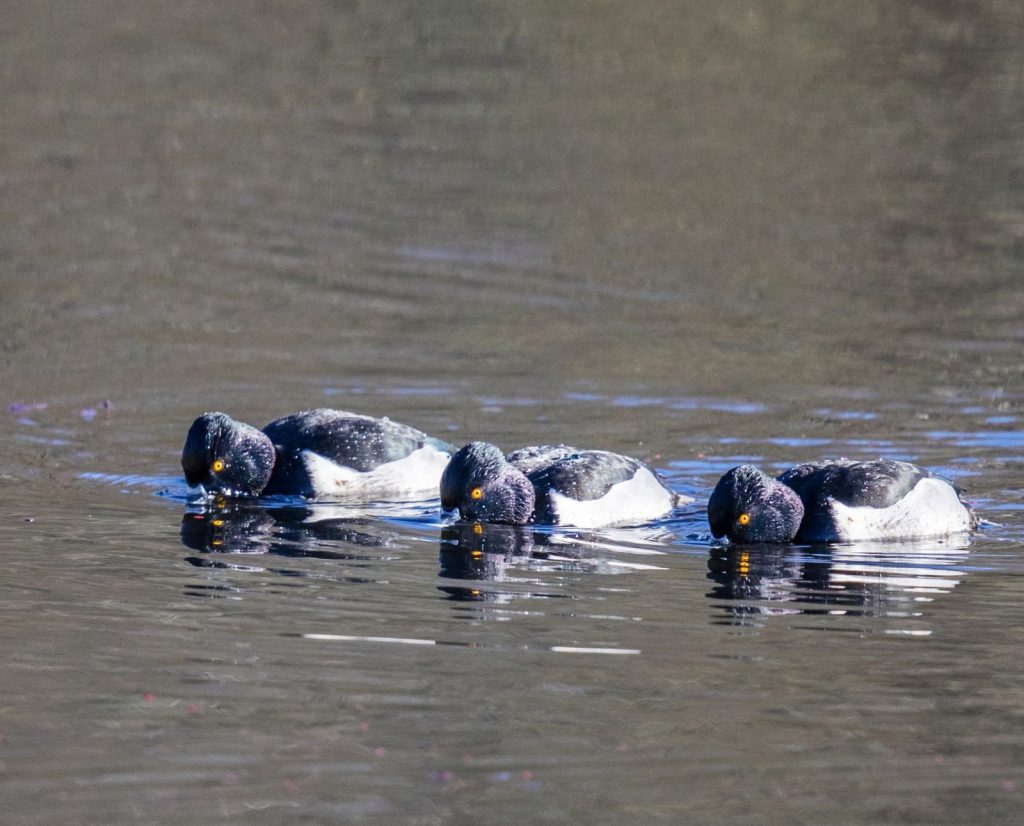
Breeding begins in early spring when ring-necked ducks congregate in shallow bays in large numbers where the drakes begin courtship with hens. During this, the male will throw his head backward until it contacts his back. Another common method of courtship is when the drake swims forward swiftly while bobbing his head. The ducks will pair up and typically stay together until the hen begins the incubation process of the eggs (CLO).
Both the drake and hen will choose a nesting site by exploring the edge of the shoreline, eventually deciding on a location. Nests are not particularly well thought out, and the hen doesn’t put a lot of effort into the actual build until the eggs have been laid. Nests are built overtop of the water, often on floating vegetation (AS).
The hen lays six to fourteen brown, olive, or buff colored eggs. The incubation process takes roughly 25 days to complete. Mother and young leave the nest 24 hours after the ducklings hatch and seek cover instead of making for open water, which is more common with other species of diver ducks (DU, CLO).
The young are able to fly by 50 days of age. Unlike other species of divers, it is common for the mother ring-necked duck to remain with her ducklings until they are able to fly (AS).
Ring-necked Duck Conservation Status
Luckily for us, this species is considered of least concern. At the time of this writing, populations are considered stable or increasing over the long term (DU). Because this species requires quiet, shallow, forested lakes, of which the boreal forest is known for, protection of this region is considered critical to ensure that stable numbers of birds are able to raise clutches of eggs.
These ducks are also well known to be exceptionally sensitive to deforestation and degradation of wintering grounds and may not use an area that has been altered by human development (DU).
How to Hunt Ring-necked Ducks
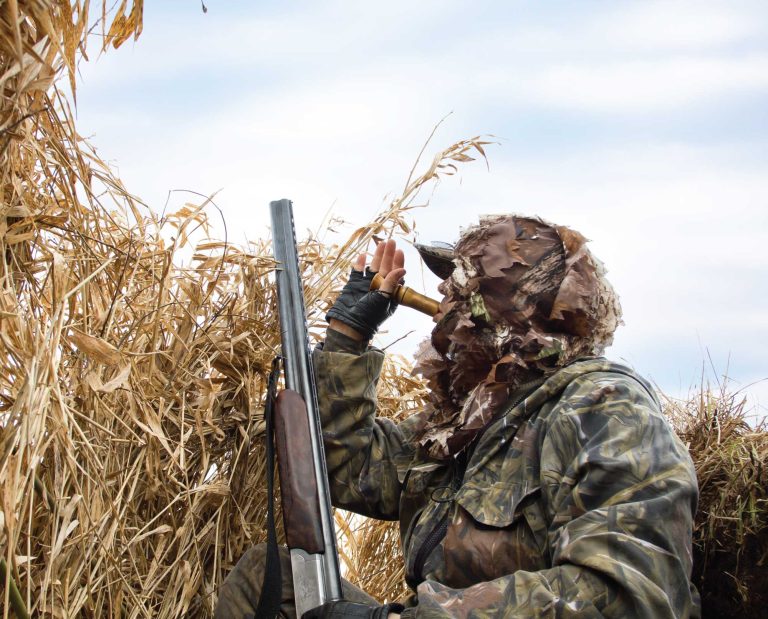
Hunting ring-necked ducks requires a familiarity with their preferred habitat, effective decoy spreads, and calling techniques. These ducks are fans of a mixed spread of puddle duck decoys, especially if you incorporate a handful of “ringer” decoys on the outer fringes of that block. Ringnecks don’t seem to mind less than ideal conditions that other birds, such as mallards and pintails, might otherwise not move in, such as warm weather and calm days.
Shallow bays scouted ahead of time are prime locations to find these ducks, as well as weed mats and the mouths of rivers and creeks. Again, knowing what the birds are feeding on and where that food source is located will go a long way toward consistently finding good numbers of ring-necked ducks.
For more specific hunting information, read our complete ring-necked duck hunting guide.
Are Ring-necked Ducks Good to Eat?
These ducks, if nothing else, were handcrafted for the ardent waterfowler who loves the taste of duck in all of its glory. The ring-necked duck is the perfect size meal for one person. Because their diet consists almost entirely of aquatic vegetation during their migration season, their fat is creamy white, unlike the orange coloration of their fish- or mollusk-eating counterparts.
So, what does this mean for the hunter with a couple of ringers? I highly recommend gutting the bird and, if you’re able to, hang them for a day or two before plucking them whole. These ducks were made for roasting whole, and that’s exactly how I like to do them, especially those fattier late season birds of November.
Cook: Project Upland’s Duck Recipes
Though you can, I don’t recommend breasting out ring-necked ducks. In the grand scheme of things, it doesn’t yield nearly as much meat as eating the entire bird does. Because of their small body size, you can also brine these ducks overnight if you wish. Smoking them on a low heat is a fantastic way to cook them as well.
Remember that while most of these ducks live on a vegetarian diet, sometimes it’s possible to run into a renegade that has been dining on shallow water mollusks. For this reason, pay attention to the color beneath the skin of your birds. If there’s any hint of orange, first, do the smell test. If you’re picking up notes of fishiness, skin that bird and cook the meat differently.
For a duck that many hunters overlook or even mistake for another species, the ring-necked duck has a lot going for it. They show up early, decoy readily, and offer some of the finest table fare a waterfowler could ask for. Whether you’re watching the first small flocks drop into a quiet backcountry pond in October or roasting a plump bird whole after a cold November hunt, the humble ringer has a way of making a lasting impression. And once you start paying attention to them, you may find—as I did—that chasing these little “divers” becomes one of the highlights of hunting season.