


Is Burton Spiller the Poet Laureate of Woodcock?
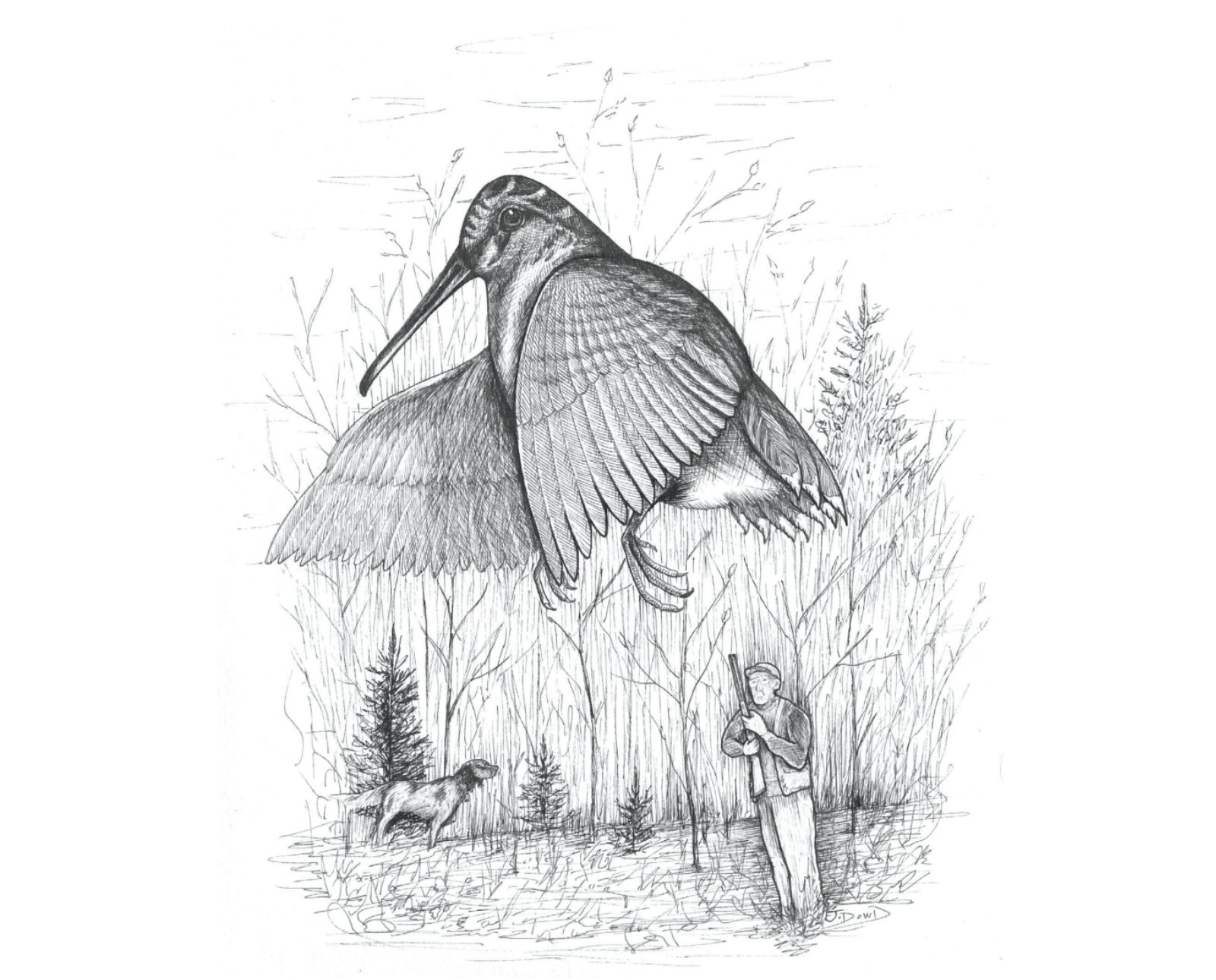
Burton Spiller on woodcock hunting and his admiration for the “little russet feller”
This article originally appeared in the fall 2022 issue of Project Upland Magazine. Original artwork is by Jay Dowd.
“Right up near the top of the list of scatter-gun carousals will be found the name ‘woodcock.’” -Burton Spiller
On December 21, 1886, Burton L. Spiller was born in Portland, Maine. In his younger years, Spiller was an avid hunter. He even joined the ranks of the market hunters for a few years pursuing ruffed grouse for money, until he started working for an attorney who showed him what it means to be a true sportsman and also taught him the love of good literature on the sport.
In 1932, Burton published his first article with Field & Stream, entitled “His Majesty, the Grouse,” which garnered the attention of Eugene V. Connett, the editor of Derrydale Press. Impressed by this article, Mr. Connett reached out to Spiller by letter and stated, “If you would care to think over the matter of writing a book on shooting, I would be glad to either talk to you about it in advance, or to give the manuscript very careful consideration when it is submitted.”
Of course, Spiller jumped at the opportunity and produced the manuscript in about two months’ time. The book that resulted is the renowned Grouse Feathers, which was first published by Derrydale in 1934. The book quickly sold out.
Spiller followed up Grouse Feathers with a few titles, including Thoroughbred and Firelight, that received less fanfare. As a result, Connett convinced Spiller to go back to his roots and Spiller published the final installation with Derrydale Press during his lifetime, More Grouse Feathers, in 1938. After its publication, this book also received enthusiastic reviews and good sales.
Thereafter, Spiller continued to publish numerous articles in outdoor magazines and in 1962, some of his articles, including “His Majesty, the Grouse” appeared in book form in Drummer in the Woods, which is considered by many as Spiller’s best work. Spiller died in May of 1973, but other excellent articles of his appeared in print in Grouse Feathers, Again, which was fittingly published by the Derrydale Press in 2000.
Burton’s books and his numerous articles have earned him the unofficial title of “the Poet Laureate of the Ruffed Grouse.” Most who have read Spiller’s work agree with this title, as his vast experience, writing, and storytelling really capture so many of the enjoyable details of ruffed grouse hunting: the wiliness of the bird, challenge on the wing, dogs, joys of good hunting companions, and the unapologetic fun of it all.
Burton Spiller and Woodcock Hunting: Early Experiences
Undoubtedly, ruffed grouse were Spiller’s first love in the uplands. However, lesser known to many is that Spiller was almost as passionate about American woodcock and woodcock hunting. From the beginning of his writing career, Spiller wrote about the sport in his books and in some of his articles. When Connett responded to Spiller’s initial proposal for Grouse Feathers, he specifically requested, “Would it be possible to include something on woodcock shooting in the manuscript? The two birds seem to go together as a rule, and the inclusion of woodcock might broaden the market for the book.” Spiller replied that he would certainly include the species in the book.
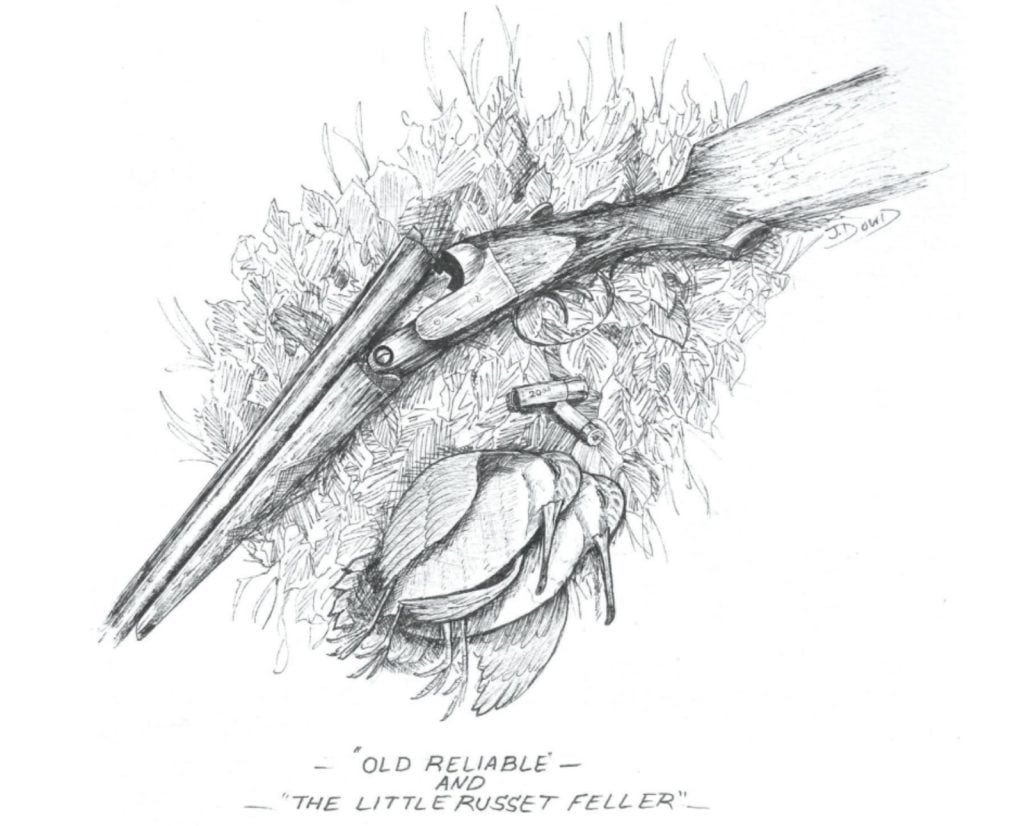
Notably, the sixth chapter of his first book, Grouse Feathers, is wholly dedicated to the pursuit of the American woodcock, and in which he first coined the term “the little russet feller.” The nickname has been used by almost every outdoor writer who has written about this grand game bird since. In this chapter, Burton tells of his first encounter with the woodcock after hearing of a “tremendous flight of woodcock in the Walker pasture.” At the time, Spiller believed grouse to be the hardest of all targets and felt confident in his abilities because he could occasionally kill them on the wing. Spiller had heard that woodcock were comparatively easy and surmised that he “could kill woodcock as fast as they got up.” To this end, he went early in the morning, and, as reported, the birds were present in great numbers, but by “nine o’clock [he] started homeward, minus one box of shells and plus absolutely nothing but a saddening experience.”
After sharing this humbling first experience, Spiller confessed: “I cannot truthfully say I have ever found woodcock an easy mark.” Spiller further explained that the bird’s “mechanism appears to be a tremendous spring, wound to the last, ultimate cog. At what moment it will release and propel him upward twenty feet in the air, neither he, my dog, nor myself knows.”
Read: Tips for Better Woodcock Shooting Skills
Regarding the effects this unpredictability had on Spiller’s shooting, “Reason tells me it is merely a matter of timing. I am keyed up for a fast one, and old Timberdoodle lobs one of those disconcerting fade-away balls over the plate. If I discover in time, I can drive it into the bleachers, but, too often for my egotism, I swing too hard and too soon.” Obviously, Spiller found American woodcock to be a challenging game bird and he respected them on the wing.
In More Grouse Feathers, Spiller again touches on woodcock hunting, but did not devote a whole chapter to the pursuit as he did in the first book. Interestingly, he argued in this book that a good grouse dog should not be hunted on woodcock because he felt the differences in handling the two birds would ruin the dog.

Burton Spiller Books and Essays on Woodcock Hunting
After the publication of More Grouse Feathers, Spiller continued to write articles for numerous outdoor magazines and many of those were on woodcock hunting, including “Woodcock Like it Wet,” “Woodcock Daze,” “Woodcock High and Dry,” and “The Unpredictable Woodcock,” the first of which appeared in book form in Drummer in the Woods. The latter three appeared in Grouse Feathers, Again, which is a real treasure trove of Spiller’s works that were mostly unavailable until the year 2000. The themes of these articles touch upon finding woodcock in wet years, the joys of hunting them with pointing dogs, finding them in the high country in drought years, and their overall general unpredictability. Notably, in “Woodcock Daze,” Spiller recanted his position on not hunting grouse dogs on woodcock and admitted that he “learned to appreciate the few good qualities that my dogs did possess,” and, as a result, he “began to get some actual joy from my [woodcock] hunting.” Most agree with Spiller’s conclusion that hunting woodcock with a good dog (or even a decent dog for that matter) makes hunting them more enjoyable, not to mention more successful.
A recurring theme throughout Spiller’s writing about American woodcock is their genuine unpredictability in flight, their migration, and their preferred coverts. “Woodcock High and Dry” has some of the best quotes on this: “If a prize were offered to the upland game bird which proved itself to be the greatest individualist, I am thoroughly convinced that the woodcock would be judged the winner. Without a doubt it has a good reason for the unpredictable things it does, but many of them are baffling to mere man.
This particular article details a severe drought year in which Burton and his hunting companion struggle to find woodcock in any of their usual coverts and eventually abandon the pursuit to search for grouse in the high country. To their surprise, Burton and his hunting companion, Gene, end up finding a number of woodcock on top of a mountain, where they had never seen them before. They then remembered the tales of an old upland hunter who told them that in drought years, the birds can be found up in the high country. Spiller admits that they did not believe the septuagenarian at the time he first reported this, but experience proved him correct. From this unusual experience, Spiller stated: “It’s an axiom among prospectors that gold is where you find it. I’m betting they stole that phrase from an old woodcock hunter.”
Listen: Woodcock Shooting – Edmund Davis’ 1908 Classic in Audio Format
In the “Unpredictable Woodcock,” published in Field & Stream, September, 1962, maybe the last article he wrote on the species, Spiller began:
Of all the game birds that I’ve hunted, the woodcock is the most unpredictable. The others have a plan of living that follows at least the semblance of pattern, but old Jonathan apparently possesses neither foresight nor hindsight. He doesn’t know what he intends to do next, and after he’s done it he doesn’t know why. Now, how can you apply logical hunting methods to a bird like that?
He then shares a story of hunting with the famous Tap Tapply who was training a young dog and wanted to go to a covert that only had one or two birds so as not to demoralize the dog with too many flushes. Burton then took him to a haggard covert within the city limits of East Rochester that would fit the bill. To both of their delight, the covert was loaded with woodcock and they took six while children played in the streets nearby and parents rushed out to bring them home due to all the gunfire. Spiller then goes on to say, “You never know where a timberdoodle will be—or go.”
After describing some of the crazy things woodcock do on the wing, Spiller wrote: “I hope no one will think I hold Jonathan in contempt. Quite the contrary. I like him and I wouldn’t change one russet feather of him. He is a rugged individualist, and his way of life must be the right way or else he would have long since gone the way of the dodo.”
While his writing about grouse is much more prolific, Spiller’s love and admiration of the American woodcock is clearly evident in his works. This begs the question: Is Spiller also the Poet Laureate of Woodcock? I think the jury is still out on that, as there are many writers who have written wonderful books solely on the subject, such as Edmund W. Davis, Tom Huggler, Guy de la Valdene, and Tom F. Waters.
While Spiller did not write a stand-alone book on woodcock hunting, his timeless works should be on every woodcock enthusiast’s short list of excellent writing on the subject. No doubt, Spiller captures the mystery, the unpredictability, and the sheer fun of hunting the bird he lovingly called “the little russet feller.”


Enjoyable listen . So many wonderful writers keeping us connected to the upland season and Burton Spiller is definitely one of my absolutes. Thanks.