


Buying a Pointing Dog: Comparing Puppies, Started Dogs, and Finished Dogs
What new bird dog owners should know about the costs, commitments, and tradeoffs of puppies, started dogs, and finished dogs
All of us dream of watching a dog slam on point followed by an eruption of game birds and the blast of a double barrel shotgun. But getting to that point looks very different for everyone. When selecting a pointing dog, it can be very difficult to sort out the various breeds that would fit your lifestyle and hunting style alike. And then there is the challenge of selecting a breeder that consistently produces the type of dog you are looking for that regularly performs in the conditions you hunt in. Once these steps are complete, then the process of getting a dog to work well in the field has just begun. When buying a pointing dog, you will need to decide whether a puppy, “started” dog, or a “finished” dog is best for you.
This article is intended to help you understand the dog market and decide what route is best for you as an aspiring pointing dog owner and handler. Knowing the processes of bringing a puppy, started dog, or finished dog into its first season with you as a hunter and handler will help you make the right choice for your needs.
Buying a Pointing Dog Puppy
If you are thinking about starting your pointing dog journey with a puppy, it is important to take the time to research exactly what you’re looking for out of your new hunting companion. Simply choosing a hunting breed will not guarantee the dog to be a proven bird dog.
One consideration to make is that cost can vary greatly on puppies from any breed or certain blood lines. One example is, I have seen German Shorthaired Pointers advertised as low as $400 from a local backyard breeder and as high as $3,500 from a proven hunting line.
Read: How to Choose a Pointing Dog – Breaking Down 38 Bird Dog Breeds
The benefits of starting with a puppy are numerous. If you have children in your home, it allows them to be a part of the training and bonding process. It also helps to have a puppy when integrating them into the pack. Long time breeder, trainer, and trialer Dan Hendrickson of Phantom Kennels stated, “When you get a puppy at eight weeks of age, that puppy bonds with you and that bond follows to the field.” While the bond between you and your dog is very important, it needs to be considered that puppies require a lot of time and attention. A puppy can easily disrupt the home, chew your favorite shoes, and stain your carpet. And in today’s world, extra time is becoming increasingly difficult to come by.
If a puppy is the best fit for you, there are multiple paths you can go down to prepare your puppy for the field. They include:
- Working with a mentor
- Utilizing a professional trainer for 1×1 or group sessions
- Boarding the dog with a professional trainer
- Training the dog yourself
Let’s dive a little deeper into each option.
Training Options After Buying a Pointing Dog Puppy
I have found that people in the bird dog community are generally very helpful and willing to mentor new handlers. It is not uncommon for someone to offer for you to join them when they are training their own dogs. For example, through a friend of a friend, I was put in touch with a couple of guys that trained multiple times a week together. Surprisingly, after a short phone call, they invited me to train with them the following morning. This was a very enlightening process because not only did I get to work my own dog with people experienced in training wild bird dogs, but I got to see other dogs go through the process as well. One of the gentlemen has a guide string of a dozen or more Pointers. I paid very close attention to every dog as they ran and asked as many questions as I could.
If a mentor is not available to you, working with a professional bird dog trainer can function in similar ways.
Professional Training Options
Many professional pointing dog trainers offer 1×1 or group sessions for a minimal fee. A lot can be taken from these sessions in terms of both obedience and field work. While your puppy is maturing in the field and training process, you will be maturing as a handler.
Living in Southern Arizona, I utilized Kelly Kirby of Luna Rita Outfitters for private training lessons. Kelly offers group sessions with six dogs and handlers at a time. I enjoyed watching the large variation of breeds, lines, dogs, and ages run through drills.
Another professional training option is to board your puppy with a trainer. If you think you will board your dog with a professional trainer, I advise contacting the trainer as soon as you know you are getting a puppy. The best ones are booked well in advance. This will ensure you have a slot in the training season that will fit with the age of your dog.
Trainers will likely provide a small list of training prerequisites prior to the drop off date. Most reputable trainers are charging upwards of $1,600/month with a minimum of a three month commitment. Depending on the dog’s breed, temperament, and your expectations, it can take anywhere from three to six months for your puppy to be professionally trained. Usually, you will have a weekly check in, during which the trainer will show you your dog’s progress. It is important to spend time with the trainer while your dog is being boarded to ensure you are comfortable handling the dog in the field before taking it home.
It is vital to research the trainers’ philosophies and methods to ensure they align with yours as a handler. This is important because even once a dog is professionally trained, you will need to follow up throughout the course of the dog’s life utilizing the same training techniques.
Dan Hendrickson mentions, “The worst thing a new handler can do is have a dog professionally trained and never learn how to handle it.” Having the puppy professionally trained can be the best of both worlds if it is financially available to you.
Training Puppies Yourself
While I learn best through working with others and observing other dogs’ reactions to training, many people are very good at reading information and applying it to their own training process. There are many good books that guide you through training. Some of the most notable are Training Bird Dogs with Ronnie Smith Kennels by Reid Bryant and Training with Mo by Martha H. Greenlee.
Read: The Gibbons-West Method of Pointing Dog Training with Mo Lindley
Do your due diligence on the different training methods. Research the method that will align with your lifestyle and your dog’s temperament. Choose a method and stick to it. Set aside the time needed to see progress with your dog each day. Most training methods will outline a minimum of 15 minutes a day of focused training time.
The path to bringing a puppy into their first hunting season is a long one. It requires a big time commitment, patience, and love.
Buying a Started Pointing Dog
A “started” dog can be a very loose term when it comes to bird dogs. Every person’s version of “started” can mean something very different. Professional dog trainer and guide Kelly Kirby of Luna Rita Outfitters describes a started dog as such:
- Actively searches/hunts
- Points and holds
- Lets you walk in front to flush
- Some sort of a retrieve
- Knows basic obedience of kennel, woah, and here
- Gunbroke
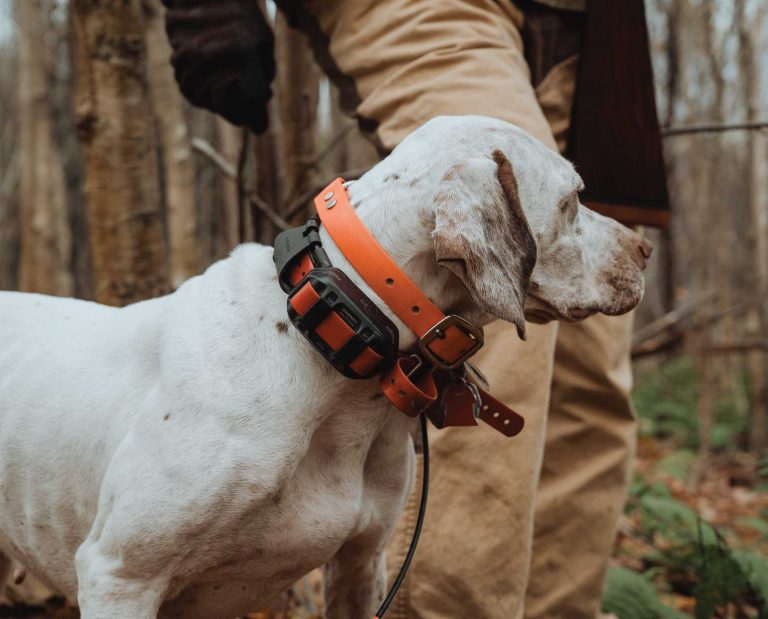
- Some e-collar conditioning
Kelly noted that he has higher expectations of a started dog compared to others in the industry. That is why it is imperative to buy from someone honest and has an open line of communication about expectations.
Started dogs are on the market for various reasons. They could have been a dog that doesn’t show the potential for a field trialer. Maybe this means they do not run as big as they would like for a horseback-based field trial. Or it could be a dog that a breeder held back from a promising litter, and for whatever reason, the breeder decided against breeding this dog. With very selective breeders this is understandable as they are analyzing gait, run, pace, trainability, nose, confirmation, intelligence, and much more. In either case, it can lead to you, as a new handler, getting a fantastic dog to start your journey with.
Dan Hendrickson said, “I sold a young female as a started dog to a guide because I didn’t like the way she responded to obedience training. That dog went on to be the best wild bird dog on the guide string.”
Read: How Much Does it Cost to Have a Hunting Dog?
A quick search online will show that the cost of started dogs can range from very inexpensive to astronomical. When I was looking for a started English Setter, I found a handful of dogs from quality breeders that were priced at $7,000 with one season of wild bird experience. Of course, there are started dogs priced far below this point as well. Depending on your expectations for your dog, more training may be needed.
Here are some questions you can ask folks selling started dogs:
- What is the dog’s natural range that it likes to hunt?
- How well does the dog take to training?
- Has it been a kennel dog?
- Is it housebroke?
- Has the e-collar been introduced, and if so, on what commands?
- What commands does the dog know? Recall? Woah?
- What is your training philosophy and methods?
- Has it been introduced to gunfire? If so, what type of gunfire and how close to the dog?
- Is the dog staunch on point?
- Where is the dog at in the steadiness process?
- What is its pace in the field?
- Have there been birds shot over it?
- Has it trained on or hunted on wild birds at any point? If so, how did it perform?
- Is there any reason this dog could not be hunted in the upcoming season?
- Have you sold started dogs before? If so, could you please provide a few references?
- Why are you selling this dog in particular? What makes it not fit into your program (hunting, guiding, breeding, ect.)?
- If this dog does not perform as described, what will next steps be?
If you’re impressed by the seller’s answers, ask if you could watch the dog work in the field prior to purchasing. If it is too far away for you to physically see the dog, you can resort to a handful of quality videos. However, it is important to note that there is still a risk in purchasing a dog that you did not see hunt in person.
I have purchased two started dogs. Of the two dogs, one was exactly as described. However, the other dog was gunshy. As a new handler, it took a good portion of a season for me to figure out the dog was gunshy. Kelly said, “Most issues a started dog comes to me with can be fixed with a little work. But gun shyness is normally the nail in the coffin.” Kelly has a deep understanding on the subject as all nine dogs on his guide string are rescues.
Buying a Finished Pointing Dog
“It might be a finished dog in the training field, but what does it do on wild birds? A lot of dogs without wild bird experience still have a big learning curve,” Kelly stated. Kelly went on to say that a finished dog should do everything a started dog does plus the following:
- Be fully e-collar conditioned
- Know the obedience commands of kennel, woah, here, and heel
- Handle in the field with hand, tone, or whistle signals
- Be steady on point to wing and shot
- Honor other dogs on point
- Have a solid retrieve
- Ideally has some sort of wild bird exposure
Purchasing a “finished” dog can be a sure way of finding your first pointing dog that will work well in the field. However, it can be very costly due to the time and effort that has been put in by the trainer. The price range for a finished dog on the online market is vast. But to find a finished dog that performs to the standards listed above, it is pretty safe to say you will be somewhere in the range of $5,000 to $10,000. Most finished dogs will be sold around two years of age, which can make it challenging to integrate the dog into the household or family if that is what you desire. With that said, Kelly’s entire guide string has been taught house manners later in life successfully. Kelly stated, “With some dogs, it took a lot of work to get there, but it can be done.”
The list of questions from the started dog section also applies to a finished dog. When purchasing a finished dog, it’s arguably more important to see the dog run in the field due to the financial commitment.
To keep them steady, some training in the off season will still be necessary. However, the large training burden and learning curve for you as a first-time handler has been taken care of by someone else. In theory, this should allow you to dive right into hunting season and find your passion in the uplands.
Choosing the Right Pointing Dog for You
At the end of the day, there is no wrong or one definite path to success when it comes to getting your first pointing dog. There are clear benefits to each choice. You need to ask yourself what kind of time commitment can your life handle right now. After speaking with both Kelly and Dan about the subject, the most important thing is to choose the route that fits you best, learn as much as you can along the way, and enjoy your time in the field with your new bird dog. All the hard work and dedication will pay off when your dog crosses a brush pile with the wind in their face, comes to a sudden stop, standing like a statue as the world slows down, and you walk in for the flush.

Very disappointed that you omit coverage of NAVHDA, the largest bird dog training organization in North America with over 10,000 active members and over 100,000 historical members. They are a great way to learn to handle/train your own dog, access birds, training grounds and mentors. They also are the only organization with 50+ years of breeder/Vesatile Hunting Dog lineage/hunt test scores so you can do your homework and find the right breeder and puppy for yourself. There are currently 99 chapters in the US (including the Arizona Chapter in Flagstaff and another 14 chapters in Canada.