

A Different Approach: The Versatile Deutscher Wachtelhund
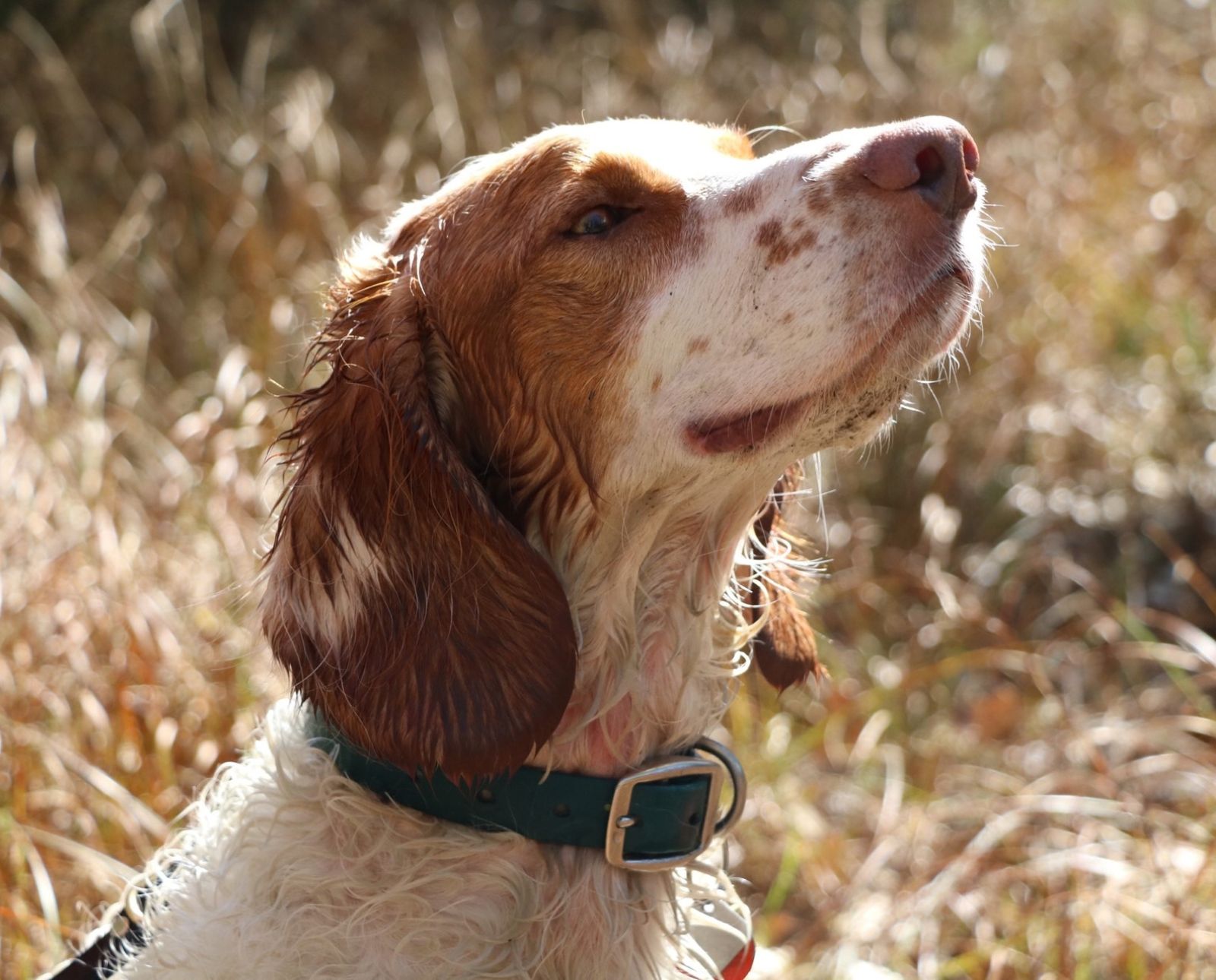
The Deutscher Wachtelhund is a rare German hunting dog known for its tracking and big and small game hunting abilities
This article originally appeared in the fall 2022 volume of Hunting Dog Confidential.
It was a crisp, late October day in southern Alberta. My new friend and I were following my seasoned dog, Quill, through waist-high, thick, sharp, golden swamp grass.
“Do you think we’ll find a pheasant here?” Evan asked.
“I’ve gotten a few around here over the years.”
At that moment, as if he understood, Quill dropped his head and tensed up. His tail’s tight, rapid circular motion told me all I needed to know. “Be ready, Evan! Quill’s got one for you!”
Quill began to dart back and forth rapidly, as he had many times before. Then, in a burst of noise and flashy color, Evan got his opportunity to close the deal on his first bird. He swung the shotgun and let the shot fly toward the young, wild rooster. It wasn’t the best hit, but an impact nonetheless. The pheasant sailed until it eventually landed in a tangled mess of wild roses far too thick for us to follow the bird into the cover.
Evan looked pale. “That bird hit the ground running! Will we be able to recover it?”
I smiled. “Let Quill do his thing,” I said as I called my dog to where we could see the wild rose bushes. I lined him up and sent him with a command, “Back, Quill!”
With his trademark enthusiasm and composure, Quill made a beeline for the area where he was directed. Evan and I watched the branches and leaves shake, the only clue that Quill was in there somewhere. Evan eventually became concerned and asked if we should try to push our way in to join in the search for the bird. I shook my head and found somewhere comfortable to sit.
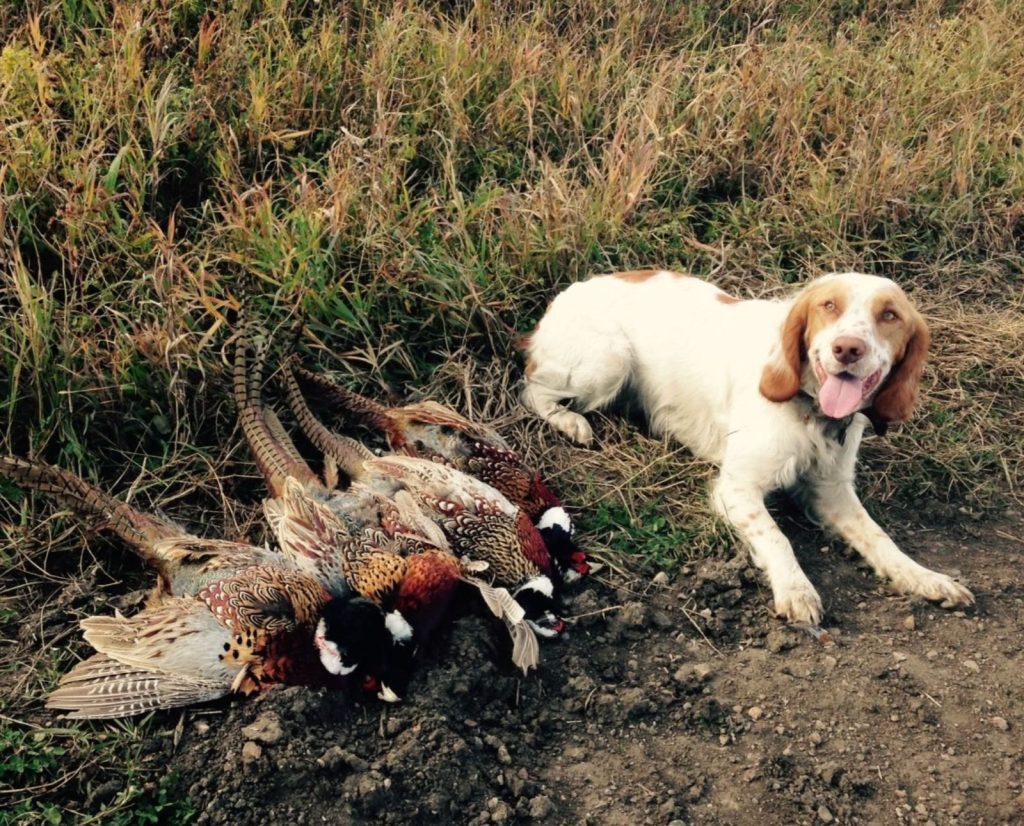
A few more minutes passed before Quill popped out of the cover with his prize. Wagging his tail, Quill looked around for us, so I calmly called his name and gave a quick wave. Then, my happy dog bounced toward me with a beautiful pheasant in his mouth.
“That’s Evan’s bird, bud, give it to him.” Quill understood and corrected his course to his new hunting buddy. Evan received his first bird to hand, presented by a proud Deutscher Wachtelhund.
We continued our hunt and ended up with a few sharp-tailed grouse and a missed opportunity on a swiftly departing jackrabbit. As we unloaded the birds and stowed away our shotguns, Evan had lots of questions about this unusual hunting dog that flushed and retrieved birds with such enthusiasm. My new friend was interested in all things hunting dogs and was not just being polite, and of course I am always more than happy to have a long conversation about this breed with which I am totally enamored.
The History and Origins of the Deutscher Wachtelhund
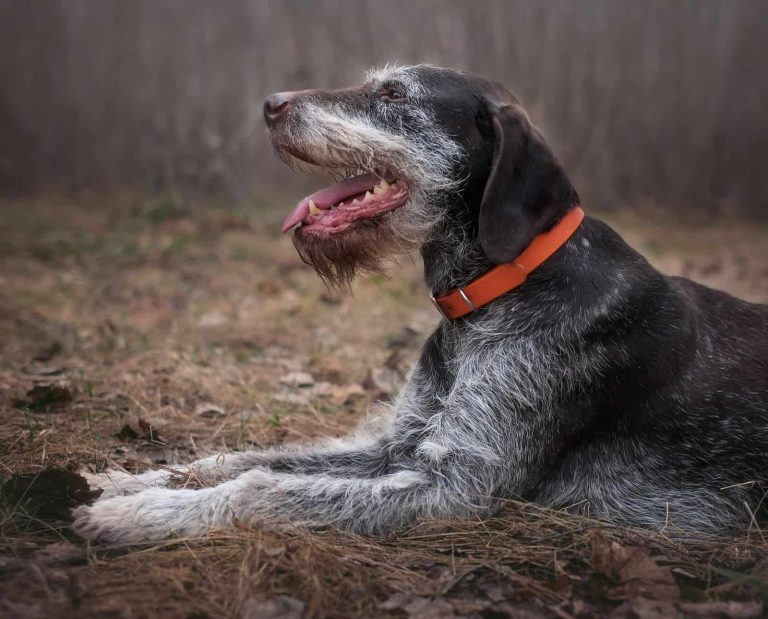
The Deutscher Wachtelhund (DW) is a relatively unknown breed in its native Germany and even less common in North America. It is a medium-sized hunting dog with pronounced muscles, thick bones, and long, wavy hair. They come in a wide range of colors and markings including solid brown, solid red, brown Schimmel (roan), red Schimmel, brown and white, and red and white. Tri-colored or brown with red markings are also known to occur.
DW genealogy can be traced back to the 1700s when a medium-sized, densely-muscled dog with long, wavy hair became popular in the German hunting community. These dogs were known as Stöberhund. Hunters, gamekeepers, and foresters used their Stöberhund for hunting every opportunity available. They hunted game birds, waterfowl, hares, and other small mammals. They were expected to exterminate small predators like foxes and weasels. In addition, they were prized for their ability to push wild boar and the native deer from thickets and forests before their hunter. The Stöberhund were bred with pointing dogs from the United Kingdom and Spain (among other countries) to form many of today’s well-known German hunting breeds.
Listen: Learn about the history of hunting dogs – Hunting Dog Confidential Podcast
In the early 1900s, the Stöberhund had lost its popularity to new breeds and was becoming rather uncommon. A young forester named Rudolf Friess decided that the ten most prized Stöberhund should be bred together to create a new breed, the Deutscher Wachtelhund, which translates to German Quail Dog. In 1903, the owners and breeders of these dogs formed an official club, the Verein für Deutsche Wachtelhunde (Society for German Quail Dogs), also known as the VDW. Soon after, German hunters developed a system of performance-based testing and health screening to select breeding dogs. The VDW were pioneers of this system and developed it alongside other hunting dog enthusiasts, including those with pointing dogs, blood trackers, terriers, and similar breeds, to form the Jagdgebranchhundverband (JGHV).
How the Wachtelhund Is Used for Hunting in Germany
DWs are used in Germany for almost all hunting situations. Most owners use their dogs primarily to hunt wild boar and deer in the German forest during traditional, driven hunts. The dogs are expected to independently search the forested area—which is surrounded by hunters—to push the game towards the ready shooters. In addition, the dogs are expected to track and recover any game that may have run off, wounded from a marginal shot.
Listen: Hunting and Forest Management in Germany with Nadja Niesner
A traditional driven hunt in Germany takes place during the late fall and winter months. They are large gatherings steeped in tradition, inviting hunters from all over Germany. When the hunters arrive, the hunt director calls a meeting with everyone involved. In this meeting, the director explains the geographical region where the hunt will take place and the type and age of the targeted game. The safety of hunters and dogs is stressed above all else.
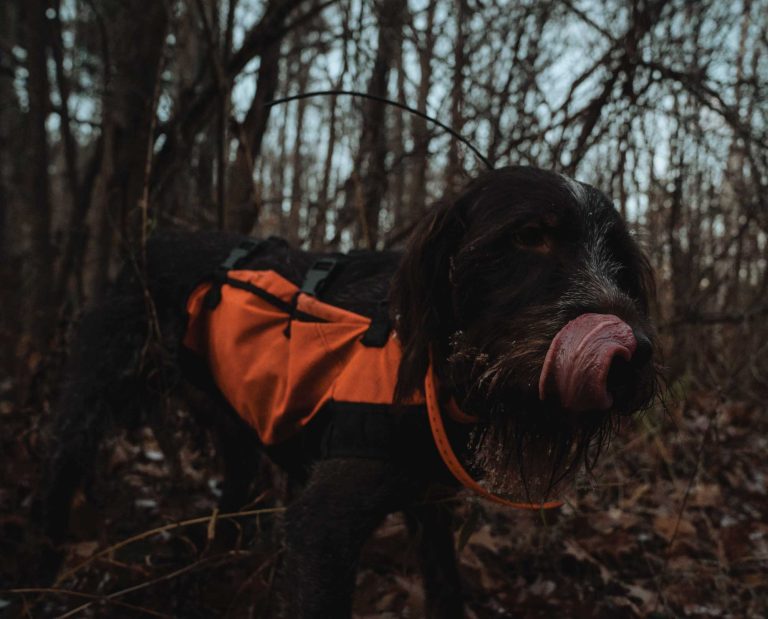
First, it is decided which hunters will be “shooters” and where their stands will be located. Next, dog handlers are assigned as “pushers.” Before the pushers take their place in the forest, hunting songs are played on traditional horns signifying the beginning of the hunt. Once the designated shooters are in their stands, the DW’s work begins. Wachtelhund handlers walk through the forest while their dogs independently roam out in front of them. The dogs tirelessly search every nook and cranny where boar or deer may be hiding. Once the dog discovers the game, no matter the species, it is expected to push the animal from its cover. The Wachtelhund achieves this by aggressively entering the cover, becoming loud (barking), and scaring the animal into fleeing from its hiding spot. Then, the DW will continue to trail and bay the animal until it has reached a waiting shooter. The DWs bark continuously while on the hot trail of game and this, combined with their brightly-colored, protective vest, allows the shooter to decide when—or if—it is safe to shoot.
The handler will collect their dog to investigate if the animal was shot but not recovered. The handler calmly places their dog in a “down” position within view of the suspected shot site. The handler examines the site for evidence such as blood or hair. Once the handler finds evidence, they outfit their dog with a thick leather tracking collar with a long lead and begin to follow the blood and scent trail. The DW can track the wounded animal and will often find them. If, however, there is sufficient evidence that the animal was hit by the shooter and the DW is unable to make a recovery, then a specialized tracker and their bloodhound will be called in to investigate further. It is rare that wounded game is not recovered in a German driven hunt, as a significant effort is made to follow up on each and every shot.
Driven hunts conclude with a feast and large fire. The achievements of shooters, handlers, hunters, and dogs are recognized during the banquet.
During the driven hunt “off-season,” Wachtelhunds are the constant companions of their hunter-forester owners. The dogs wait patiently under the highstands of their hunters during spring and summer hunts for boar and roe deer. Wachtelhunds are also used while stalking red deer in the forest.
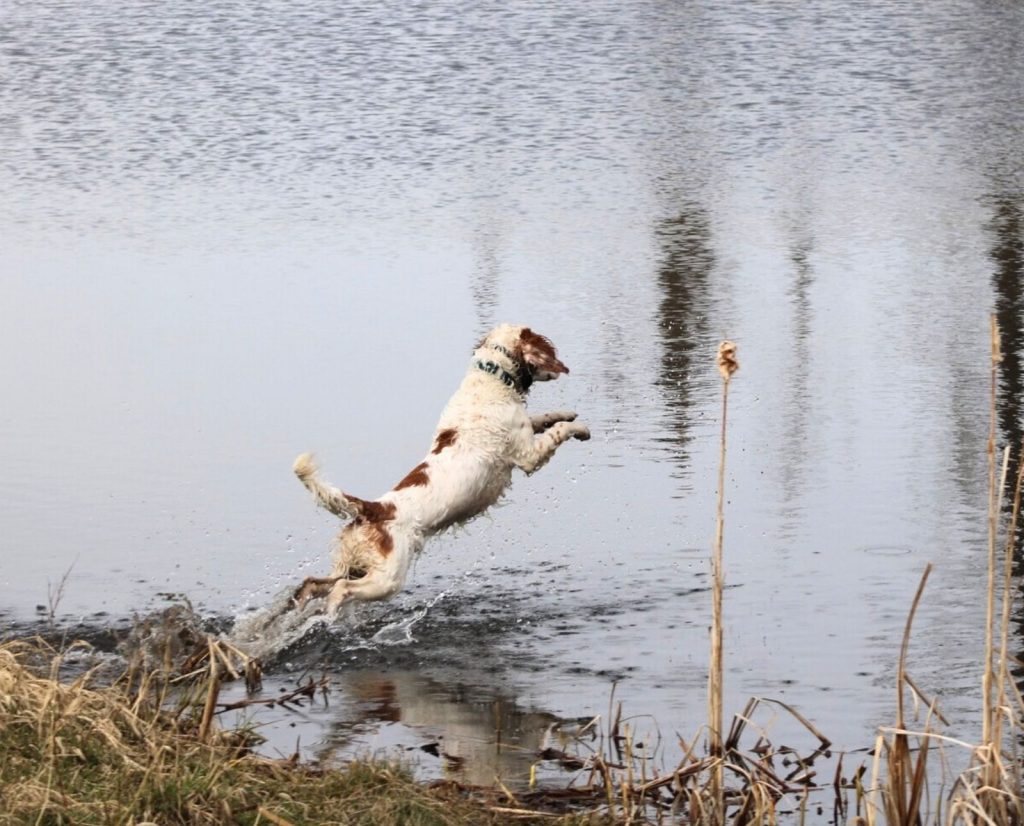
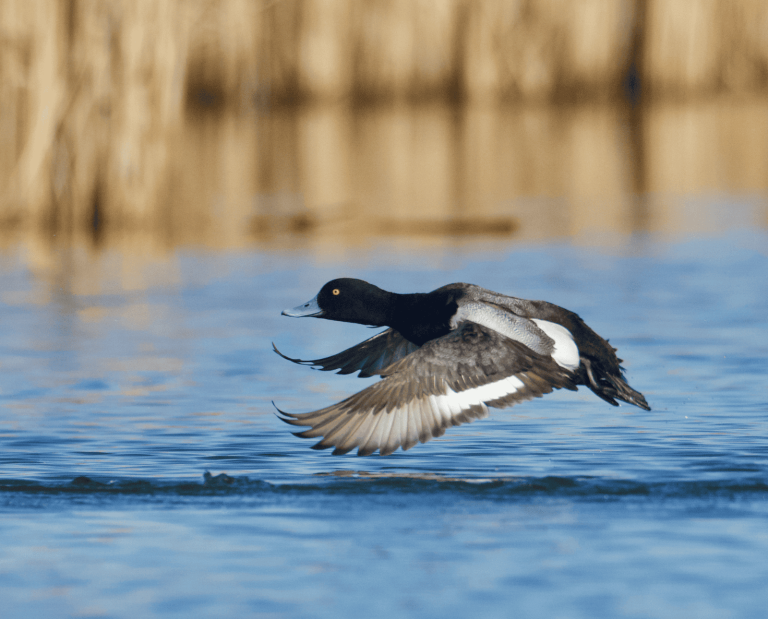
DWs are well-known in the German hunting community for being enthusiastic water dogs and retrievers. They are commonly used for flushing ducks and other waterfowl from heavily vegetated bodies of water and will wait patiently in duck blinds to retrieve. In addition, many European hares are shot in farmland and forest edges with a Wachtelhund in hot pursuit. The Wachtelhund is expected to retrieve any shot game and deliver to hand.
The Wachtelhund in North America: A Rare German Hunting Dog
For as uncommon as the breed is in its native Germany, it’s even less common in North America, where best estimates put the population at less than 200.
Most North American DW owners use their dogs to hunt and flush upland birds, retrieve waterfowl, and track wounded big game on leash. I have also heard stories of DW treeing bears and big cats like a hound or used as decoy dogs for coyotes and wolves. With proper exposure and understanding of the breed’s traits, these dogs can adapt to nearly any hunting situation.
I started my own search for a hunting dog shortly after my wife and I purchased our first home. Having grown up with two hunting Labrador Retrievers, I began by researching Lab breeders close to me. Unfortunately, I was having difficulties with understanding the different registries, hunt tests, and field trial scores that I found on these dogs’ pedigrees. Still, I knew that I wanted a high-caliber dog from proven lines.
While scrolling through a breeder’s website, I noticed a picture of an intriguing-looking dog. The dog was quite pretty and reminded me of paintings I had seen of setters and spaniels in my father’s old hunting magazines. I contacted the breeder for details. They were not planning on breeding any more Wachtelhund pups, but she told me that if I found one, I would be hard-pressed to find a better hunting companion. So instead of continuing my search for the perfect Labrador, she suggested I look into the Deutscher Wachtelhund North America (DWNA) club.
I liked the idea of a compact dog that could perform a multitude of hunting tasks. I was interested to learn that the breed did not use competitive field trials for breeding selection. Instead, the VDW requires all breeding dogs to pass a series of non-competitive tests and rigorous health checks to be certified for breeding. I decided that I would pursue this little-known breed.
As with many rare breeds, the process of finding a puppy was a long one, filled with research and lots of inquiries. I finally received news of a planned litter from a breeder located in Michigan, which was a long journey from my home in central Alberta. We arranged a phone interview and immediately hit it off with a great conversation about hunting and dogs. We agreed that a DW would suit me well, so I was placed on their litter waitlist. The journey wasn’t over, though, because the litter turned out to be a single pup and I knew it was unlikely I’d be lucky enough to get him. It was meant to be, though, and eventually we were on our way to pick up our little Quill.
Training and Hunting with a Wachtelhund
Quill and I immediately grew very close. This little red-and-white pup was everything I had dreamed of and consistently impressed me as he progressed through his early training. That first Autumn, Quill hijacked an elk hunting trip I had planned with a close friend. As I packed my clothes and gear, Quill lay directly in my suitcase.
“I think you better take the dog!” my wife advised.
Graciously, my friend agreed to take my new pup on our trip. After a few days of seeing nothing but old elk sign and many ruffed grouse, we decided to try our luck with the shotguns. We ended up with a couple limits of grouse that first day and big smiles from watching an excited Quill work the birds. After that day, we completely forgot about elk and happily hunted—and ate—grouse for the rest of our trip.
Quill and I continued to hunt grouse that season and often found success. We even managed to find a couple of rabbits on our adventures. He was exceptional at listening, hunting, and flushing, but he had a significant flaw: he was only interested in live game. He would investigate shot game but immediately abandon them, hoping to find more to flush. In other words, I was retrieving my own birds. I knew that I needed some help with properly training my hunting companion.
I was fortunate to come across the Alberta Chapter of NAVHDA. I reached out to these like-minded hunters and explained that while I did not own a pointing dog, I had similar training goals. Graciously, they agreed to work with Quill and me. The first few training events were eye-opening as we were exposed to experienced dogs and trainers. I was impressed by the level of polish and control these dogs had. Under the tutelage of seasoned trainers, Quill became a dog that was in control, happy, and reliably retrieved.
That next season, Quill and I discovered our true passion: pheasants. Wachtelhunds have an extremely strong prey drive which allows us to hunt in a unique way. Where most flushing dogs air-scent birds, Quill tracks the ground scent to pinpoint the prey’s location, occasionally lifting his head for air scent, before launching himself to flush the game.
Over time, Quill learned that the best way to capture his prey was to have me nearby with my shotgun. When Quill knew he was close to the game, he would pause and look for me—waiting for me to catch up if necessary—before he would flush the animal. We found success by hunting in this fashion and formed a close bond. We shot numerous pheasants that year. We also found success in jump-shooting waterfowl in the ponds around the pheasant habitat. Quill happily retrieved the animals I shot over him on both land and water.
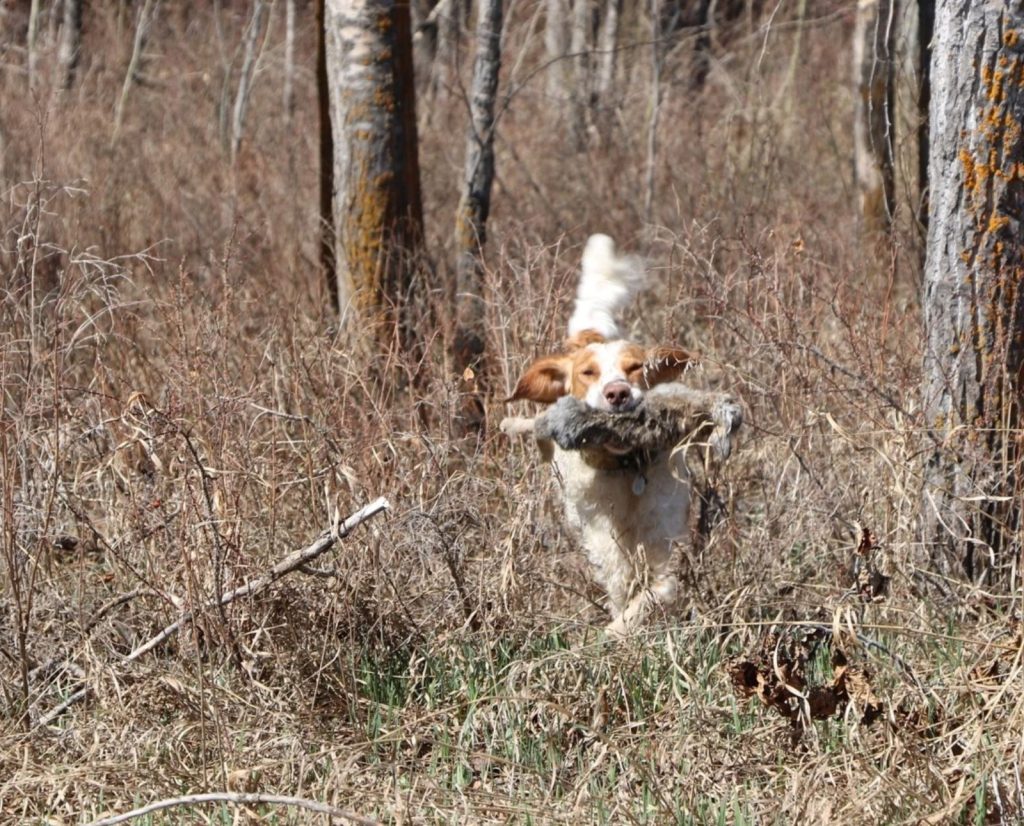
Experience taught us an effective way to hunt for rabbits and hares, too. I would send Quill searching before me in thick forest and into the islands of shrubs and bushes on the Alberta prairie. When Quill’s body language became animated and his pace slowed, I knew to prepare myself. Quill would sometimes produce a rabbit that was easily shot, but more often, they would sprint from unseen cover or prove unsafe to shoot. Quill would then pursue, excitedly barking as the rabbit ran around on its worn escape paths, all of its attention focused on the pursuing dog. I would remain in the area of the flush and stay focused. Quill’s barking let me know of his location; often the rabbit would return to the site it had been flushed from, giving me plenty of time to safely line up my shot. Quill was developing into a hunting companion to be proud of.
Wachtelhund Performance Testing and JGHV Evaluations
Being a flushing dog, Quill couldn’t run in tests such as NAVHDA which are meant for versatile pointing dogs. DW have their own performance tests, but with the incredibly small population, tests can be few and far between. In fact, no tests were planned for the year after Quill and I started hunting together.
Instead, I researched and prepared for whenever a testing opportunity might arrive. We had plenty of experience with tracking rabbits, flushing and retrieving game, and working effectively for the gun, but the independent search and on-lead blood tracking—two subjects the DW are most valued for—were foreign to me and the trainers I was working with. We fumbled through learning and training these subjects to the best of our ability and continued hunting at every opportunity.
Read: Comparing NAVHDA, JGHV, and AKC Hunting Dog Tests
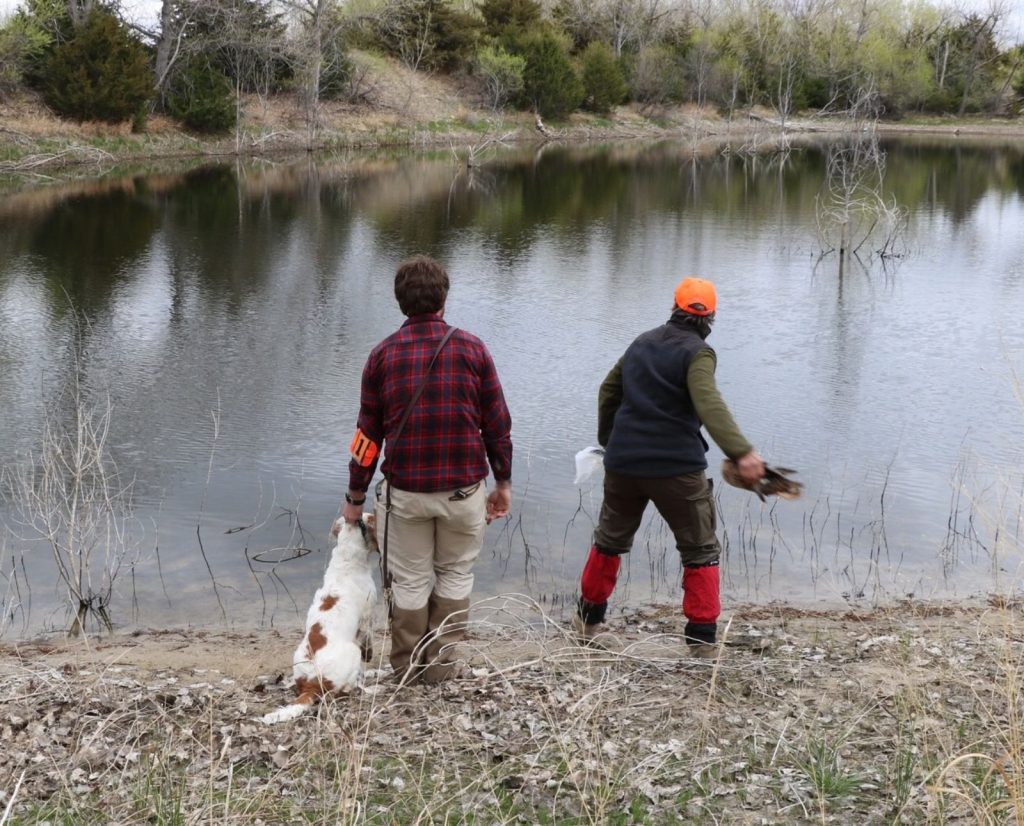
In 2016, we got an invitation to a DWNA test in southwest Nebraska. I was curious to see the other DWs as Quill was still the only one I had ever seen in person. Quill was too old to participate in the puppy test (JP), so instead we entered the Versatile Ability Test (EP), which would test his ability to track both rabbits and blood, retrieve furred and feathered game on land, and complete challenging blind retrieves over water. Quill was working great for the way we hunted, but I was intimidated by the scope of the test. Nevertheless, we began the 20-hour drive to the test site with an open mind and hopes of meeting fellow hunters and their dogs.
Upon arrival at a beautiful lakeside campsite, we were greeted by DWNA members, dogs, a VDW judge from Germany, and two Drahthaar judges. Before dinner even began, I had met kindred spirits in my fellow handlers. Introductions were made and we were briefed on the running order, locations, and expectations for the upcoming test. Quill and I excused ourselves shortly after dinner so we could attempt to sleep off our nerves in anticipation of the coming morning.
The first subject to be completed was the hare track. A line of volunteers walks through broad farm fields attempting to flush jackrabbits. Leashed dogs and handlers follow close behind. Once a rabbit is flushed, the judges note the point of the flush and the rabbit’s path. The dog then is released at the flush point and its work is observed by the judges. Dogs are judged on their willingness to progress on the track, persistence with which they continue the track through difficult conditions, and the distance and manner in which they bark on track. Each dog gets two opportunities to run the hare tracks.
I was amazed as I let Quill go on his first track. He worked quickly through the arid field in hot pursuit of the rabbit, his nose full of rabbit scent. After about 100 yards, he began to bark, then disappeared from sight in the large field.
My heart sank as I said, “I don’t think he is coming back!”
“Don’t worry,” a judge said as he slapped my back. “That was an amazing track, and besides, we planned for this. We have a member with a truck on the other side of the field to grab your dog.”
I was relieved but still uneasy until Quill was back at my side. Quill’s second track went much the same. Despite the arid conditions, all dogs had high scores on the track that day.
Next came the drags. A judge drags a dead pheasant for 150 meters through a field with a couple of turns along the way. The dog is shown the start of the drag, then released to follow the trail independently and return with the game, delivered to hand. Quill quickly and efficiently followed the trail and delivered the bird to me.
After that was a drag with a dead rabbit which is similar to the feathered game drag, but it is 300 meters in length and the last two-thirds must go through a wooded area. Again, I sent Quill on the drag and waited. Finally, after an eternity, we heard barking in the forest.
“Call him back and restart him,” I was instructed by one of the judges.
With a whistle, Quill returned. Our second attempt was the same. It was what I had feared; Quill found something more interesting. I called him back to my side for our last try to get the rabbit, but unfortunately, Quill was not interested in dead rabbits and did not complete the task.
We failed the test, but I was determined to complete the remaining subjects to gain experience and knowledge. As expected, Quill did well in the independent search of a forested area, searching thoroughly and happily until he was called back to my side. He proved to be gun-sound in the water and land but he refused to pick up a dead duck for his blind retrieve. It seemed our old retrieving habits had returned.
The last subject was the blood track. Early that morning, a judge had laid a 400-meter track through the forest using 250 mL of blood. The track must age for at least two hours before it is worked. While we waited, the weather turned, and heavy snowflakes began to fall. By the time we were meant to start tracking, the ground was blanketed in white. I approached the starting point and attached Quill’s blood tracking collar and long lead. He quickly darted back and forth, erratically wagging his tail and pulling me toward thick cover. We were called back to the start of the track by the judges.
“Think about this logically,” a judge told me. “This is meant to simulate the tracking of a wounded boar or deer. Think about where an animal like that would run, probably through the path of least resistance and not through the thick cover where rabbits are. Also, watch your dog; he will slow down and focus on the ground while tracking blood. His tail should be wagging in tight circles, not erratically thrashing. He was after rabbits. Take a deep breath and start again.”
We did. I was able to focus Quill on the correct path, and soon, with luck and guidance from the judges, we came to the placed deer hide, marking the end of the track. Quill and I gained valuable skills and knowledge.
That evening at the banquet, I was approached by the VDW judge from Germany.
“The dog did not fail today; you have failed him. You must try again,” he said. I knew this was not meant as an insult but as constructive criticism, so I took it the way it was intended, encouraging me to do better in the future. I vowed to return and pass the EP.
The following April, another test was held and we returned to complete all of the subjects and proudly passed with a “Prize 3.” Afterward, we were approached by a Drahthaar judge who had attended both tests. “You seem pretty serious about this testing business, and you have a great dog there,” he told me. “You know, a Wachtelhund has never completed the GP [utility test] test in North America. You could be the first.” The prospect of Quill and I being the first team to complete the GP was exciting, so I decided that we would work together toward this goal.
We trained daily. I studied everything I could and filled the gaps in our knowledge with phone conversations, text threads, emails, and a couple of weekend trips to train with experienced JGHV handlers and judges. The more time we spent training, the happier we both became.
We were confident and excited as the test approached, knowing we were well-prepared this time. At the test, Quill impressed the judges by attacking every task with a wagging tail. He could switch from a furious, independent hunting machine to a happily obedient stalking partner. We overcame challenges; Quill got covered in hundreds of sand burrs during his rabbit drag and had distractions during his blood tracking, but we succeeded in every event. I was beaming with pride as the scores were read aloud; we had done it.
The Future of the Wachtelhund in North America
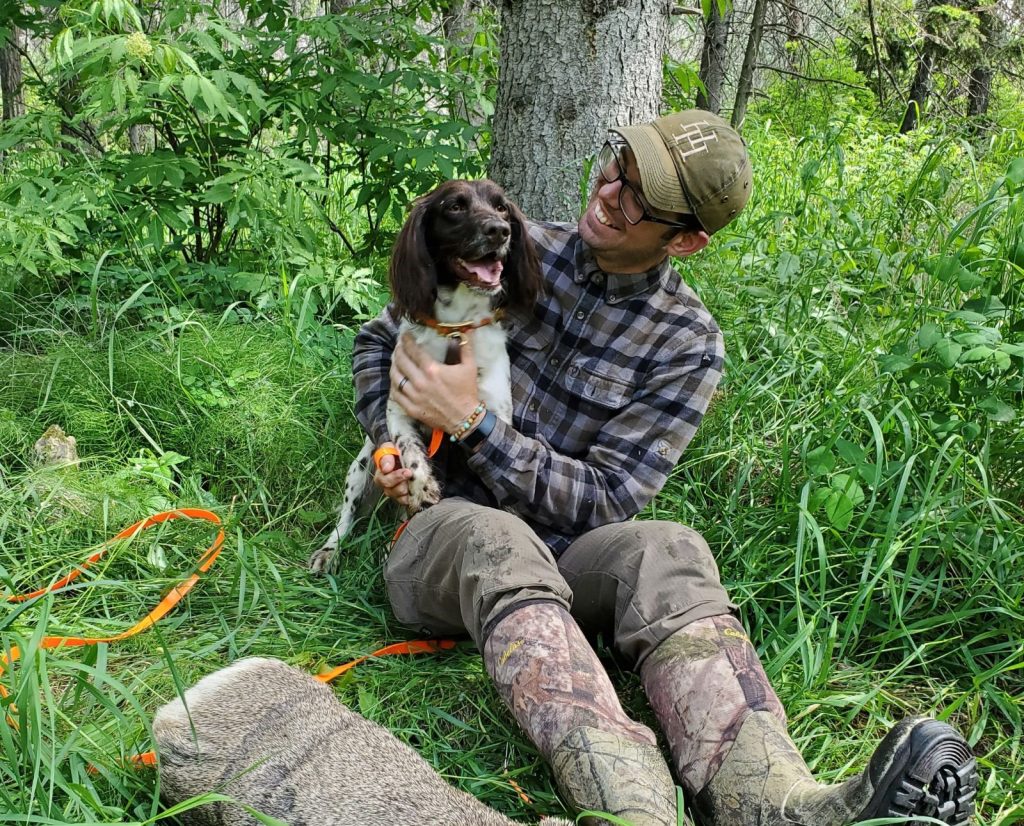
Through my experience with Quill and the other Wachtelhunds, I developed an incredible love for the breed. I became so passionate about the German testing system that I wanted to continue my journey even further, so I began my apprenticeship to become the first certified VDW judge in North America. I hope that more DW hunters follow in my footsteps, complete testing with their DWs, and continue the German tradition in North America.
The Wachtelhund is a fantastic hunting companion but requires an understanding handler. DWs are traditionally hunted in a manner that is unfamiliar to most North Americans, which means they are virtually unknown outside of Europe. However, DWs can perform in nearly any hunting situation with enough patience, understanding, and persistence from their handler. I believe if more people were exposed to this versatile breed, they could gain a strong following within the North American hunting community, especially when it comes to tracking, waterfowl, and hogs.
Wachtelhund Temperament and Hunting Ability
With the rise in popularity and legalization of blood tracking in many states, the Wachtelhund would be an excellent choice as a tracking dog. At home in Germany, Wachtelhunds complete advanced blood tracking tests and recover hundreds of wounded game animals annually. In addition, they are brave and have incredible focus—qualities that any serious deer tracker looks for.
I have never encountered a Wachtelhund that did not have an intense prey drive and natural love for the water. With proper exposure and training, they make very reliable retrievers. They are compact in size and have a coat that insulates well in cold conditions. They are a dog that any waterfowler would be impressed with.
And finally, with the increasing feral hog populations in North America, I think it is only a matter of time before hunters begin utilizing Wachtelhunds in this way. Wachtelhunds are very popular in Germany among wild boar hunters and could quickly adapt to North American hunters that are focused on eradicating problem hogs.
Although I have had great success with hunting pheasants and other upland game with Quill, I don’t see them catching on as upland bird dogs. They require a different approach to upland birds and, with many “specialist” breeds available, may frustrate an upland-focused hunter with their fur and big game drive.
At home, DWs are affectionate and well-behaved, as long as they have sufficient daily exercise and are trained to maintain control. In my experience, they do best when living in the house with their owners and are not well-suited to kenneling. DWs typically do well with children and other pets when properly introduced, keeping in mind that Wachtelhunds are very athletic with a high prey drive. They must be owned by hunters and allowed to pursue game.
Looking back on what Quill has given us, as a hunting dog and companion, we hope more people in North America discover this versatile breed. For more information on the Deutscher Wachtelhund in North America, please contact the Deutscher Wachtelhund North America club.

I am a Wachtelhund owner that cannot say enough great things about this breed. My first Wachtelhund was a female that was amazing on upland birds. She never gave up on a retrieve after the shot was fired. Woodcock in the thick swampy woods of U.P. Michigan were always retrieved with joy. The biggest challenge with her was her game drive that resulted in three porcupine encounters that required quill plucking but never stopped the hunt. Unfortunately we had to put her down last year because of health challenges but I now have a 2.5 year old male hell tiger(which looks exactly the same as the dog in the last picture) that is showing great promise to pick up the torch.