

Islands in the Sky: The Last Holdouts of Southwestern Dusky Grouse
Catastrophic wildfire and increasingly warm, dry climates may eliminate dusky grouse in the southern Rockies by 2060
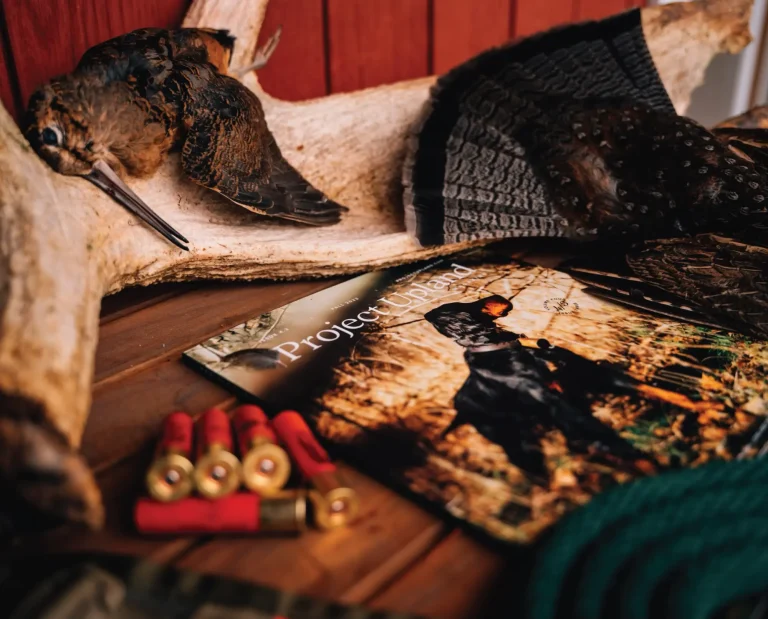
This article originally appeared in the summer 2023 issue of Project Upland Magazine
In the mountains rising over southwestern New Mexico, Jennifer Frey (no relation to the author) has a cabin. Poised on the edge of the Gila Wilderness—the first wilderness area established in the country—it was built during the Great Depression by the “boys” of the Civilian Conservation Corps. They lived there while their crews were stationed in the Gila National Forest building ranger stations, carving out campgrounds, cutting roads, and raising fire towers to watch for plumes of smoke rising from the forest.
The cabin’s name is “Grouse,” which always seemed curious to Frey. She had never seen a grouse anywhere nearby. A professor in the Department of Fish, Wildlife and Conservation Ecology at New Mexico State University and the curator of the school’s Fish and Wildlife Museum, she would know a grouse when she saw one.
The dusky grouse in this region can be cryptic, but elsewhere in the Rockies, they’re pretty common. They occupy pine and fir forests and rugged mountaintops along the Rocky Mountains’ spine into northern Canada. However, they’re scarcer in the southwest at the southern edge of their range. Most grouse populations in New Mexico cluster together in the mountainous northern edge of the state. Still, some cling to the higher altitudes of the Gila National Forest to the south, scattered among the so-called “sky islands” that rise thousands of feet above the desert southwest.
Modeling Historical Dusky Grouse Habitat
Frey’s specialty is the intersection of biology and geography and what it means for rare and imperiled species. She devoted much of her recent research to creating spatial models to guide conservation efforts. Usually, she focuses on mammals, but the dusky grouse seemed like an ideal research subject, and she had a potential researcher in mind. Joe Youtz was one of her undergraduate students, an aspiring biologist, and a self-described “NBA nerd” from Baton Rouge, Louisiana, who fills his Twitter feed with a mix of basketball fandom and science news. Youtz worked for Frey maintaining the museum’s collection of bird specimens.
“I wanted to do what every wildlife student wants to do: work with big predators,” he said. “I quickly learned that working with birds was incredible.”
Frey challenged Youtz to explore the history of a bird that, since it doesn’t fly much, acts in some ways more like a mammal. She tasked Youtz with combing online museum archives for records of grouse in New Mexico going back over 100 years. At first, the idea was simple. Combining historical records with modern computer modeling, they hoped to paint a picture of where dusky grouse would likely occur. This knowledge could help state biologists manage this game bird, whose presence in New Mexico is poorly understood.
But the project grew. Soon, Youtz’s research was also looking at where the bird was spotted in Arizona. Then, it jumped from the past into the future when they used a form of artificial intelligence known as machine learning to turn their data toward predicting how climate change might affect the dusky grouse in these high-altitude southwestern redoubts. Before they could publish their findings, the future became the present. The largest wildfire in New Mexico’s history ignited northeast of Santa Fe and swept across dusky grouse habitat, raising questions about how long the species would remain in New Mexico.
Climate Change and Wildfire Threaten Dusky Grouse Habitat
“The prevailing wisdom has been that fire is beneficial for dusky grouse,” said Frey. Wildfires can open up forest canopies, allow sunlight to reach the ground, and nurture grasses and forbs. In theory, this provides ideal areas for the birds to nest and hide from predators. “That may be true elsewhere in their range,” Frey said, “but the situation in the American Southwest is quite a bit different.” There, dusky grouse survive in isolated pockets of high-altitude habitat, and losing these pockets could be devastating.
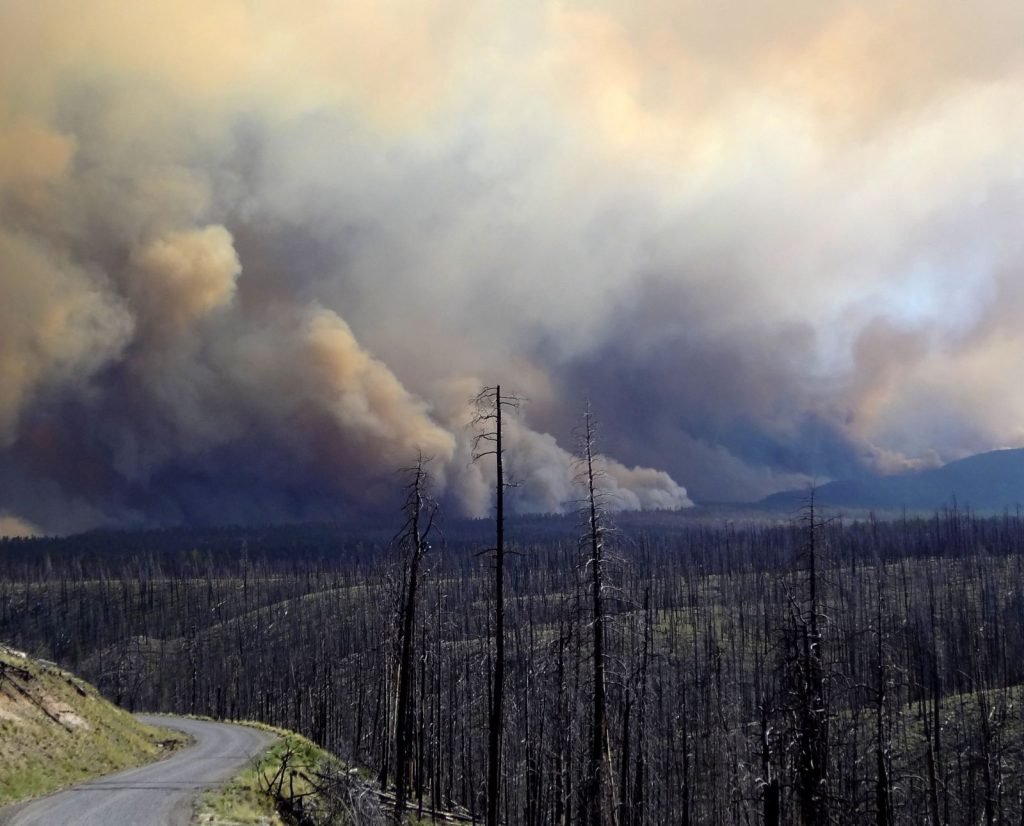
“These were stand-replacing fires that occurred right in these high-elevation areas that are important for grouse,” Frey said. “There are few patches of habitat left, and they are now isolated by seas of burned forests.”
When she and Youtz looked at their predictions, they found that the dusky grouse’s days in the southwest were numbered. By 2060, warming temperatures would virtually eliminate its remaining habitats in the region even if greenhouse gasses were curbed. On top of the changes in temperature, rainfall, and vegetation that come with climate change, they found that the risk of catastrophic wildfire would hasten the bird’s demise. When the Calf Canyon/Hermits Peak Fire burned across the landscape last year while their paper was awaiting publication, it underscored how imminent their findings may be. Much of the bird’s remaining habitats would soon be burned, and the blaze probably killed many dusky grouse.
“We see this as a serious situation for the dusky grouse,” Frey said. “They are suddenly losing habitat at a rapid rate.”
The Split: From Blue Grouse to Dusky Grouse
In a way, there were no dusky grouse in New Mexico or anywhere else until nearly two decades ago. When Youtz searched for grouse records, it was the blue grouse he was looking for. That was the name for dusky grouse and their Pacific Coast cousins, the sooty grouse, until 2006. Although biologists had their suspicions, the two were considered a single species for over a century. Biologists split them apart due to distinct genetics and specific differences in their plumages, displays, and vocalizations.
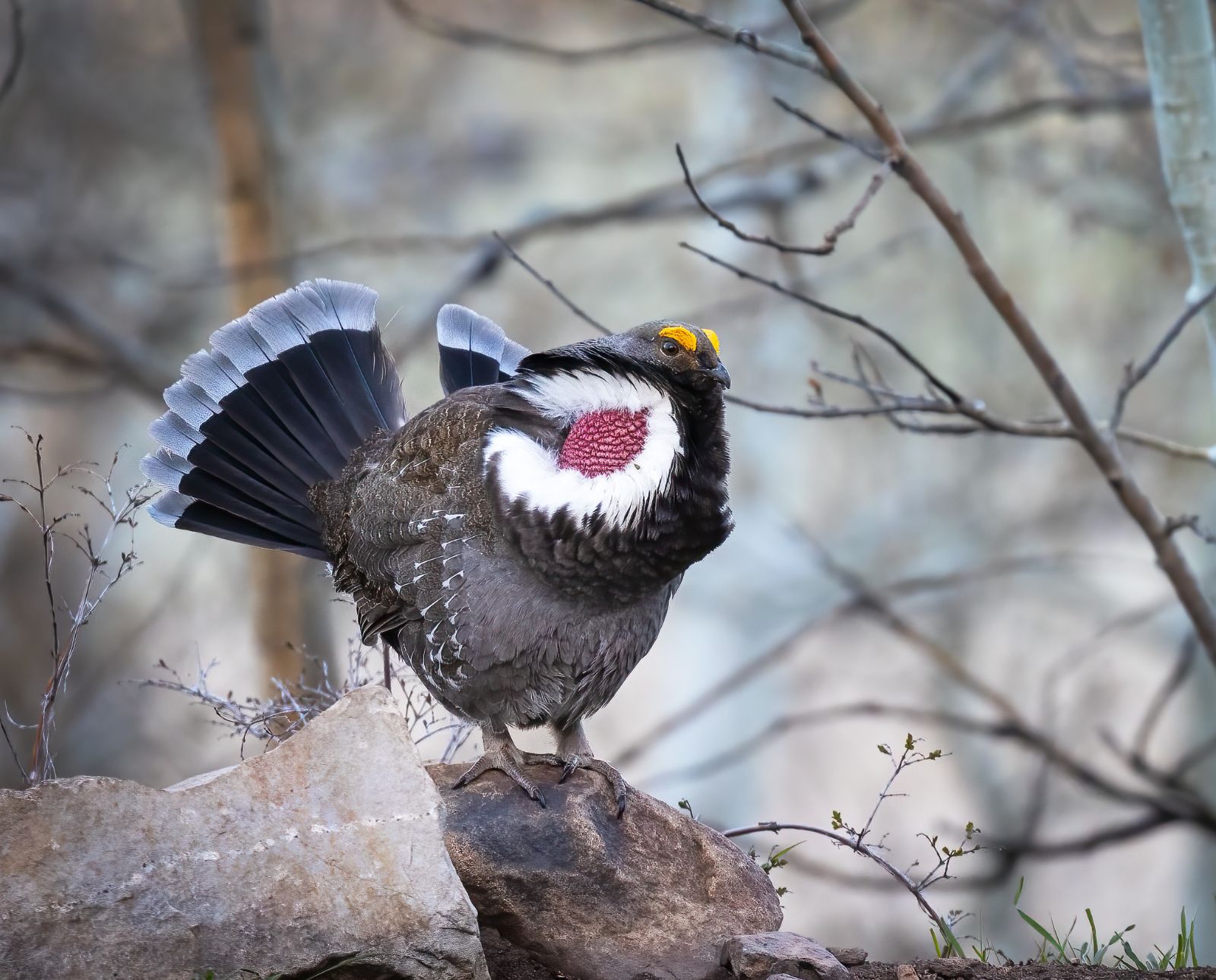
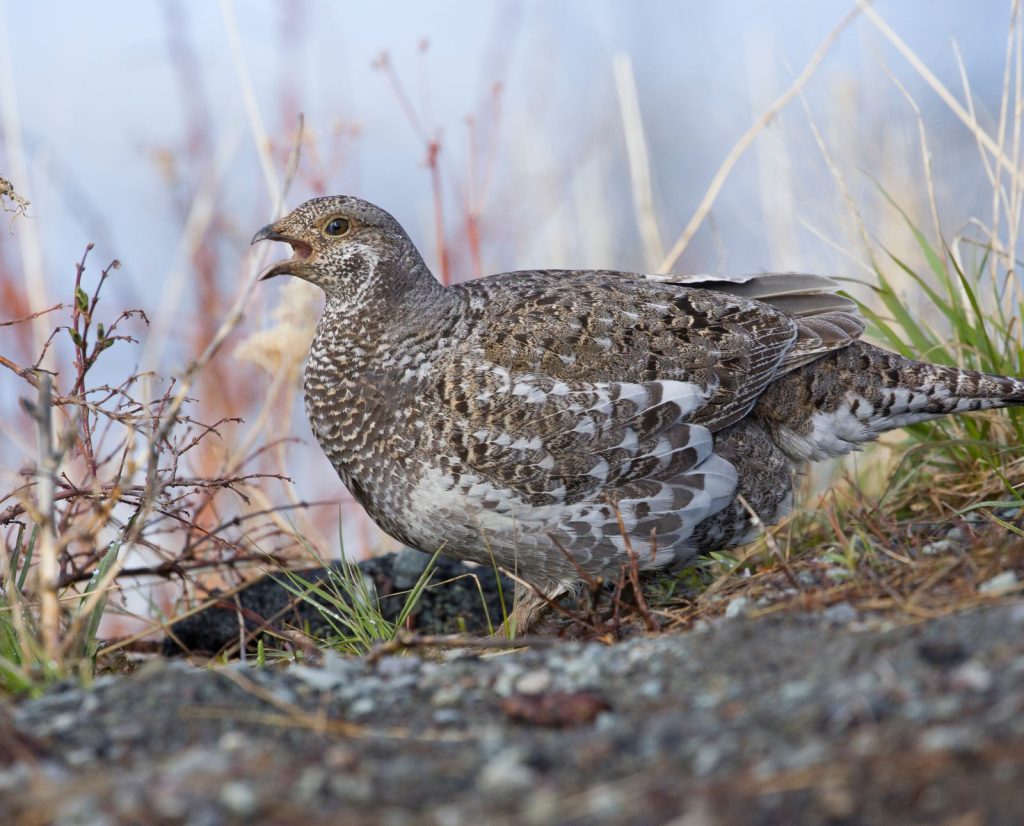
Duskies are the third largest grouse in North America, behind the greater sage-grouse and Gunnison sage-grouse. Females are a ruddy brown, which helps them vanish into the understory of conifer forests. Males are grayish blue with flamboyant orange eye combs and air sacs on their necks, which they display during mating. The birds are particularly reliant on conifer forests. Each year, they engage in a sort of reverse migration, heading up into the high country in the winter to forage for conifer needles and descending to meadows to nest in dense, grassy vegetation in the spring.
Predicting Future Dusky Grouse Habitat—Or the Lack Thereof
The dusky grouse has been a popular game bird throughout its range, although spotting them in New Mexico isn’t easy. Combining museum records dating back to the 1800s with modern camera trap images, citizen reports on the birding app eBird, and observations from US Forest Service employees, Youtz stitched together 747 records of grouse at 430 unique locations in New Mexico and Arizona.
To fill out their model, they overlaid these locations with what they knew about the topography, vegetation, and, most importantly, climate. The model did a good job of showing where the grouse had been and where they likely disappeared over the past hundred years. But it was the next hundred years they began to wonder about. “We wanted to take this a step forward to fill out the potential impacts of climate change on grouse in the region,” Frey said.
They applied two different greenhouse gas emission standards. One model expected to raise temperatures by three degrees Celsius by 2100, and the other expected to increase by five degrees. Neither model had good news for grouse populations in the southwest. Even in the moderate scenario, almost all the high-quality grouse habitat was projected to be gone by 2100. In the southernmost edge of their range, important pockets would disappear by 2060. Higher emissions would eliminate the bird from the region even sooner. And, they concluded, it’s probably too late to stop it.
“Even if we tried to curb climate change now, the grouse would experience those climate effects,” Youtz said.
Those models didn’t consider the increasing likelihood of catastrophic wildfire, though. Throughout the region, some four percent of dusky grouse winter habitat had already experienced moderate to severe wildfires since 2000. In southwestern New Mexico, about 70 percent of its habitat was believed to be gone due to fire. Two massive wildfires burned through core dusky grouse habitat in recent years. In 2011, Arizona’s Wallow Fire became the state’s largest fire ever. The Whitewater-Baldy Fire burned through New Mexico the following year, becoming that state’s biggest fire at the time. For the researchers, this suggested that fire could eliminate the dusky grouse from the southwest even faster than their standard climate change models predicted.
Habitat loss to wildfire in the southernmost portion of the grouse’s range is “likely to continue with future climate change and provides an example of what may happen in the future to more northerly populations,” Frey and Youtz wrote in the paper they would soon publish in the journal Avian Conservation & Ecology. Then, their predictions came true.
Wildfire and the Loss of High-Elevation Forests
On April 6, 2022, a Santa Fe National Forest crew was conducting a prescribed burn when afternoon winds sprayed cinders into the surrounding landscape. This ignited spot fires in the tinder-dry forest. The southwest was in the midst of a “megadrought” that began around 2000. The spring of 2022 was one of New Mexico’s warmest and driest yet, and the blaze raged out of control. Dubbing it the Hermits Peak Fire for a nearby mountain, crews spent two weeks trying to rein it in. They nearly had it contained when another fire ignited nearby on April 19, which was caused by leftover burn piles from an earlier prescribed burn.
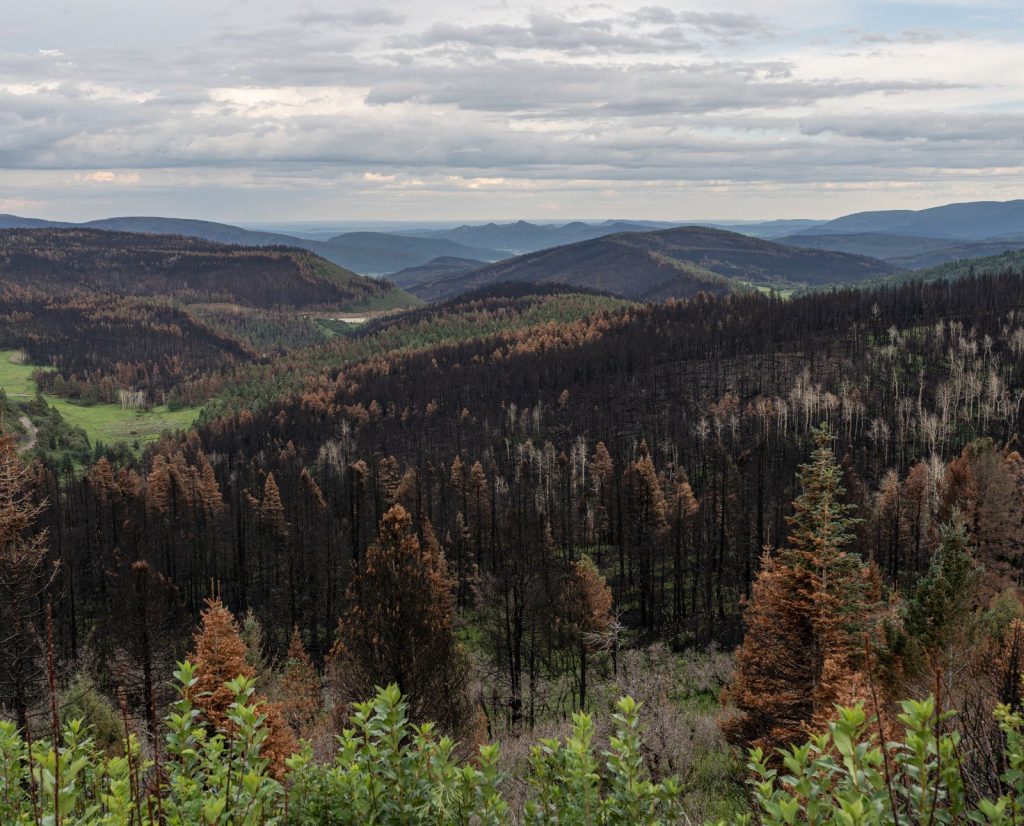
On April 22—Earth Day—high winds caused both fires to race together into a single conflagration. Over the following weeks, explosive conditions sent the blaze racing, burning as much as 10,000 acres a day. The columns of fire-fueled clouds towered tens of thousands of feet into the air. By August 21, when firefighters declared it contained, the fire had torched 341,735 acres, overtaking the Whitewater-Baldy Fire to become the state’s largest. Like the catastrophic fires that occurred a decade earlier, it scorched critical dusky grouse habitat.
“It shows that these fires are outpacing our predicted habitat loss due to climate change,” Frey said. “To me, it’s just like an eraser. It’s erasing all the mixed conifer forests from these mountains. We’re losing it. There’s mounting evidence that many of these forests aren’t going to succeed back into conifer forests.”
Changing Southwestern Forests Outpace the Grouse’s Adaptability
In some ways, the alpine forests of the southwest are different landscapes than the ones the Civilian Conservation Corps knew. And the Gila National Forest is a different place now than it was a century ago when Aldo Leopold convinced the US Forest Service to protect part of it as “a continuous stretch of country preserved in its natural state” 60 years before Congress signed the Wilderness Act.
“The richest values of wilderness lie not in the days of Daniel Boone, nor even in the present, but rather in the future,” Leopold wrote. Perhaps he was too optimistic. Climate change brought hotter, drier conditions even to the high forests where cool-seeking species like dusky grouse find refuge.
Frey speculated as to how Aldo Leopold might feel if he could witness the Gila National Forest today:
I think Aldo Leopold would probably be devastated by what he sees today. There’s a stark difference, and it would be profoundly sad. If you stand on any high spot in the whole area, all you see are burned trees, except for at the lower elevations. The upper elevations are basically gone in terms of forests. They’re black sticks. The old-growth forest is mostly gone in the non-wilderness portion of the lower elevations because of logging.
In New Mexico, temperatures have risen more than two degrees Fahrenheit since the beginning of the 20th century, according to the National Oceanic and Atmospheric Administration. The state is seeing more extremely hot days and unusually warm nights. These trends are expected to increase over the coming decades. The past ten years have been their warmest on record. Droughts are expected to become more commonplace. A drought from 2011 to 2014 was the second worst on record, and state water levels remain low even after years of near-normal precipitation.
Explosive wildfires are expected to continue to be a part of New Mexico summers. The five largest fires in New Mexico have all taken place since 2011. Arizona’s five largest blazes have taken place since 2002.
“It does not look good for the dusky grouse,” Frey said.
To Save New Mexico’s Grouse, We Must Act Now
As the species disappears from the southwest, Frey worries researchers don’t know what they are losing. The species is not well understood in the region. Isolated on sky islands, the dusky grouse at the southern edge of their range could be genetically distinct from those anywhere else in the Rockies. “We really need to have a better genetic study done soon so people are aware that we may be losing something that’s completely unique.”
In the meantime, the dusky grouse continues to persist in unburnt patches of habitat in the mountains of the southwest. In the spring, their low hoots can still be heard in the high country as males strut back and forth along open landscapes with their tails fanned, air sacs undulating, and eye combs exposed in search of a mate to extend their populations one more generation.
“There’s still hope,” Youtz said. “It’s pragmatic hope, but I think there is hope for the grouse. But if we want to do something to maintain this emblematic bird, we really need to do something soon, or we’ll lose this opportunity altogether.”