

Dusky Grouse vs. Sooty Grouse: Telling the Difference Between the Two Species of “Blue Grouse”
A guide to the history, range, and field marks that separate these two nearly identical Western game birds.
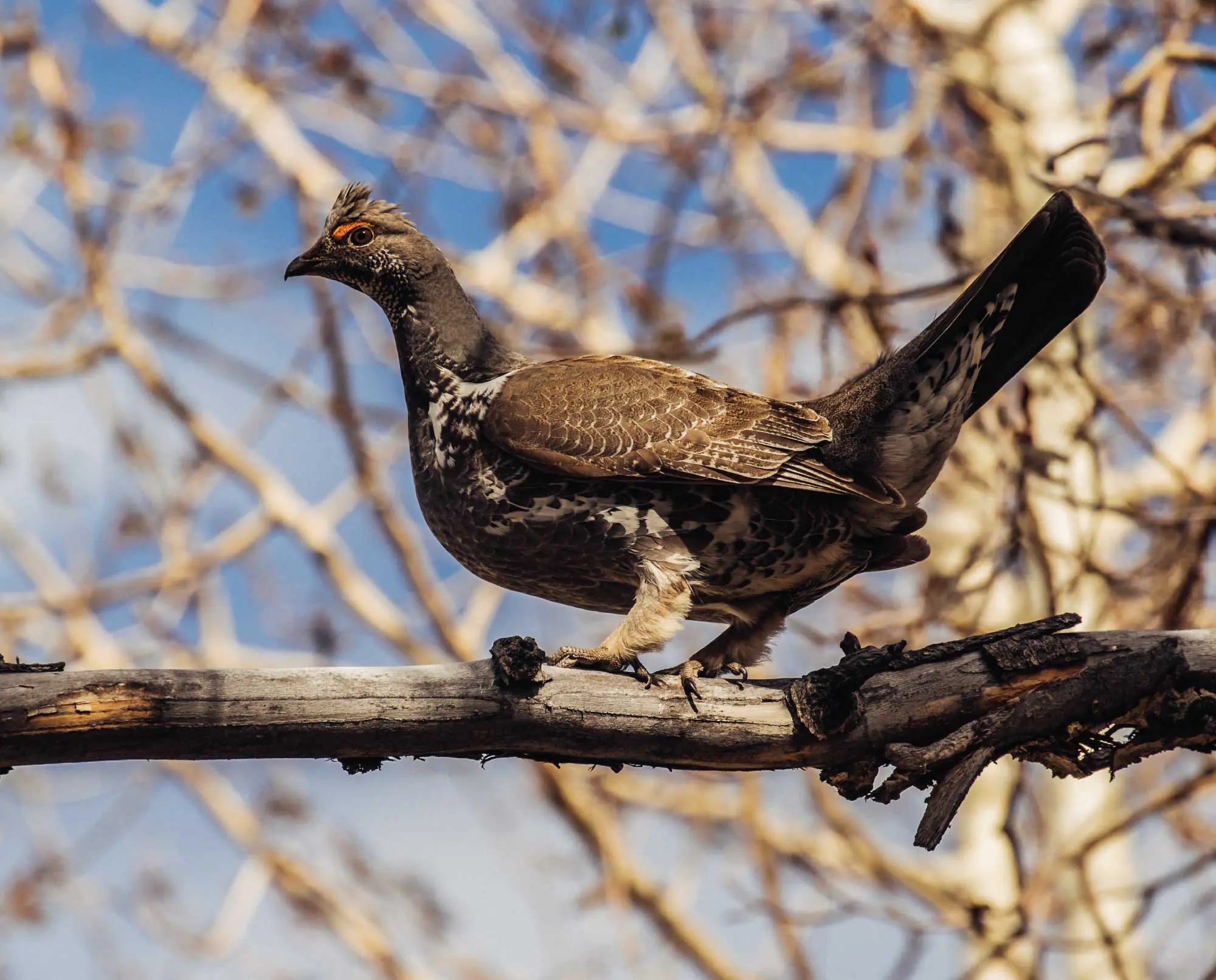
The sooty grouse and the dusky grouse are two similar, but distinct species of forest-dwelling birds primarily found in Western North America. The species are so similar, in fact, that distinguishing between them has been a point of contention throughout history. For a time, they were both simply considered “blue grouse.”
Here’s the story of how the two iconic game birds became distinct species—and how to tell them apart. If you just want a shortcut about the physical and geographical differences between dusky and sooty grouse, here it is:
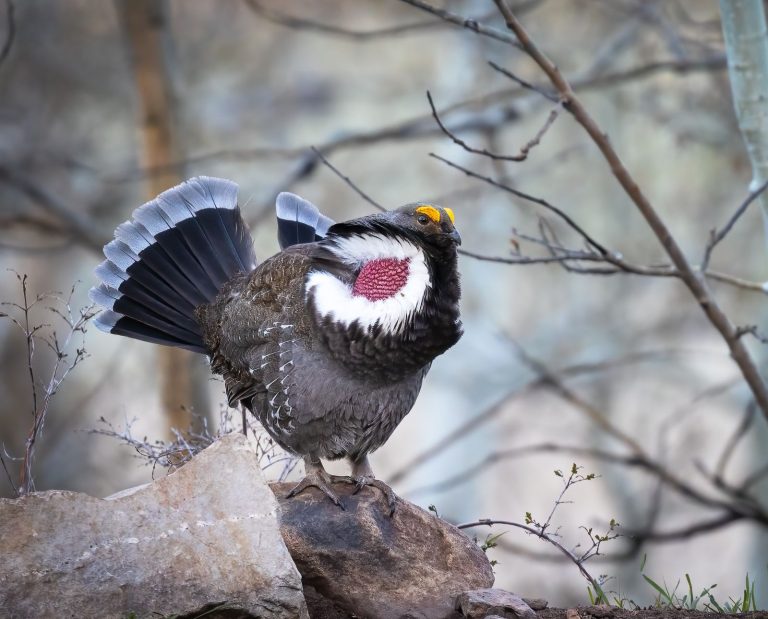
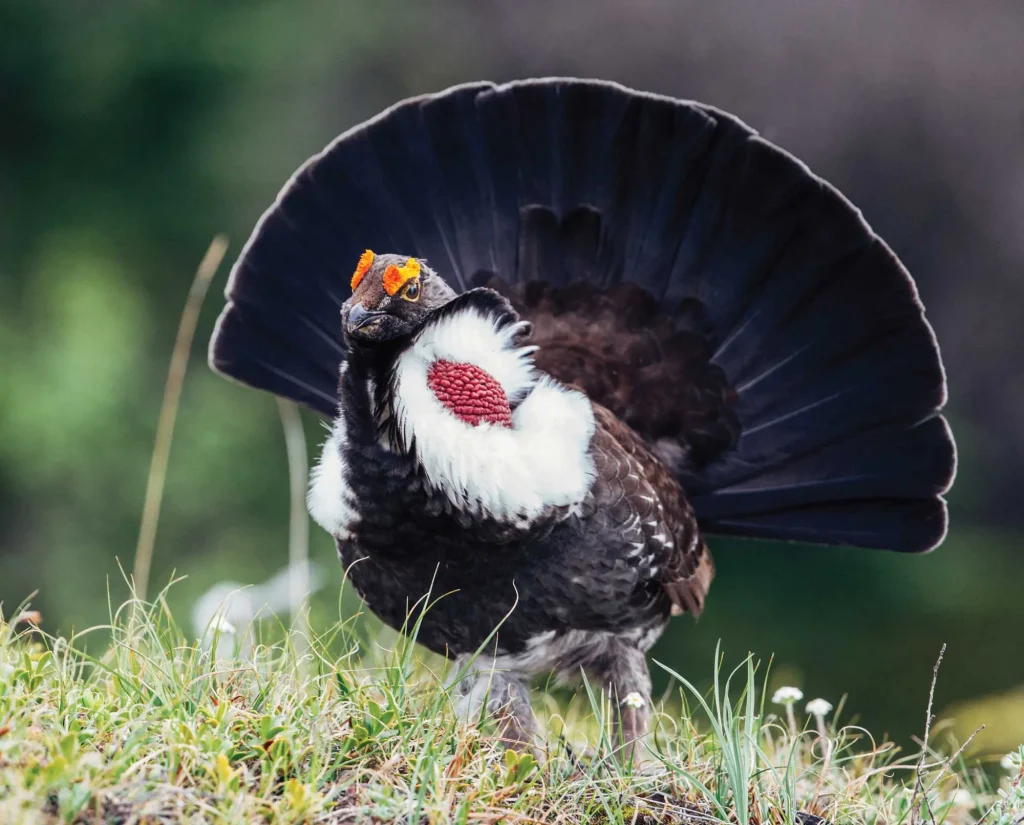
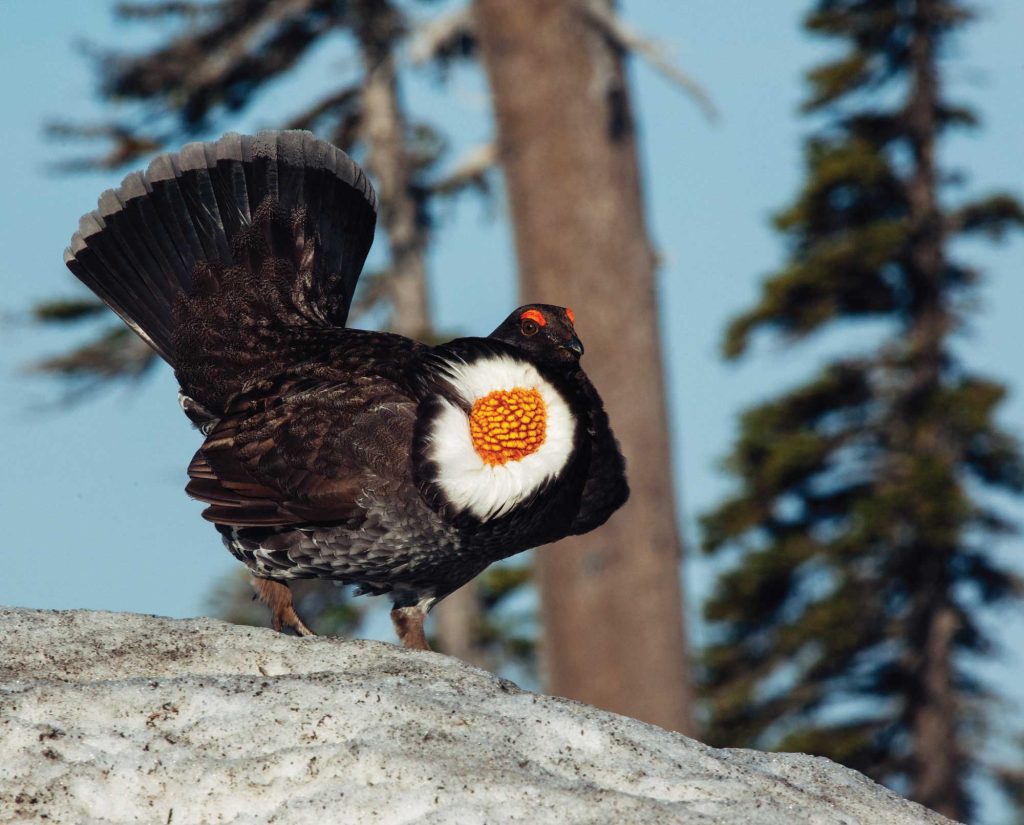
- Dusky and sooty grouse have different colored apteria. Male dusky grouse have red air sacs, or apteria, on their throats and yellow eye combs that turn red during the breeding season. Male sooty grouse have yellow apteria and yellow eye combs.
- They have subtle differences in their tails. Male dusky grouse have a solid black tail fan that sometimes has a gray band along the edge. Sooty grouse have a grayish-black tail with a gray band on the edge.
- Dusky grouse and sooty grouse have two distinct ranges that only slightly overlap. Dusky grouse live in the interior Rocky Mountains from the Yukon down to New Mexico. Sooty grouse live in more coastal forests from southeastern Alaska and western British Columbia to California.
Identification Comparison for the “Blue Grouse” Species
Beside DNA research—which played a significant role in reclassifying blue grouse into two species—it is possibly but difficult to distinguish between dusky grouse and sooty grouse. The table below, which uses biological information provided by the Washington Department of Fish & Wildlife (WDFW), lists the identifying characteristics for each species in order of usefulness in the field.
| Trait/Identifier | Dusky Grouse | Sooty Grouse |
| Color of neck/throat air sacs (called apteria) | Red | Yellow |
| Male tail fan color | Solid black, though occasionally with light gray band | Grayish-black with light gray band |
| Overall body appearance | Brown and light gray feathers | Darker gray, brown, and black feathers |
| Typical display location | On the ground | Tree canopies |
| Volume of display hooting | Heard within 100 meters | Heard within 2 kilometers |
| Typical number of tail feathers | 20 | 18 |
For example, the top row is one of the most important identifiers from afar, though it can only be used if a male is displaying during mating season, while the bottom row would be impractical to check until you were holding the bird in your hand after you’ve shot it. Some of these characteristics are physical features, while others are situational, such as displaying location and volume of hooting. If you want to be relatively sure of your identification, try to match up as many of these as you can.
As you can see, the characteristics distinguishing the two species are not particularly obvious, and it’s easy for the causal onlooker to confuse the two. The photographs in this article clearly demonstrate some of the most apparent visual differences between male birds during mating season. The first bird is a dusky grouse and has a red throat sack and all-black tail feathers; the second bird, a sooty grouse, has a yellowish-orange throat sack and gray-tipped tail feathers.
Where Do Dusky and Sooty Grouse Live?
Sooty and dusky grouse occupy distinct ranges. The dusky grouse mostly occurs on the drier, interior (eastern) sides of our western mountain ranges. It is found throughout the western United States and Canada, primarily occupying Colorado, Wyoming, Idaho, Montana, Utah, Oregon, and Washington, as well as most of British Columbia, Alberta, and the Yukon Territory of Canada.
Meanwhile, the sooty grouse usually occurs on the moist, coastal (western) side of our western mountain ranges and coastline. Its range follows the Pacific Ocean coastline from California to Alaska, though some populations also extend through the Sierra Nevada Mountains. They primarily occupy California, Nevada, Oregon, Washington, and Alaska, as well as most of coastal British Columbia, Canada.
In places where their ranges overlap, it’s important to consider biological differences to distinguish between dusky grouse and sooty grouse.
The Historical Context of Dusky and Sooty Grouse
According to a 2003 study published in the journal Northwestern Naturalist, Lewis and Clark were the first white settlers to identify dusky grouse (Dendragapus obscurus) and the sooty grouse (Dendragapus fuliginosus) during their expedition in the 1800s. The authors of that study say that, though many references to grouse and other gamebirds in the explorers’ logbooks were too ambiguous to determine certain species, they did write the first descriptions of blue grouse.
It’s not entirely clear if the early explorers differentiated between dusky and sooty grouse. In his first description of blue grouse, Lewis simply described encountering one near what is current-day Helena, Montana: “I also saw two fesants today of a dark brown colour much larger than the phesant of the U’States.”
Lewis later expanded on his description: “I saw a flock of the black or dark brown phesants…the male has not the tufts of long black feathers on the sides of the neck which are so conspicuous in those of the Atlantic. their colour is a uniform dark brown with a small mixture of yellow or yelloish brown specks on some of the feathers particularly those of the tail, tho’ the extremeties of these are perfectly black for about one inch.”
During the early 1900s, scientists differentiated between dusky and sooty grouse, but by the mid 1990s, naturalists simply described to the birds as “blue grouse.” It wasn’t until 2006 that the American Ornithologists Union took a closer look at the forest birds and again divided them into two distinct species based on genetic, morphological, and behavioral evidence. Researchers announced these findings in that year’s publication of The Auk, which is currently known as the journal Ornithology.
Why the back and forth? At a quick glance, it’s easy to see why the blue grouse remained a single species for so long. The males can look essentially the same with only minor physical differences, while the females look nearly identical. They occupy many of the same types of forested mountain habitats, especially along the transition area between the currently accepted ranges. And they are also suspected to interbreed where their ranges overlap, further complicating identification.
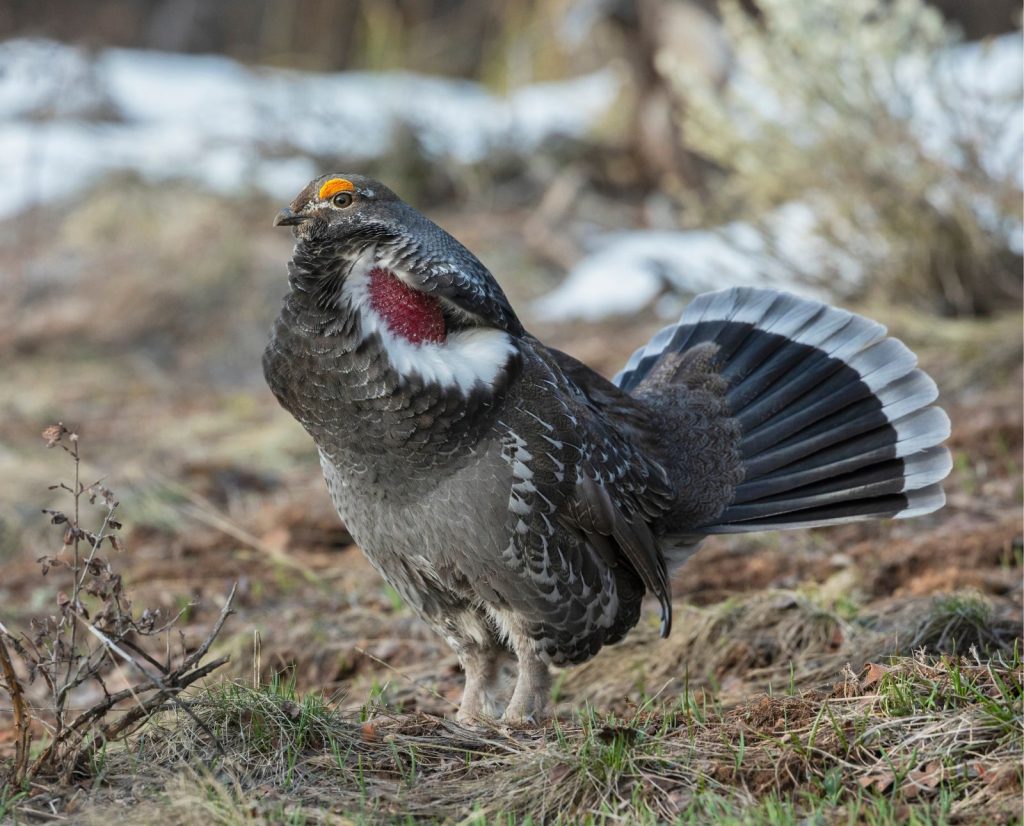
Dusky vs. Sooty Grouse Identification Isn’t Always Clear
Depending on which part of their range you are in, the birds’ feathers may be slightly different colored, and the identification features above might be less helpful. For example, in parts of southeast Alaska (where their ranges overlap), sooty grouse have been observed with red throat sacs instead of yellow ones. Additionally, according to a 2004 study led by George F. Barrowclough published in the journal Molecular Ecology, some dusky grouse in Colorado and New Mexico have banded gray tails instead of black ones. This phenotype variation is suspected to stem from the geological isolation of those dusky grouse. Other recent research, including a 2009 study by WDFG Upland Bird Research Scientists Michael Schroeder, shows that the variation of genetics and how birds actually look with these species is pretty large. That means that even within each species, there is a lot of variation in appearance.
Thankfully, most states do not differentiate between dusky and sooty grouse when it comes to hunting regulations. Hunters do not have to identify whether they’re shooting a dusky or a sooty grouse before pulling the trigger. As a result, identification is more a matter of curiosity than necessity for the average upland hunter.