

Launch of the Project Upland Foundation
Our mission is to invest in rigorous scientific research that generates practical solutions, measurable results, and lasting benefits for game birds and the landscapes they occupy.
Project Upland announces the launch of the Project Upland Foundation to help invest in underfunded scientific research, while rekindling the connection between hunters and the science that supports effective gamebird conservation and wildlife management.
*This first appeared in the opening letter titled “A Vision for Science-Led Gamebird Conservation” by Jennifer Wapenski and A.J. DeRosa in the Spring 2026 issue of Project Upland Magazine.
Project Upland was built with a commitment to leave the uplands better than we found them. That core idea leads to a foundational principle of wildlife conservation in North America: science-based management. Unfortunately, that term has become emptier over time, diluting into a buzzword as support for the “science” part of the equation dwindles.
Similarly, hunting culture has moved away from the vision of hunters who lived by bold principles for the greater good of our wild spaces. Instead, it has shifted toward the sensationalism that dominates the media today. We live in a day and age when science is often considered political rather than a “candle in the dark.” Without a shared belief in the power of science, funding for wildlife conservation dries up and money is directed elsewhere.
To realize this mission, we are proud to announce the launch of the Project Upland Foundation. This nonprofit organization is dedicated to investing in scientific research focused on practical solutions, measurable results, and lasting benefits for game birds and the landscapes they occupy. Like any new beginning, our first steps are small, but our vision is vast. We imagine a world in which resources are readily available for natural resource scientists pursuing knowledge and the practical application of data. Further still, we see a world in which hunters are at the leading edge of the push for well-funded science to support conservation efforts and inform public policy.
Part of this vision is to connect hunters to the researchers who are deeply involved in the science behind our beloved game birds and their habitat. That means a return to the basics: understanding the scientific method, the need for rigorous peer review, and the foundational belief system that constantly tries to prove itself wrong. As Carl Sagan put it, “One of the reasons for the success of science is that it has a built-in error-correcting machinery at its very heart.” We cannot say that about other institutions. Sagan expanded on this idea by writing in The Demon-Haunted World, “In science it often happens that scientists say, ‘You know that’s a really good argument; my position is mistaken,’ and then they actually change their minds and you never hear from that old view again.”
The history of hunting in North America is a story of intersecting interests and a willingness to drive change. Writers, artists, scientists, professors, and even politicians carried us from market hunting to landmark conservation policy such as the National Refuge System, National Monuments, National Forests, the Pittman–Robertson Act, and the Sport Fish Restoration Act, to name just a few. Many were hunters who saw catastrophe, sounded alarm bells, and responded in ways that protected resources for us to enjoy today. Those figures include President Theodore Roosevelt, Senator Key Pittman, Congressman John Dingell, Aldo Leopold, Frances Hamerstrom, Olaus Murie, and John James Audubon. These are just a few of the icons of our past who had lasting impacts on our wild spaces.
But we are now in a new era of resource threats that undermine scientific progress and undo the work that has allowed the heritage of hunting to thrive. This is not because we do not have the right people doing the right work in the right places. In fact, at Project Upland, we have had the pleasure of meeting many of them. There are individuals making groundbreaking progress in science despite dwindling resources and others who have carried the torch to Capitol Hill to fight an almost impossible battle. The missing piece is demand from the hunting public to fund these efforts and to push forward toward a better future. We believe that education and storytelling will go a long way toward connecting hunters to this essential part of science-based resource management and that Project Upland is uniquely positioned to tell those stories.
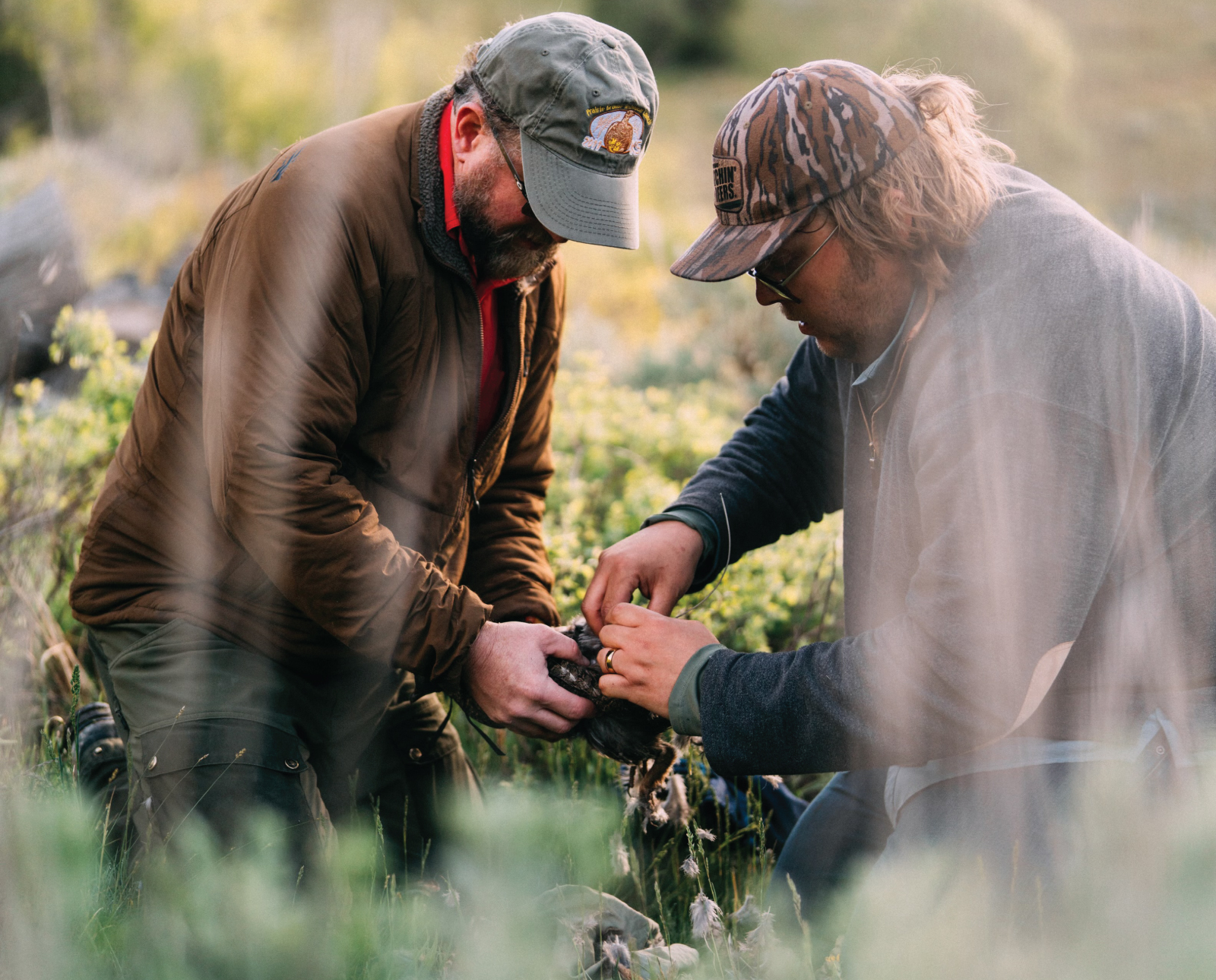
This magazine issue features the Foundation’s first project: sharp-tailed grouse research. We have turned our cameras toward living birds to tell the story of these native grouse on the prairie landscape. We want you to feel invested in their future because their survival depends on researchers and policymakers working together with robust data to guide their decisions. If hunters are truly conservationists, now is the time for all of us to step up and support the science that should guide wildlife management.
We invite you to join us from this humble beginning and share a vision in which hunters reclaim the lead in advancing science-based game bird conservation.


Are you taking donations for this foundation?
Yes! Please visit http://www.projectuplandfoundation.org to read more about the mission and to make a donation. Thank you!
Wonderful vision and one that is much needed. I have learned in recent years that the often-maligned livestock industry can be a vital tool in cost effective improvement and restoration of grassland bird habitats, when used correctly. Old opinions about cattle being all bad are being adjusted and new research is helping us move forward.
Do you see major support coming from foundations or more of a grassroots funding model?
Good work and good luck.