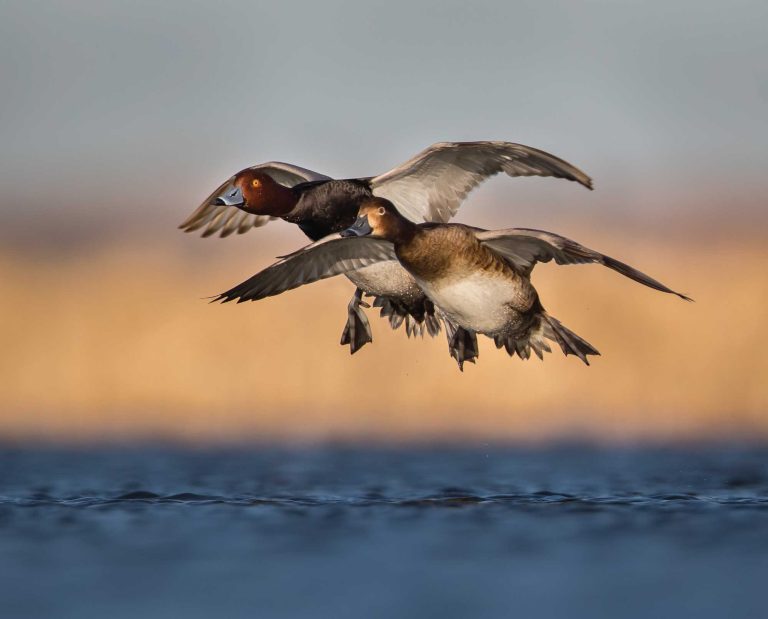


North America’s Huntable Rails and Snipes
Learn about Sora, Wilson’s Snipe, Virginia Rail, and King Rail, all waterbirds hunters can pursue in North America
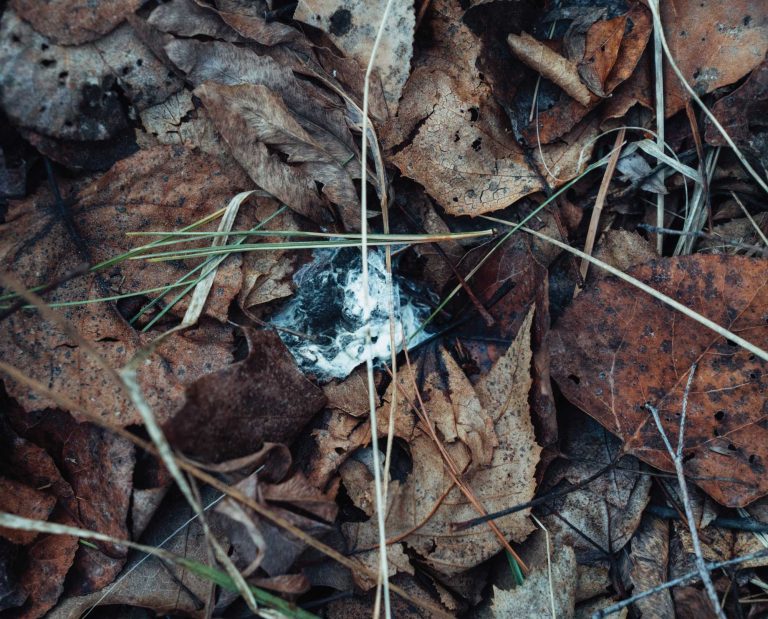
If I’m on a date and pay for a crawfish dinner, I might think I’ve laid the foundation for a pretty good night. That optimism might plummet to revulsion, however, if my date later hawks up the shells in a gelatinous and congealed tubular pellet. I’m reflecting on the courtship displays of a king rail, of course. A cryptic species living on the brink, king rails’ mating rituals begin with a seductive dance and transpire through the male’s offering of a crayfish. Yes, his sanguine mate will probably regurgitate the shells, but it’s the thought that matters.
Of the rails and snipes that occupy America, king rails might top the list as the most bizarre, but that shouldn’t come as a surprise. Together, rails and snipes have a diverse evolutionary past as malleable as potter’s clay.
Since the Paleogene period 60 million years ago, rails and snipes have been altogether molded, glazed, and eventually kilned into the forms we see today. Some forms ended up stranded on small islands, like the Galapagos crake. Others became shackled to niche habitats, like the Junin crake, whose entire existence revolves around a single, four-mile-wide lake just outside the rainforests of western Peru.
Wingshooters in North America got lucky. Snipe and rail species fill the continent, and their hunting seasons reflect that prosperity. From the Wilson’s snipe of Puget Sound to the sora rail marshes of North Carolina, this is your guide to America’s huntable rails and snipes.
Sora Rails
Oology came into vogue during the early 1800s amid growing curiosity about birds and their lives. A practicing oologist would locate a bird nest, possibly shoot the incubating parents, send their carcasses to museums, collect the eggs, and blow out their innards. From these brutish acts of science, biologists could learn a great deal about bird reproduction.
By the end of the 19th century, oology became so popular that it had its own magazine, titled The Oologist, for the Student of Birds, Their Nests, and Eggs. Dr. Morris Gibbs, a medical doctor who preferred the nickname “Scolopax,” was a frequent contributor. In the 1888 publication of the Oologist, Gibbs detailed the nesting behavior of sora rails. “The nest is frequently placed so low down that an inundation often submerges the eggs to the sorrow of the disconsolate parents,” he wrote. “If the eggs are only one-third or a half-covered, however, the old birds, both of which alternately incubate, stick to the ship and its cargo.”
The science of oology drowned in a tsunami of conservation legislation, including the Migratory Bird Treaty Act, the Lacey Act, and the Endangered Species Act, which collectively suffocated the act of haphazard nest raids. However, sora rail nests still survive the occasional water douse, and today, sora rails exist throughout the Lower 48.
Sora rails breed in northern latitude wetlands rife with emergent vegetation. During nesting season, you can find them above the Mason-Dixon Line out east and in an unbroken range encompassing the Great Lakes, the Prairie Pothole Region, and the near entirety of western America. They migrate south in the winter, occupying salt marshes, rice fields, and flooded pastures from the Chesapeake Bay through Central America.
Sora Identification and Hunting
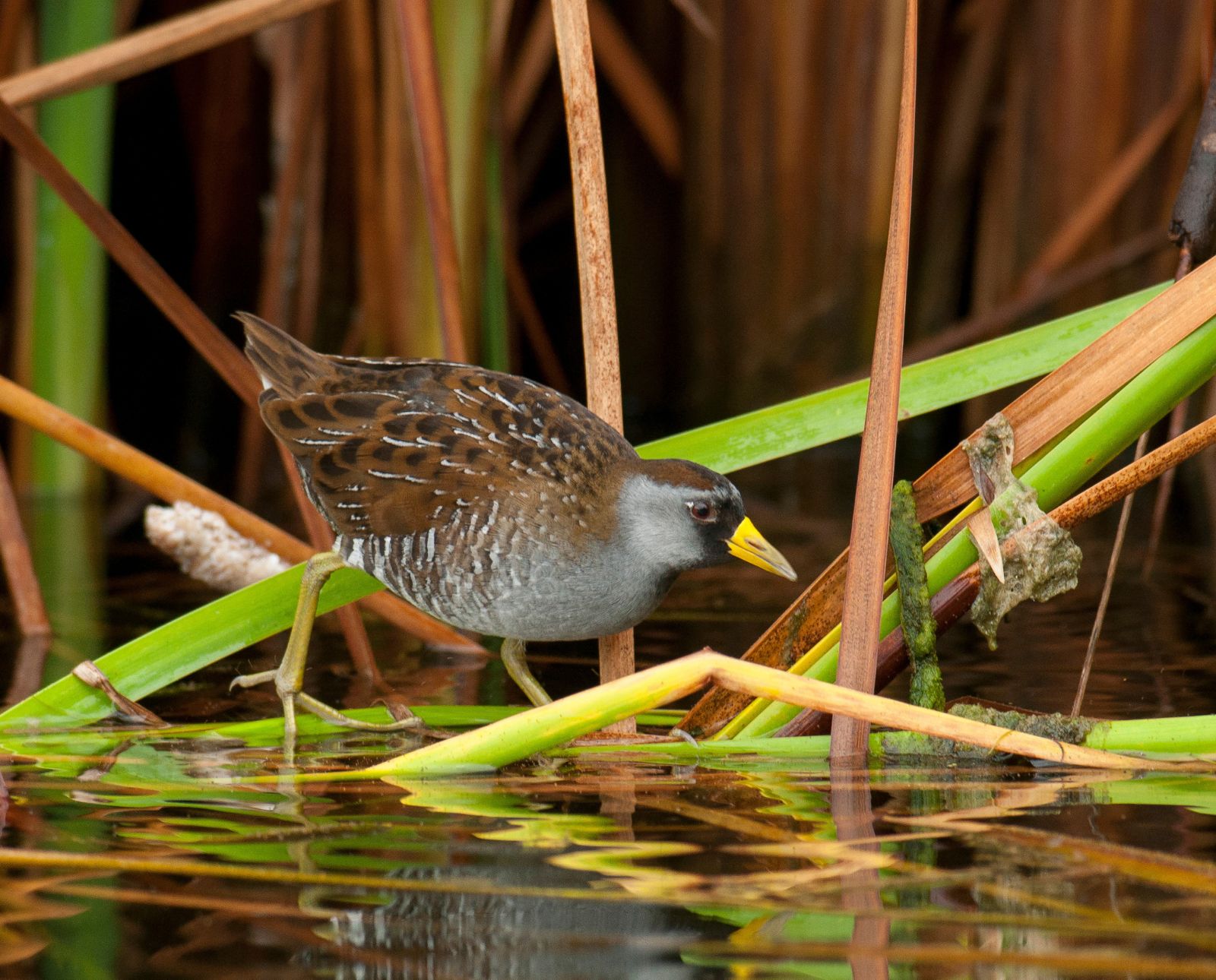
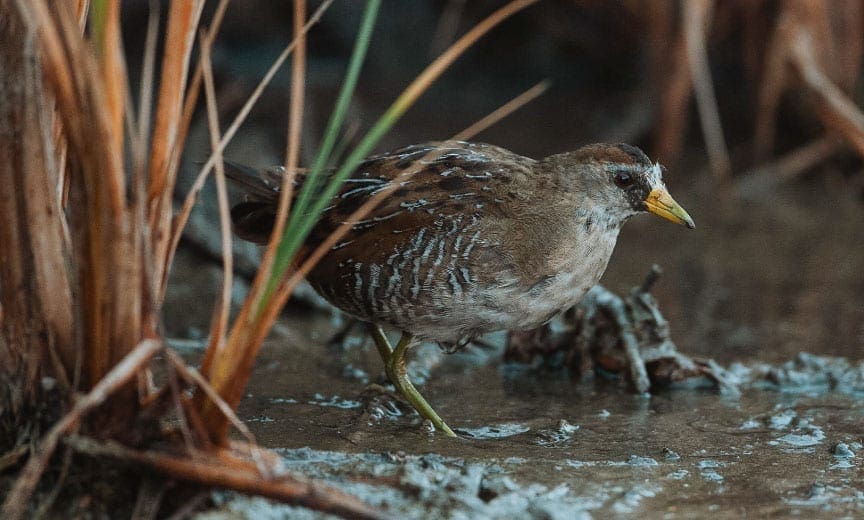
The popularity of sora rails among hunters can be attributed, at least in part, to their radiating beauty. Unlike the muted color palettes of most other rails, the sora rail brims with artistic expression.
Their bill, lemon-yellow, shaped like an Egyptian pyramid, acts like a pair of surgical pliers. It can pick, with discrimination, the three-millimeter-long seeds of bulrushes, smartweed, and crowngrass. In low light, their plumage almost glows, from a black face mask to a cyan belly, washed over by chestnut-brown shoulders and a chocolate-covered rump.
The best way to appreciate a sora rail would be to listen for its high-pitched whinny, which releases in a series of ear-piercing pulses, sounding somewhat like the subdued version of a wood duck squeal. Birders suggest listening for the calls on a flooded wetland. Bring a stool and sit underneath some shade because you’ll likely have to wait. Then, glass the open areas as sora rails dart from covert to covert.
Thirty-one states offer sora rail hunting opportunities. Successful hunters wait for flood conditions that push soras out of their most secretive haunts. For a shot, flush the birds from either boot or push-poled skiff.
Virginia Rail Life History and Hunting
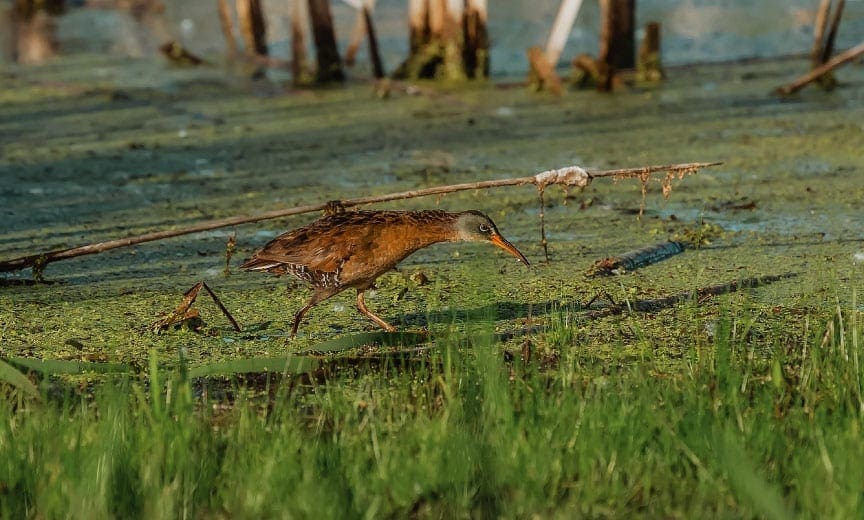
Early in the Virginia rail’s evolution, it made a pact with the sora rail not to beef over food. In ecological terms, it’s a strategy called resource partitioning, whereby two competing species evolve non-overlapping niches that allow them to coexist peacefully. The sora rail grew a short and stubby bill designed for seed-eating, and the Virginia rail developed a long-curved bill specializing in invertebrates.
The Virginia rail lives alongside sora rails in the coastal regions of the contiguous United States, pockmarking its middle portions where suitable habitat exists. The bird is a frequent visitor of the Prairie Pothole Region and the low-lying basins of Arizona, Colorado, and Nebraska. Along with their clapper rail cousins, who reign in backwater marshes, Virginia rails are dubbed marsh hens.
The differences between the clapper rail and Virginia rail are subtle, lying almost exclusively in the salinity of their preferred habitats. Both birds have equally drab plumage, share a gnarly appetite for beetles, snails, spiders, and crustaceans, and let their feet dangle when they awkwardly fly in a labored attempt to catch air. It’s a point of excitement for hunters and a point of vulnerability for the rail.
John James Audubon also distinguished the two rails by their salinity. He used the term Salt Water Marsh Hen for the clapper rail. In his time, Fresh Water Marsh Hen could be applied to either of the Virginia rail or the king rail, although in Birds of America, Audubon opted to use it for the king rail.
Virginia rail hunting season occurs in September in most states. To find them, flush the emergent vegetation of a freshwater meadow. The acclaimed author Thomas McGuane says that the best way to fly fish is to keep your fly in the water. If he were a Virginia rail hunter, I’d bet he’d suggest keeping your boots in the grass, covering as much ground as possible.
Wilson’s Snipe Facts and Hunting
Shooting a snipe requires so much marksmanship that it spawned its own verb. In the 1770s, British military soldiers living in India hunted the common snipe. To shoot one, a hunter had to line their bead on a feathered softball flying as erratically as a pursued housefly; no easy feat. A successful shot demanded celebration. The hunters called it a “snipe.”
The term infiltrated military vocabulary. Instead of sniping snipe, you could snipe enemies. The battlegrounds of World War I soon adopted the term, and today, the word “sniper” impresses an image in the collective consciousness as someone who can execute a long-range, often near-impossible shot, from behind the lens of a suped-up rifle.
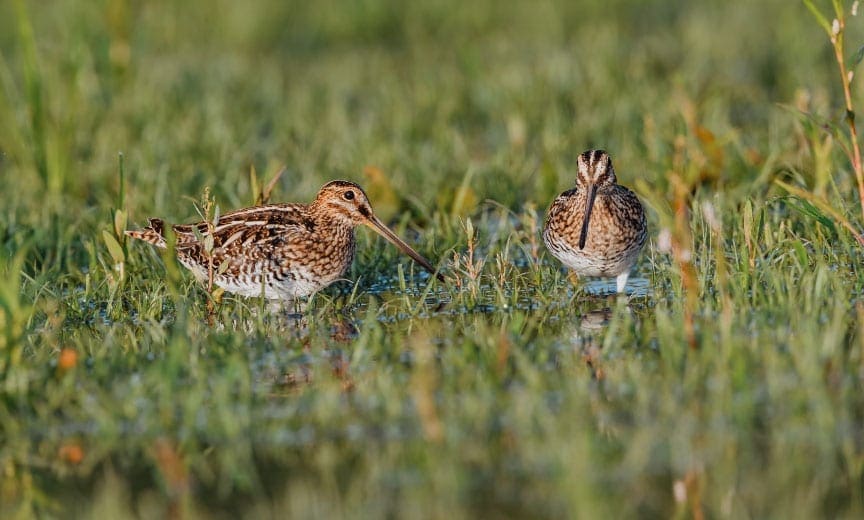
The momentum of the word outweighed its original act, but still, shooting a snipe requires some finesse. From the wetlands and flooded fields they call home, snipe flush at your boots or beyond, flying in patterns as predictable as next year’s weather. Their flight resembles that of their cousins, the American woodcock. As timberdoodles twirl through the air, marshdoodles, or Wilson’s snipe, pirouette.
Snipe Taxonomic History and Adaptations
Both Wilson’s snipe and woodcock belong to the family Scolopacidae, a genetic family tree dominated by shorebirds and, at one point, Dr. Morris Gibbs. The sandpipers that scurry along the whitewater of breaking ocean waves belong to that family. So do willets, yellowlegs, and godwits—all shorebirds. In fact, in Alexander Wilson’s nine-volume book, American Ornithology, published in 1808, he referred to all these birds as different types of snipes. To make matters more confusing, he categorized them by their accepted genus of the time, Scolopax, which has since been stripped from all shorebirds and snipes but retained by the woodcock.
Somewhere in the woodcock and snipe’s genetic lineage, their ancestors had become detached from ocean and bay fronts, and the birds were forced to adapt to inland habitats. The woodcock chose a life in deep timbered thickets, while the Wilson’s snipe chose to live along riverbanks, bogs, fens, and anywhere else with water, perhaps as a reminder of their ancient home.
One shorebird heirloom the Wilson’s snipe kept was a characteristically long and straight bill. It’s an insect-sucking syringe, rigid at its base and flexible near its tip. A hungry snipe will plunge the needle face-deep in soft soil. Hyper-sensitive nerve endings will detect the slightest hint of a worm, larvae, or other edible invertebrate. If the detector sounds, the base of its bill will lock shot shut as its near-prehensile tip opens, grasping its prey and sucking it down without the bill ever leaving the mud.
Snipe Hunting
Hunting opportunities exist in every state except Hawaii, with seasons starting as early as September 1st. In states like Georgia, the season extends into February. Successful hunts can be accomplished with or without a dog, but a dog adds some excitement.
Any waterfowl retriever, upland pointer, rabbit dog, or kindergarten pup can easily convert into a snipe dog. Snipe live like waterfowl but flush like grouse. Work low vegetation on the edges of semi-aquatic habitat such as wet basins, riversides, bogs, fens, or flooded agricultural fields. Be prepared. Snipe can flush solo, in pairs, or in threes and even fours.
King Rail – A Species of Conservation Need
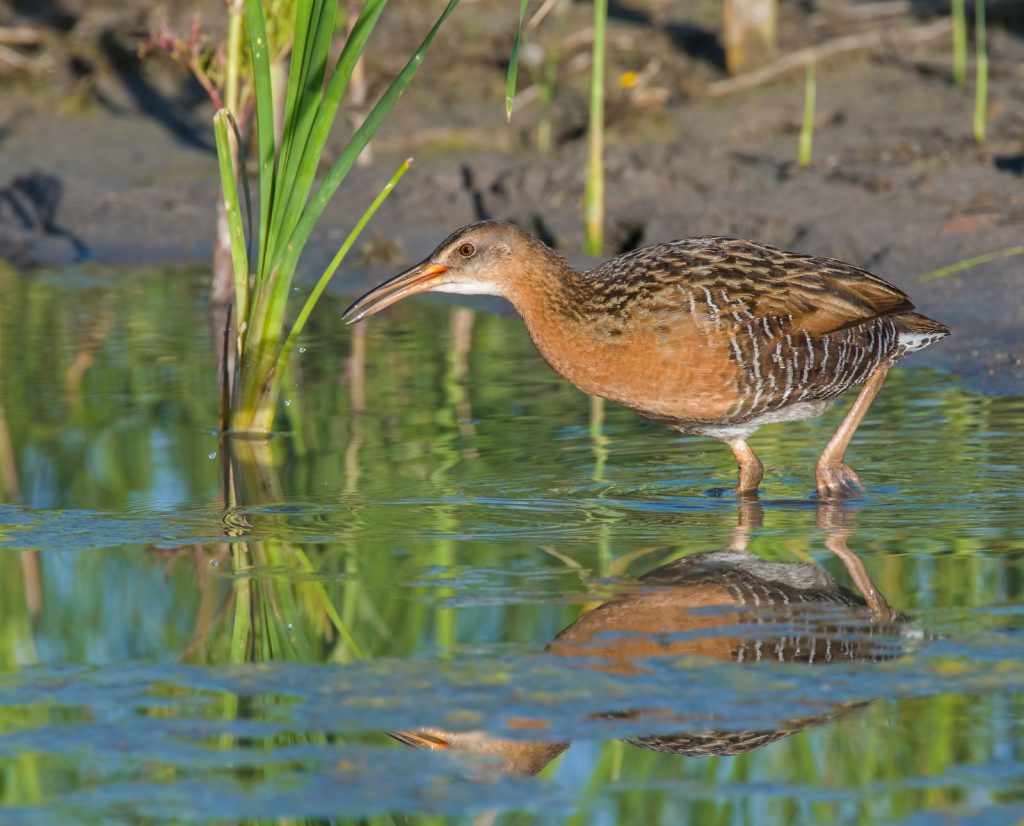
King rails cap our list for a couple of reasons. First, because they’re elegant and the largest and most reclusive of huntable rails, their existence demands center stage. Second, because these birds aren’t doing so well, and it’s a plight that all hunters ought to be aware of.
The king rail depicted in plate 203 of Audubon’s Birds of America lived in the marshes of the Atlantic Flyway. Last year, in the same flyway, the US Fish and Wildlife Service estimated that hunters did not harvest a single king rail. In 2022 and 2021, there were no king rails harvested. The year before that, 0. In the past decade, nothing
Since 1966, king rail populations have declined by 90 percent.
Canada listed the king rail as federally endangered in 2003. Meanwhile, the US Fish and Wildlife Service lists the species as a “gamebird below desired conditions,” a euphemistic understatement for a bird that occupies just a fraction of its historic range. Twelve states, including Illinois, have listed the bird as state endangered. Others have closed hunting seasons. Others still keep the season open but record little to no harvests.
Birders have found some luck. A glance at eBird maps reveals that despite all the pressure from wetland development, draining, dredging, habitat fragmentation, and inundation of wetlands by invasive grasses, king rails still persist. They are mostly on flyways other than the Atlantic, confined to tight habitats isolated from human pressure.
Rail hunters, too, report flushing the occasional king rail, but their overall scarcity reflects a fate many rail species have faced over the past several hundred years. Like the island-cramped Galapagos crake and the Junin crake of Peru, king rail populations are as frail as the individual bird itself. Without proper investment into studying and conserving the species and its habitats, king rails might dissolve in the American mind as the once mighty gamebird, fabled almost heroically for its seductive dance and gift of crayfish.