

Stichelhaar Podcast: The Rare German Pointing Dog You’ve Probably Never Seen
Discover how the Stichelhaar endured studbook battles, misguided purity standards, and the upheavals of history to become Germany’s most obscure surviving pointing breed.
In this episode of Hunting Dog Confidential, host and dog historian Craig Koshyk uncovers the turbulent and almost-forgotten story of the Stichelhaar—Germany’s oldest rough-haired pointing breed and one that nearly vanished more than once. From 19th-century arguments over its origins to the nationalist politics, studbook battles, and misguided purity standards that choked its gene pool, Craig charts how this rugged old hunting dog survived in spite of its breeders rather than because of them. Along the way, he reveals its deep connections to the drahthaar, its close kinship with the Český fousek, and the small circle of modern hunters and breeders fighting to keep it alive. The episode follows Craig’s own journey to finally see the breed in northern Germany, offering a rare glimpse into a resilient gundog whose story is as tangled and wiry as its coat—yet still deserving of recognition, respect, and a future.
Listen to past episodes here: Hunting Dog Confidential Podcast
Podcast Episode Transcript
Hey folks, we’re back in Manitoba chasing grouse, and in the last episode I mentioned that we’re gonna be taking a look at a breed that you’ve probably never heard about—and if you have heard about it, it was probably while you were reading the history of the German wirehaired pointer, where the various dog breeds that went into making up that breed are mentioned. The German shorthair, the pudelpointer, the griffon, and this breed, the Stichelhaar.
Well, that breed almost ended up in the lost and forgotten section of my book, but it actually is holding its own—hanging on, barely—and it has been doing that for about the last 125 or 150 years. It almost fell victim to what we call the war of the wirehairs, when different groups of people thought they had the right one, they had the best breed, they had the actual true wirehaired pointer.
Well, we know who won that battle. It’s the drahthaar—that’s the most popular breed in Germany. And the pudelpointer is going strong, and so is the griffon. But the Stichelhaar? Well, not so much. Find out how, why, and where it’s headed in this episode on the Deutsche Stichelhaar, or the German rough-haired pointer.
And as always, if you wanna know when these episodes are gonna drop, hit the subscribe button. And if you want more details than what I’m giving in this podcast, check out my books Pointing Dogs, Volume One and Pointing Dogs, Volume Two, available from Project Upland and from me at dogwilling.ca.
Okay, folks, time for a quick German language lesson.
If you do any work with leather or you’re into engraving, or even if you just have a decent collection of tools in the garage, you may know what an awl or a burin is. An awl—A-W-L—is that slender metal pokey thing you use to poke holes in leather. And a burin—B-U-R-I-N—is a similar tool. It’s long and sharp and pointed, and folks use it to engrave things in wood or metal.
So what is the German word for those tools? What is the German word for burin or awl, or basically anything that’s long and slender and pokey? The word is Stichel—S-T-I-C-H-E-L. And what if you have a dog who has a coat that looks like it’s made up of a whole bunch of Stichel? Well, call it a Stichelhaar. And that’s the breed we’re gonna take a look at.
Now, if you were a hunter in, let’s say, the mid- to late-1800s, just about anywhere in Western Europe, and you got the idea in your head that it would be a great thing to have a nice wirehaired-coated dog of your own—“I want to build my own type of dog; I want to create my own breed”—well, all of the building blocks and the basic ingredients you needed to do so were all around you.
And those were the ingredients that guys like Korthals used to create his own breed. The pudelpointer people did their own thing, and they created the pudelpointer. The drahthaar people? Well, they built on the success of those people and they built their own thing. And we have documents that shed some light on exactly what went into their recipe.
But when we come to the Stichelhaar, well, things are a lot less clear.
One of the earliest mentions of dogs called Deutsche Stichelhaar, or German Stichelhaar—German rough-haired pointers—comes from 1882 at an international dog show in Hanover. A guy named Bontant—B-O-N-T-A-N-T—Mr. F. Bontant from Frankfurt, showed dogs that were listed as Deutsche Haarhunde.
We also know that at the same show, the Delegate Commission—well, they were sort of the kennel club at that time—declared the independence and purity of that particular breed. They said, right, everybody, this is a breed called the Stichelhaar. But there was a problem.
Sure, everybody agreed: okay, we’re gonna call these dogs Deutsche Stichelhaar. That’s fine. But there were questions surrounding the origin of these dogs. Where did they come from? Who was in charge of them? How were they developed? What ingredients went into them?
Again, Europe at that time—the dog-breeding community at that time—was kind of like a stew. There were ingredients and building blocks floating around all over the place, and people were doing their own thing.
As well as nature doing its own thing, there were crosses between various types of dogs, just, you know, spontaneously under the light of the moon, or behind somebody’s barn, or just because two dogs got it on in the forest over there. So there were a lot of types of dogs running around, and we knew more or less what Korthals was doing with his griffons. We knew exactly what the pudelpointer breeders were doing—they were using poodles and pointers—and eventually everybody would figure out what the Deutsche Drahthaar was doing. They were taking all of the results of all of those other mixes and using them to create something brand new.
But with the Stichelhaar, nobody knew what was going on or where it was coming from. There was no master plan that anybody could look at. Was it a naturally occurring breed that went back years, or was it something that somebody invented in their own backyard? Well, three theories were proposed, and there were arguments among the camps that proposed these theories.
It’s super interesting to look back at those arguments and at those theories because they really do shed light on the chaotic situation of the time. One theory held that the Stichelhaar was in fact just a cross between spinoni and GSPs. Yeah, that’s right—there were people who figured that, you know what, somebody got some Italian dogs, somebody got some spinoni, and somebody bred them into GSP lines or GSP lines into spinone lines, and then they came up with this Deutsche Stichelhaar.
The fellow who brought the breed to the attention of the Delegate Commission, and who was really promoting it at the time—Mr. Bontant—well, first of all, he didn’t call them Stichelhaar. He actually called them Hessian rough-beards. But his idea, or what he proposed, was that no, no, no, no—it’s not a cross between anything. It is an ancient breed of Germanic dog found only here in Germany and enjoyed by our glorious forefathers. It’s been around since the year dot.
And a third theory was proposed by people who thought that no, it was just a variety of GSP with a long coat. You see, back in the day, genetics were not quite understood as they are today, and the idea that different types of coats developed because of the climate was actually widely accepted. People believed that if you took a short-haired breed and put it in a very cold climate, that that short-haired breed would, over time, without any involvement of man, simply develop its own long-haired coat.
And they may have a point in Darwinian evolutionary terms. If you put a short-coated animal in a climate that requires a long coat, eventually that animal will develop a long coat. But we’re talking hundreds of thousands, if not millions, of years. That’s how evolution works. It doesn’t work, you know, in 50 years or something. You can’t take a line of GSPs and stick them at the North Pole for 50 years and come back and expect that all those GSPs will still be GSPs, except they’re gonna have a longer coat. That’s not how that worked.
However, back in the day, there were people who believed that, and that’s what they thought the Stichelhaar was. They figured it was GSPs that were developed in northern Germany, where it is slightly colder than in southern Germany, and voilà—after a few generations, look at that nice wiry-haired coat you’ve got.
I mean, you can even see how widely that theory was held because supporters of that idea even managed to have the following line included in the 1883 German stud book. In there you will see that it says, quote, “The Stichelhaar was originally a variety of our smooth-coated or short-haired dogs,” unquote. And so, as a result, the first standard for the Stichelhaar was based on that of the GSP, of the Kurzhaar. The only real difference was that the Stichelhaar had a longer, rougher, wiry coat.
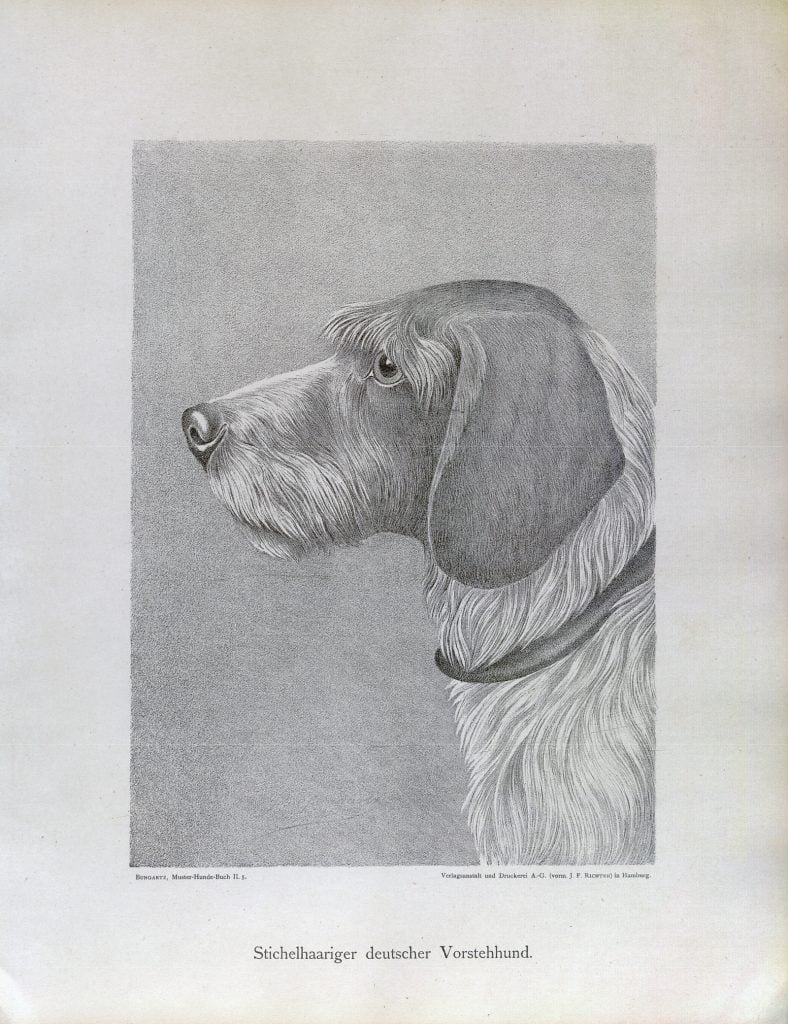
Then in 1888, after years of continued debate, supporters of the three competing theories finally came to an agreement. They published an official statement reversing their previous positions. They declared that the Stichelhaar was actually a rough-haired version of what they called the old German bird dog, or the German Hühnerhund—excuse my German pronunciation—and by no means was it a climatic variety of the GSP or the Deutsche Drahthaar.
And they based their decision mainly on “studies” conducted by a guy named Dr. Hans Kadí, a well-regarded expert at the time. Apparently, Kadí had analyzed the head shapes of all these different breeds and somehow came to the conclusion that the Stichelhaar had an ancient German origin because it had an ancient German head shape.
It is quite obvious today that his conclusions were based on the sort of racist pseudoscience that was in vogue at the time, but supporters of the Stichelhaar accepted them as perfectly valid and used them to remove the griffon. Korthals’ dogs were kicked out of the German stud book because they were a French Griffon with a French-shaped head.
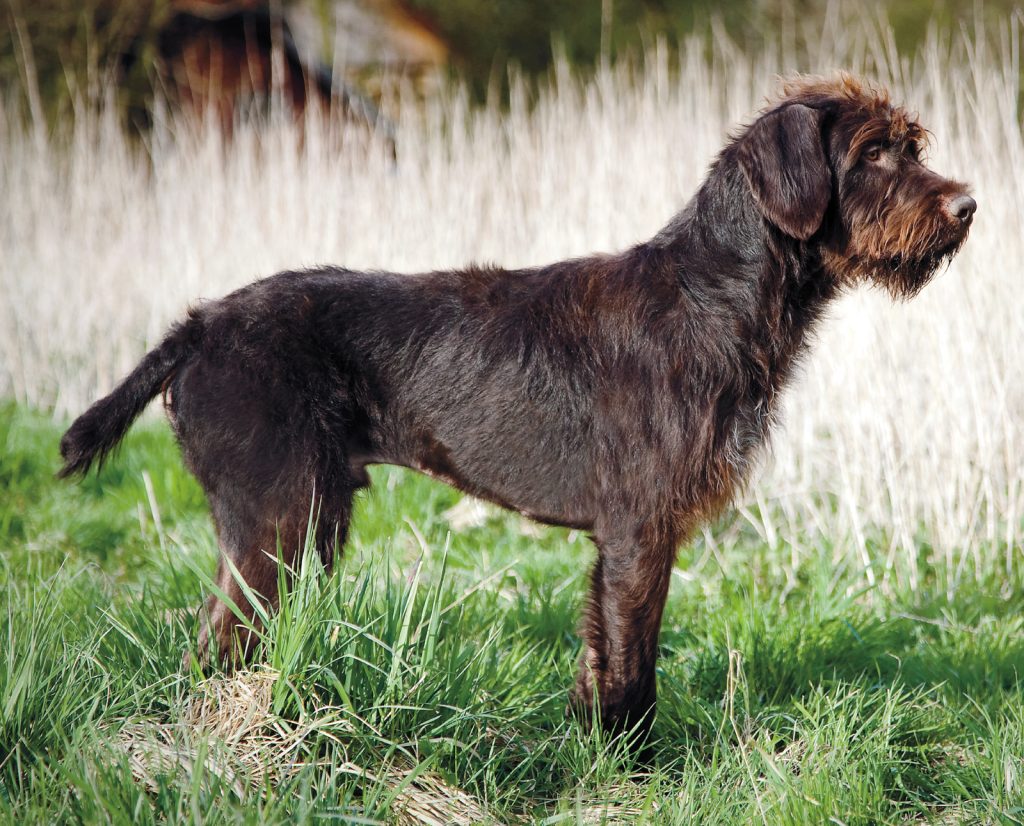
Listen, the most likely scenario for the development of the Stichelhaar is that breeders like Bontant and others started with the rough- and long- and shorthair dogs they found in and around the Hesse, Bohemia, Bavaria, and Austria region, and they crossed them with other pointing breeds. As we’ve seen elsewhere, dogs with rough, wiry coats went by a whole bunch of different names. They were called everything from Polish or Bohemian to even Icelandic water dogs, and they probably represented various lines of experimental, accidental, or incidental crosses of short-, long-, and curly-coated hunting dogs from all over the place.
As the canine system with its studbooks and standards started to develop around Europe, it just so happened that dogs of those types that were found in Germany—well, some of them were called Hühnerhunde. Others that were found in other regions like Bohemia and Moravia, which eventually became the Czech Republic, well, they were on the other side of a border. They were in a different system. They eventually became known as the Český fousek. Genetically, they were more or less the same thing, only divided by the regions or countries in which they were found.
In 1892, there was a club formed for the Stichelhaar, and it kept its own registry for rough-haired breeds, but they kept the Stichelhaar separate from the Korthals griffon. But at that time, there was an international sort of rough-haired fraternity, and they thought that all of the rough-haired breeds were of the same family and that they should be bred together. So from 1907 to 1913, Stichelhaars were registered in the griffon studbook—the one that was founded by Korthals many years before.
Then after 1913, nationalism was rising to a fever pitch. Stichelhaar breeders once again began registering their dogs separately. They also attempted to remove the traits they felt had crept into the breed because of the crosses to griffons. So they came up with tighter and tighter breeding requirements and even prohibited such ridiculous things as having an overlong beard, or hair overhanging the ridge of the nose, or even eyebrows that didn’t curl just the right way.
And they held fast to their belief that if they could only just breed pure Stichelhaars—without any foreign, i.e., English, blood in there—well, they could improve the breed. Today it is generally agreed that these attitudes were the ones that most hindered the development of the Stichelhaar. As a breed, its gene pool became dangerously restricted, and to make things worse, a number of Stichelhaar breeders actually left the breed and joined the Drahthaar movement. But they brought some of their best Stichelhaars with them to inject into this new experiment to create the drahthaar.
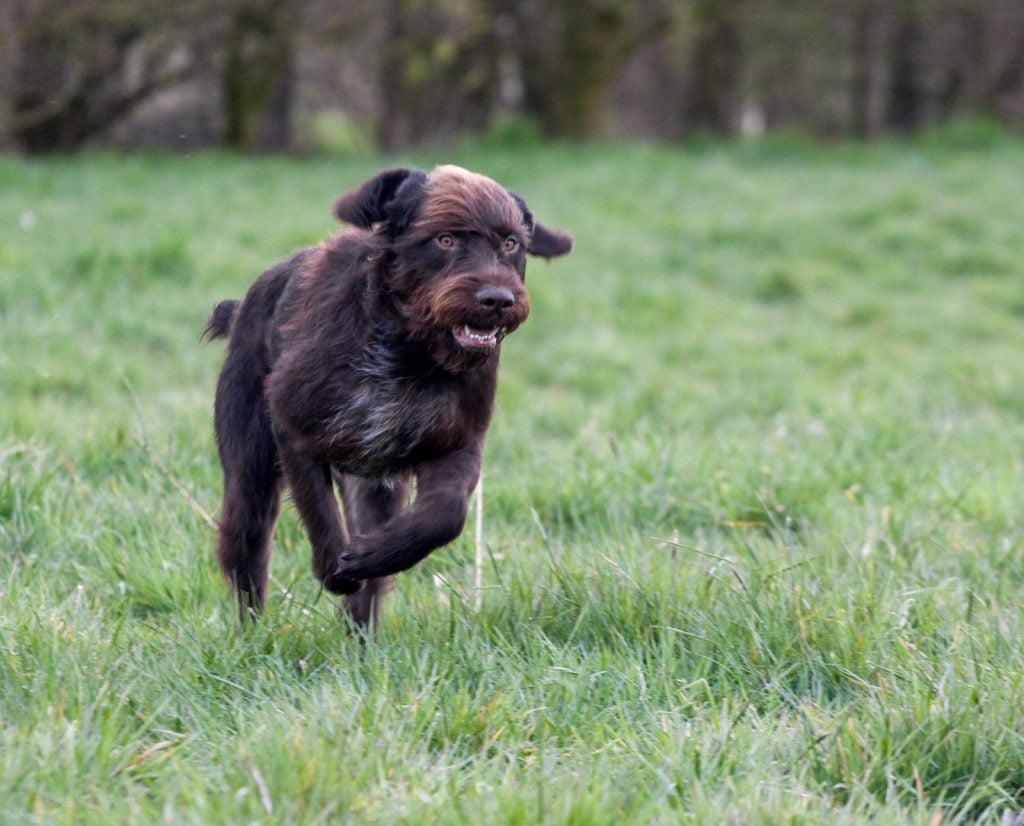
In the end, the Stichelhaar was kind of relegated to the outer margins of the gundog world, but not due to any lack of ability. I mean, Stichelhaars were highly regarded as hunting dogs. It was mainly the narrow-mindedness of some of the breeders and the really extreme selection process they clung to in order to keep their dogs “pure.”
Despite all that, a small number of Stichelhaars continued to be bred. They gained a decent reputation for sharpness—especially on predators—and were prized by foresters in the north for their strong protective instinct. But then again, World War II came, and the subsequent division of Germany proved nearly fatal to the breed. At war’s end, there were only a handful of Stichelhaar remaining, mainly in Thuringia and northeastern Germany. There, a breed club was reformed in the early fifties, and in East Germany a few breeders continued to breed a few Stichelhaars here and there.
And in the Czech Republic, the Český fousek grew to be one of the most popular gundogs among Czech hunters. In Germany today, the breed continues to lag far behind all of the other breeds. In fact, when I first started photographing dogs and compiling notes for my first book, I chose to study the better-known breeds since, you know, it was much easier to find information on them. And besides, I knew where to find hunters who owned some. So I started with drahthaars and pudelpointers and GSPs because they were easy to find.
But when I started looking into the more obscure breeds, things got a bit trickier. Not only was solid information harder to find, but tracking down owners and breeders of those breeds—well, it was tough. In the case of the Stichelhaar, not only did it take some digging, I also needed a bit of luck to finally see some in the flesh.
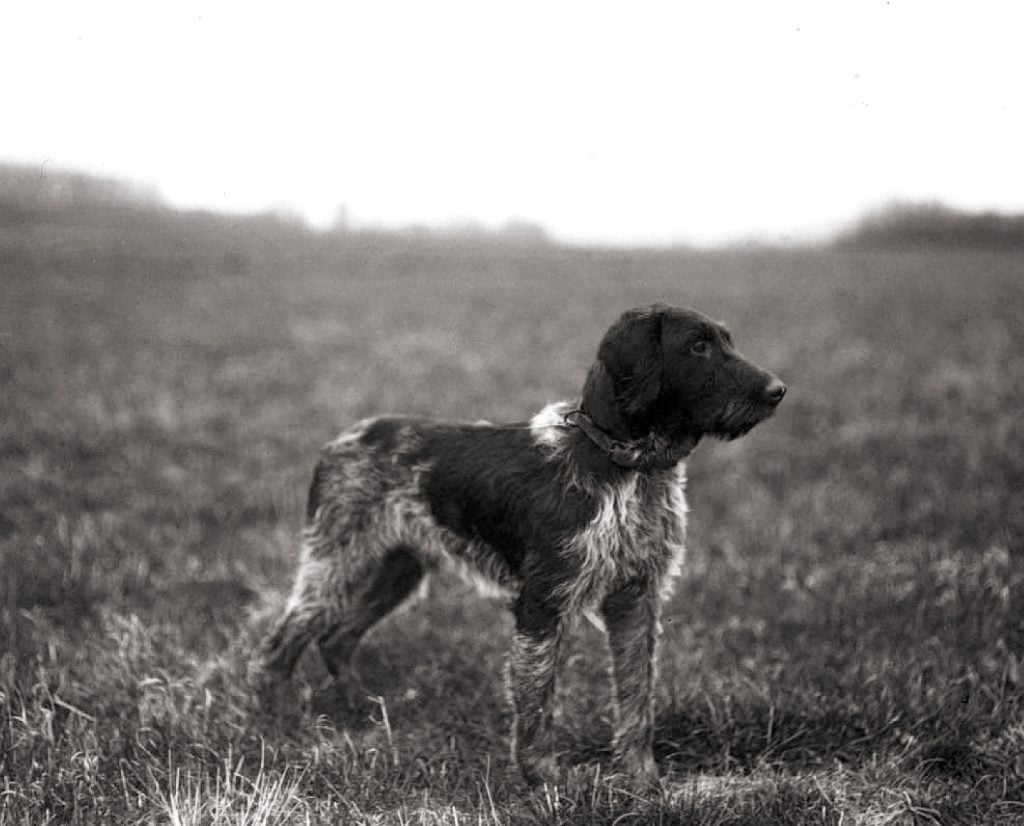
So I really had a heck of a time finding information on the breed, and I couldn’t even confirm that it was still around. I mean, the only illustrations I saw were old paintings or fuzzy black-and-white photographs in long out-of-print magazines and books.
And after a while, I just started to think that maybe, yeah, maybe the Stichelhaar was really extinct. Then in 2001, I attended a hunt in northern Germany organized by a guy named Hans Schmidt—a friend of mine, actually. He’s a renowned breeder of long-haired Weimaraners. While I was there, we were taking a break from the hunt one day, and I almost just casually mentioned the Stichelhaar.
I said, “Hey Hans, have you ever heard about this dog called the Stichelhaar?” I fully expected him to tell me that the breed was extinct, or that he had never seen one or knew nothing about them. Instead, I was stunned when he replied, “Oh yeah, I know all about the Stichelhaar. I hunt with them on a regular basis. My friend has some, and there’s a bunch of them in this particular area. They are strong hunters, you know—they’re a very old breed.”
He then suggested that we go visit a breeder—in fact, the secretary of the Stichelhaar Club—because he didn’t live very far away. Twenty-four hours later, I was at the home of the secretary of the Deutsche Stichelhaar Club.
When we arrived at the breeder’s house, we pulled up the driveway, exited the car. We exchanged some handshakes and introductions, and I took a few minutes to discuss the kind of photos I would really like to take of his dogs. Once we agreed on a plan, he let his dogs out of the house and into the yard.
And as those two big, rough-and-ready dogs came bounding up towards us, I couldn’t help feeling like the scientist in Jurassic Park when he laid eyes on a real-life dinosaur. Finally—right there in front of me—were living, breathing, tail-wagging Stichelhaars, a breed I almost thought had gone the way of the dodo bird.
Nowadays, of course, thanks to the internet, there is a lot more information about the Stichelhaar around. Even the German breed club now has a pretty decent website. Nevertheless, the breed is—and always has been—a marginal player on the German gundog scene. For most of its history, it’s been barely hanging on, and I’ve only seen a few Stichelhaars, and every one of them was in northern Germany.
I’ve spoken to some owners and breeders, including that secretary I met from the original club. I’ve read a few copies of the club’s newsletters, and I’ve been following the ups and downs of the breed via the German websites and some online forums and Facebook groups. I am far from an expert, but I certainly know more about the breed now than when I first read that it was extinct.
And the first time I photographed Stichelhaars, I got the impression that they were more like griffons than they were German wirehaired pointers—and that would probably freak Stichelhaar people out, I mean the old guys who didn’t like the griffons. But yeah, they seemed a little more griffon-like than, you know, drahthaar-like.
They seemed fairly laid back and easygoing. Their coats seemed longer and harsher than many of the drahthaar coats I’ve seen, but not as bushy as the coats on some griffons in the field. They showed a ton of drive. They ran at a medium gallop, and they were good pointers. They pointed staunchly and kind of stylishly. Also, in the water—my goodness—they were like otters. So I think that’s one of the fortes of that particular breed.
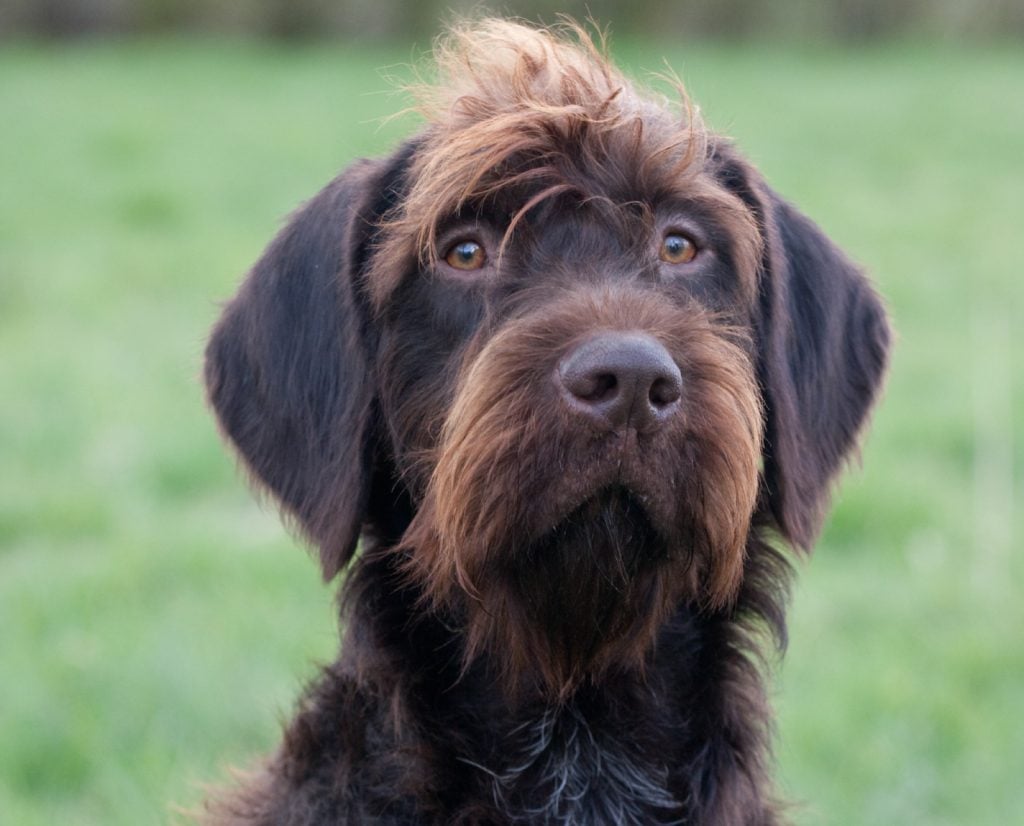
Unfortunately for the Stichelhaar, it’s always been club politics that has threatened its survival. Over all of these years, infighting among club members and the struggle for control of the Stichelhaar’s future came dangerously close to killing the breed several times. And from what I’ve seen in the field, forest, and water, it would be a crying shame if the breed ended up dying out.
Fortunately, nowadays—and only recently—it looks like cooler heads have prevailed in Germany, and that the breed is currently on a gentle upswing over there. Their new website looks great. It looks like there’s some young blood in terms of membership and leadership in the breed. I think there are more breeders now than ever—and I mean, that’s not a great number; there might be a dozen or so in all of Germany—but that’s way more than back in 2001, and things just seem to be a little bit more settled for the breed.
You can check them out online. Just Google “Verein Deutsch-Stichelhaar,” or German Stichelhaar Club of Germany, and take a look. There are some great photos. It looks like there are some really dedicated breeders on board right now, and I really hope this continues. The Stichelhaar is a pretty cool breed that really deserves a bigger following.
I mean, after all, it contributed a key element to the world’s most popular wirehaired breed—the drahthaar—so why not give it some love? Have a look at the club website. Have a look at those dogs, and hey, in the comments, let me know what you think.
Well, there you have it folks. That was our episode on the Deutsche Stichelhaar. I hope you enjoyed it, and I hope the club really does get things moving in a positive direction. It seems that they have. Their website looks fantastic, and the people I’ve contacted there recently seem dedicated and eager to move the breed forward.
If you want to learn more about the breed, contact the breed club, check out their website, and also you can read the chapter in my book about them. There’s a ton more detail, and some more photographs.
Next episode—well, we’re looking at the top dog in terms of the wirehaired breeds from Germany: the Deutsch-Drahthaar, or the German wirehaired pointer. Stay tuned for that. It’s coming along very, very soon.