


Early Shotgun Innovations and Patents By English Gunmakers
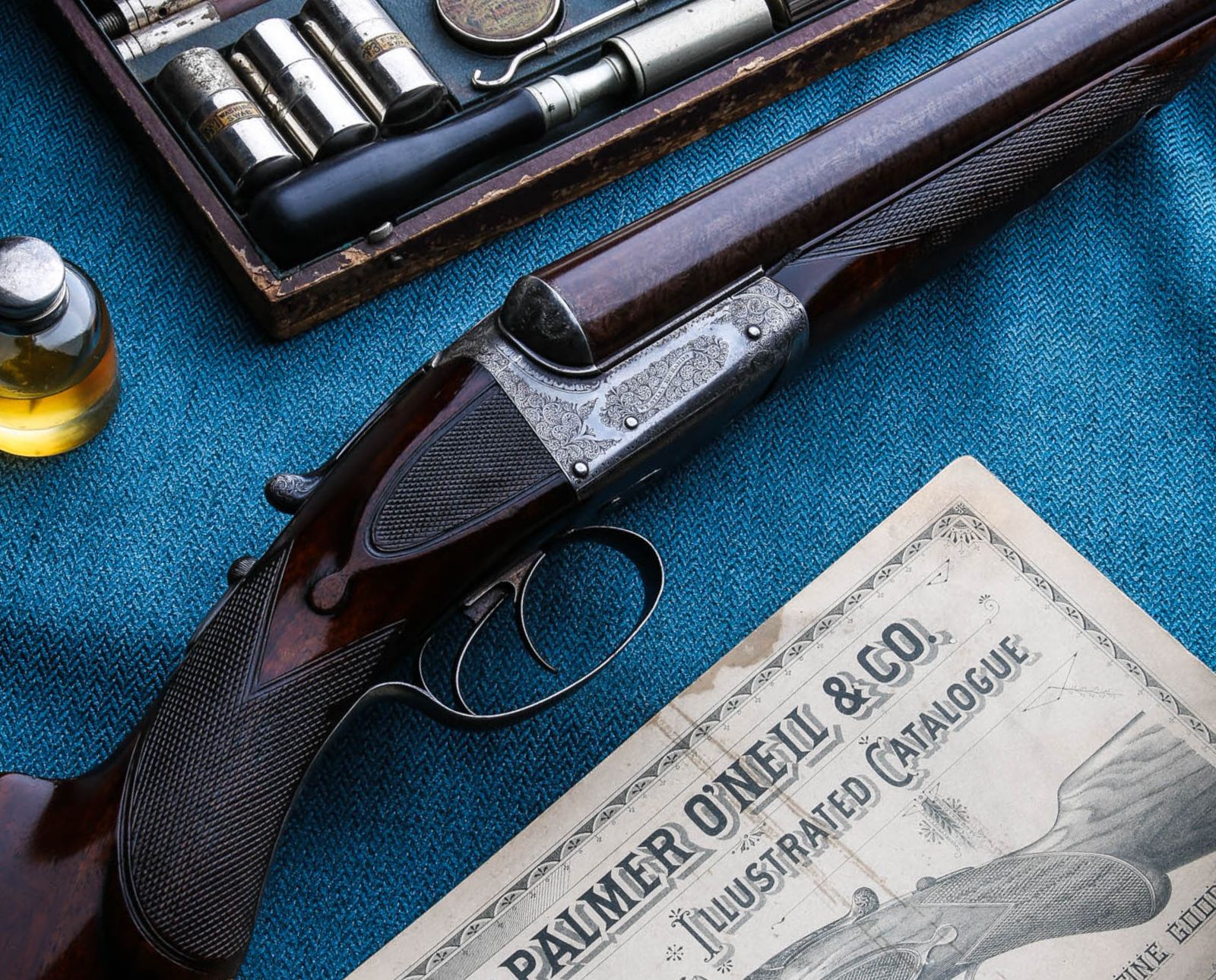
The English may not have invented the breechloading shotgun, but they certainly perfected it
This article originally appeared in the fall 2025 issue of Project Upland Magazine.
Shooting birds on the wing has been around for several hundred years. The sport became widespread in England in the 1800s and grew in popularity among England’s aristocracy as gun technology advanced. Whether the popularity of wingshooting drove the development of the shotgun or the development of the gun drove the growth of the sport is a subject for another time. Suffice it to say, the various designs, inventions, and patents by the British gun-making trade that came out of the period between 1850 and 1930 created both the side-by-side and the over-and-under shotguns we know today.
By the early 1800s, there was a well-established gun trade in England that produced exquisitely made guns. This was the flintlock era, and the most famous of these English makers was Joseph Manton. Mr. Manton’s shop produced guns made by a team of craftsmen, each gunmaker a master of their craft who specialized in making a single component of the gun.
Joseph Manton’s Flintlock Guns
Known as the godfather of the gun trade, Manton employed several gunmakers early in their career who left their own marks on the gun trade. Manton combined superior craftsmanship with the best materials of the time. He created many of his own improvements in firearms and projectiles and produced the best guns that could be made. This was the standard gun made by a shop like Manton’s, and guns like this were simply known as “best quality.”
Although these guns have fixed barrels, are loaded from the muzzles with powder and shot, and relied on flint to spark when the hammers fell to ignite the powder, the flintlock fowling pieces of the early 1800s resemble the double barrel guns we know today. Even then, shotguns had a side-by-side barrel arrangement and a familiar shape to their lock plates. These guns also had familiar serpentine-shaped hammers that were manually cocked.
As good as guns like Manton’s were, the flintlock was less than reliable, especially in wet weather. Additionally, loading them was an acquired skill, to say the least. Joseph Manton invented and patented many improvements in early renditions of the shotgun, one being a more reliable ignition system called the “tube-lock.” But the introduction of the percussion cap in the 1820s gave the tube-lock a short existence.
Percussion caps are small, enclosed cylinders of copper or brass that contain mercuric fulminate that explodes when struck. Known as a “cap lock,” the gun’s action has a nipple, which is hollow and acts as a conduit to the rearmost part of the barrel where the powder is already packed. The cap rests on top of the nipple. When struck by the hammer, it bursts and sparks the powder. The percussion cap was a vast improvement over flint since it could be uniformly made en masse and was far more reliable.
Casimir Lefaucheux And Breech Loading Guns
Improvements in percussion caps and various firing mechanisms followed, but the biggest change in gun technology came in 1851. A Frenchman named Casimir Lefaucheux introduced breech-loading guns to England. This marked the transition from muzzleloaders to breech-loading guns.
Lefaucheux patented the “pinfire,” one of the first breechloading firearm designs, which shot a self-contained cartridge. The design has a side-by-side barrel arrangement and exposed hammers that are cocked before firing, like the flintlocks and percussion guns. However, instead of the individual components of the load being rammed in from the muzzle, a preloaded cartridge containing the ignition, propellant, and projectile fit in the breech end of the barrels. By rotating a lever on the bottom of the gun, the muzzle end of the barrels pivoted downward, raising the back end of the barrels to expose the breeches.
The pinfire cartridges were originally made with paper hulls and a small pin protruding perpendicular to the cartridge case, just above its base. When the cartridge is placed in the chamber, and the gun is closed, the pin sticks out through a small hole at the back of the barrels, ready to be struck by the gun’s hammers. This was a revolution in gun design that sped up the loading process. It was more reliable in wind and rain and was far more user-friendly than loading powder and shot from the muzzle.
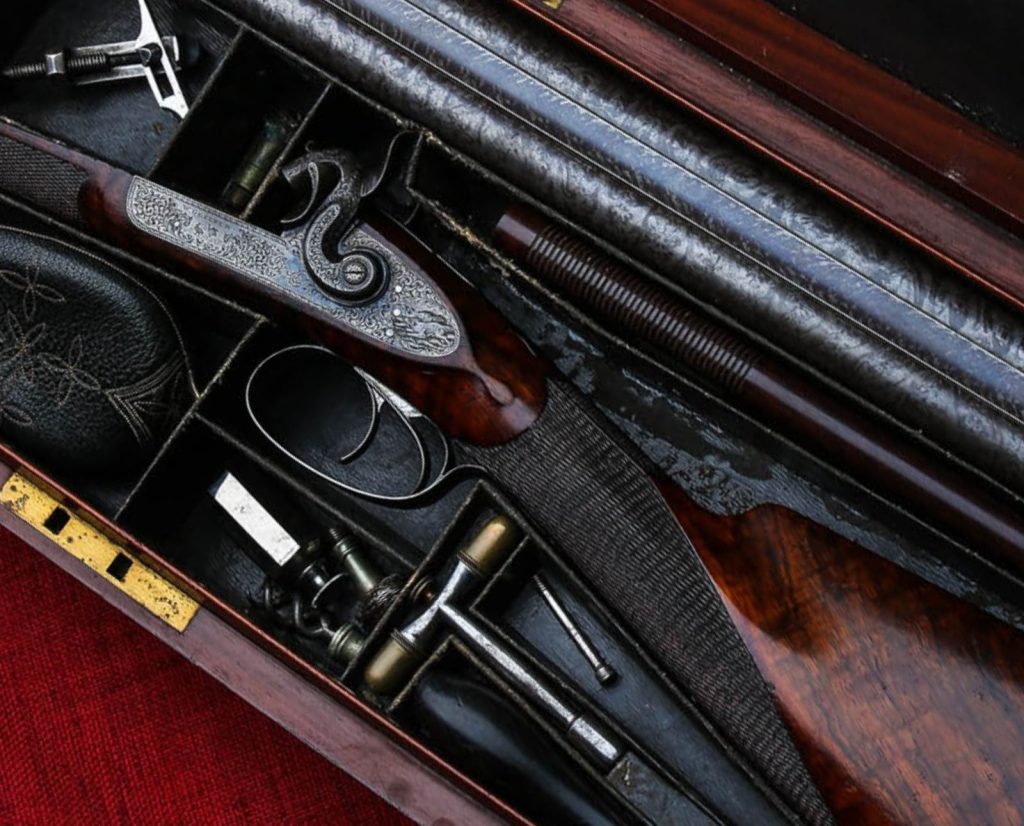
The Adoption of the Breechloading Pinfire Gun in England
It took over 20 years to finally catch hold with the gunmakers and shooters in England, but by 1883, Joseph Lang, who later created the .470 NE big game cartridge, was the first major English gunmaker to make pinfire guns in any real numbers. Charles Lancaster, formerly employed as a barrel maker by Mr. Manton, was also an early adopter of the pinfire once he made guns under his own name. Then, various English gunmakers adopted this approach. Less than a decade later, the breechloader dominated the English gunmaking scene.
The new breechloading gun was far easier to use than the muzzle-loading type. The rate of fire also increased, making these guns well suited to the shooting of driven game, which helped wingshooting’s popularity grow among England’s elite. Continually looking to speed up the reloading process, pairs of guns also grew in demand. These were two guns made to be identical in every way, so one could be shot whilst the other was loaded by someone else with no noticeable difference to the shooter.
Westley Richards Files A Bolting System Patent
The breechloading concept was revolutionary. It spawned new designs for guns that “break” in the middle and load from the back of the barrels. In September of 1858, Westley Richards the Younger, son of the firm’s founder and namesake, filed the first patent to mention a top lever and a rib extension as a bolting system for breechloading guns. The bolt is the part of the action that mates to a corresponding slot or flat spot on the barrels of a breechloading gun, known as a “bite,” to lock a gun closed.
Mr. Richards’ concept incorporated a rotating top lever that bolted to a rounded piece of steel that extends from the barrels’ top rib, past the breeches, to keep the barrels from falling open. The rib extension was filed to a slightly oval shape, thought to resemble the head of a little girl’s doll; hence, it is known as a “doll’s head” extension. The top lever was also spring loaded and snapped into the bite on the doll’s head, automatically locking the barrels closed. For the next few decades, the doll’s head and snap lever was the only locking mechanism Westley’s used on its breechloading guns. The doll’s head rib extension was adopted by many other makers.
Like W.R.&Co., other gunmakers looked to make reloading quicker with an action that could lock automatically when the barrels are closed. This is known in the English gun trade as a “snap” action. In early production of the breechloading guns, the locking mechanism was manual. Most familiar is probably the underlever patented by Henry Jones in 1859. Known as the Jones underlever, it uses a rotating bolt connected to a lever under the trigger guard, and the lever has to be manually rotated to open and close the action.
James Purdey’s Patents
While several different patents were submitted for a snap action, James Purdey patented one of the first to utilize two bites instead of one. Purdey’s version was another pivotal development of the breechloading gun.
James Purdey was also formerly employed by Mr. Manton, primarily as a stocker, until he started making guns under his own name in 1814. Purdey’s 1863 patent for “Improvements In Breechloading Firearms” is considered one of the most important developments in breechloading gun design. It was almost universally adopted as the main locking system in preceding designs.
Described as the Purdey bolt, Purdey sliding bolt, or Purdey double under-bolt, the locking system prevents the barrels of breechloading guns from falling open using a bolt that slides back and forth. These sliding bolts are flat pieces of metal that fit horizontally in the action, are spring-loaded, and actuated by a lever. The first guns by Purdey’s incorporating the Purdey bolt have a lever in front of the trigger guard that is pushed with the thumb. When the lever is moved forward, the flat bolts slide out of corresponding slots, called “bites,” that are cut into the lumps of the barrels and allow the muzzles of the barrels to fall.
READ: Why Hunt With a Vintage Shotgun?
The barrel lump is a hook-shaped extension of metal on the underside of the barrels under the breeches. There are two barrel lumps in Purdey’s design, and both bites that mate to the bolt are cut in the back of the lump. The two lumps mate to slots in the gun’s receiver and the front lump pivots around the hinge pin for the barrels to open and close. When the barrels are rotated closed, the slightly curved lumps push the spring-loaded bolt back until the bolt engages with the bite and is held in place under pressure from its spring.
In 1865, W.M. Scott—who owned and operated W. & C. Scott & Sons with his brother, J.C. Scott—patented his version of the top lever, the famous “Scott spindle.” Meant to work as a snap action, Scott’s lever was also spring-loaded but attached to the top of a vertical shaft resembling the spindle on a sewing machine. At the bottom of the spindle was a short lever that pulled back the sliding bolt when the top lever was pushed to the right.
The Scott spindle was designed to work in conjunction with the Purdey underbolt. Together, this has been the prevailing bolting system for breechloading guns ever since.
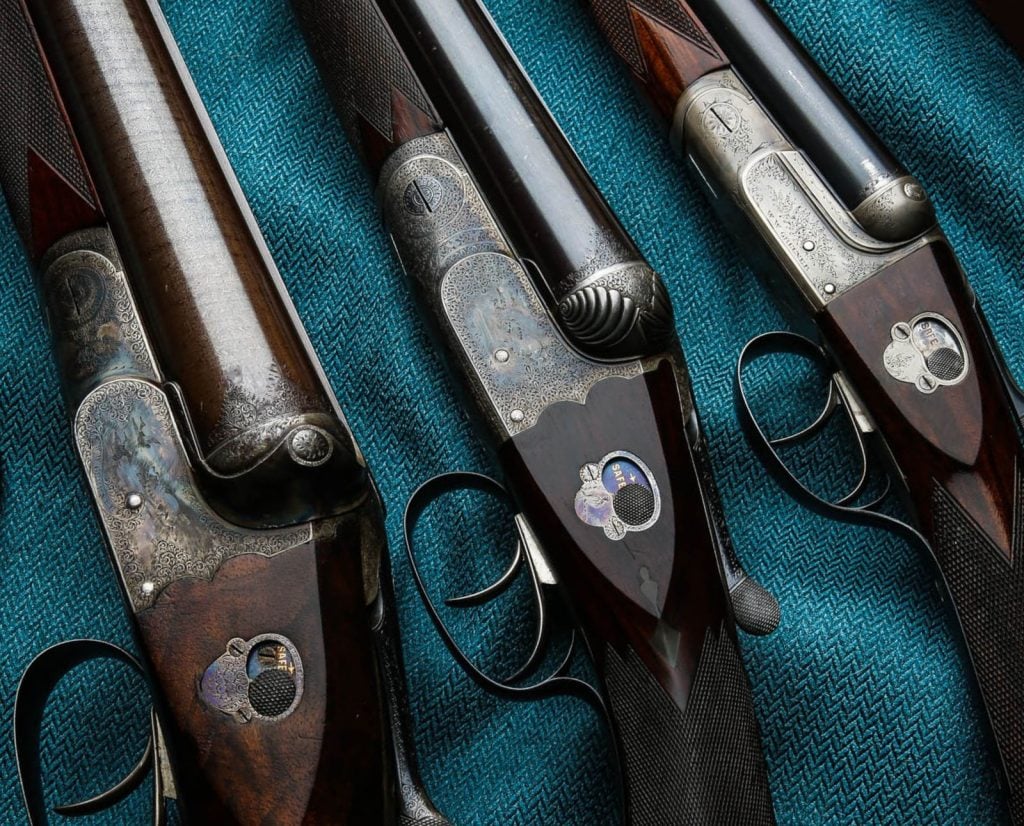
W.W. Greener And Choke Bores
The next big development in the breechloading guns came in 1875 when W.W. Greener pioneered choke bores in guns to control the pattern of shot as it leaves the barrel. American gunsmiths are considered to be the first to work on the concept of choke bore, but it was Greener who tested the concept to find the best shape and constrictions, made the tooling, and brought the process to production.
Greener had already achieved fame for his cross-bolt for breechloading guns, patented in 1867. This created one of the strongest and most common locking systems that used a third fastener, a bite or bolting system, incorporated into an action design in addition to the double Purdey underbolt.
A&D And Internal Hammers
In May of 1875, William Anson and John Deeley (A&D), on behalf of Westley Richards & Co., filed the first patent for an action with internal hammers. Referred to as a “hammerless” gun, the hammers—called tumblers—were actually inside the action body. They were automatically cocked by the fall of the barrels when the gun was opened. The action body of the A&D had a square, box-like shape. Today, this type of action is known as the “boxlock.”
Originally, the A&D action used only the firm’s patented doll’s head extension and snap lever. By the 1890s, it started to incorporate the Purdey double underbite. The lock work, or mechanism that actually fires the gun, is a simple yet robust design. It scales up and down well and makes as good a double rifle for big game cartridges as it does a shotgun. Because of its simplicity, this action did not require a high level of skill to make. A serviceable, reliable version of it later lent itself to mass production. The A&D boxlock was the first commercially successful gun without external hammers and stands today as the most copied action type for breechloading guns and rifles.
Overall, the hammerless action made a stronger, more reliable, and infinitely safer firearm. In just a couple of decades, the sporting gun evolved by leaps and bounds.
Holland & Holland introduced its Royal hammerless sidelock action in the early 1890s. The shape of the sideplates on the Royal action originally incorporated a top edge that dipped and resembled a leg of mutton, a holdover from hammer gun designs. By 1894 or so, the lock plate evolved into the sleek, sloping shape we know today.
The Self-Opening Action
Firms like Westley Richards & Co., W.W. Greener, and W. & C. Scott were located in the midlands in industrial Birmingham, the heart of the English gun trade. The latter two adopted the boxlock concept with versions of their own; this was the prevailing action taken by the Birmingham makers.
Not to be outdone, London makers hashed out their own designs for hammerless guns. The sidelock action, which has the lock work mounted to the inside of the lock plates that mate to the side of the action body, prevailed in London. In 1880, Frederick Beesley patented a spring-cocked, self-opening hammerless action and sold it to Purdey’s.
READ: A Beginner’s Guide to Collecting Vintage Side-by-Side Shotguns
The first of its kind, the Beesley patent used the leverage of closing the barrels to compress the mainspring and cock the tumblers. The upper arm of the powerful V-shaped mainspring cocks the locks when compressed, and the bottom arm of the spring drops the hammers when the trigger is pulled. Two flat-sided cams pivoted on the hinge pin. The flat sides protruded through the water table, or the flat side of the action that the barrels rest on. These cams pressed against the barrel flats. When the barrels are closed, the cams push on rods, compressing the mainsprings. When the gun is opened, pressure from the upper arm of the mainspring pushes the rods against these same cams, forcing the barrels to open automatically when the top lever moves the underbolt rearward.
This is yet another step in increasing the speed at which a gun could be loaded. The self-opening action has been used by Purdey’s, almost unchanged, since 1880.
The First Ejectors
The next hurdle in speeding up the reloading process was the automatic clearing of the spent cartridges from the chamber. The first efficient ejector was developed by English gunmaker Joseph Needham in 1874, and a flurry of patents followed in the 1880s. Famed London maker Holland & Holland used a variety of different ejector systems, including Needham’s, until they ultimately developed the Holland & Holland ejector in the early 1890s.
Many consider the H&H ejector system to be the most reliable. It is immensely simple and has been used by countless other makers since its development.
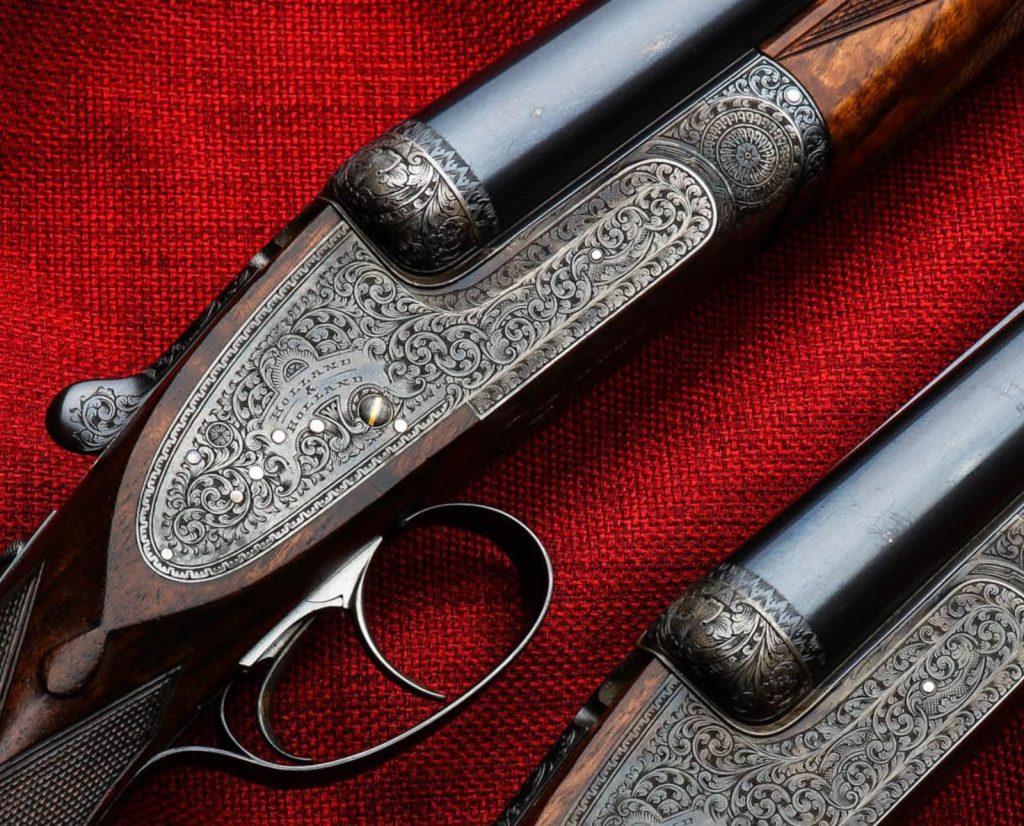
The Development of Gun Engraving
Purdey’s shop was hugely influential in the development of both guns and rifles. One of its most recognizable contributions to gunmaking is its delicate scroll engraving. Developed by Purdey’s head engraver James Lucus, it is known in the shop as “standard fine” but universally as rose and scroll engraving.
When Lucus joined Purdey’s in 1855, Purdey’s engraving followed the engraving style of the time—bold, relatively sparse, and rather simple. As Lucus’ career progressed, the engraving on Purdey’s guns became much finer and tighter and covered more area than in previous eras. By the 1870s, Purdey’s engraving incorporated a bouquet of roses surrounded by a delicate scroll, creating one of the most iconic engraving patterns in gun making.
WATCH: In Our Veins – The Story of AYA Shotguns – A Project Upland Film
Like so many of the other makers of the time, Holland’s adorned early Royal guns with a Purdey’s-inspired rose and scroll engraving pattern. Around the turn of the twentieth century, Holland’s was looking to differentiate themselves and stepped away from this nearly universal engraving. Holland’s introduced a scroll patterned after the vines of the acanthus plant—a theme inspired by the Arts & Crafts movement of the same time period. This became known as the “Royal” pattern, this has been Holland & Holland’s house engraving since.
Boss & Co. Single Trigger Developments
Thomas Boss, who was also a former employee of Joseph Manton’s, made a name for himself selling well-made hammer guns of different varieties. However, the firm bearing his name is responsible for many important developments in breechloading firearms. It also created the archetype of the modern over/under shotgun.
In 1891, John Robertson bought the rights to the Boss & Co. firm from Thomas Boss’ surviving family members. Much like Frederick Beesley, Robertson was a gunmaker for the trade and instrumental in the design and construction of guns for other makers like Holland & Holland’s Royal. In 1893, under Robertson’s direction, Boss & Co. introduced its own hammerless sidelock.
Robertson had two versions of a side-by-side action, a traditional square body, and the now iconic round body. The internal parts of the actions were the same, but the lock plates and bar of the round body action were slightly curved, and there was no bead on the action. The grip is also rounded to complement the action and is free of traditional drop points. The round action gives the gun a very sleek look and a very nice feel in the hands.
The First Successful Single-Trigger Design
In 1894, John Robertson also patented the first successful single-trigger design. Many makers attempted to invent one trigger that fires both barrels individually, but could not come up with a reliable design. Robertson figured out that the shooter inadvertently hits the trigger under recoil upon shooting the first barrel, involuntarily pulling the trigger a second time. Robertson came up with a turret design that used the involuntary pull to actuate the trigger to fire the second barrel. A complicated design that required special expertise to make, the Boss & Co. trigger is both revered by collectors for its ingenuity and feared by gunsmiths for its complexity.
Swept Triggers
Robertson also introduced other features that are now considered standard on all best guns. One example is the swept trigger, which was curved for the right- or left-hand shooter. Robertson realized the trigger was pulled back and to the side by a shooter’s finger, not straight back. He was the first to tailor the shape of the trigger to the shooter.
The Development Of The Droplock
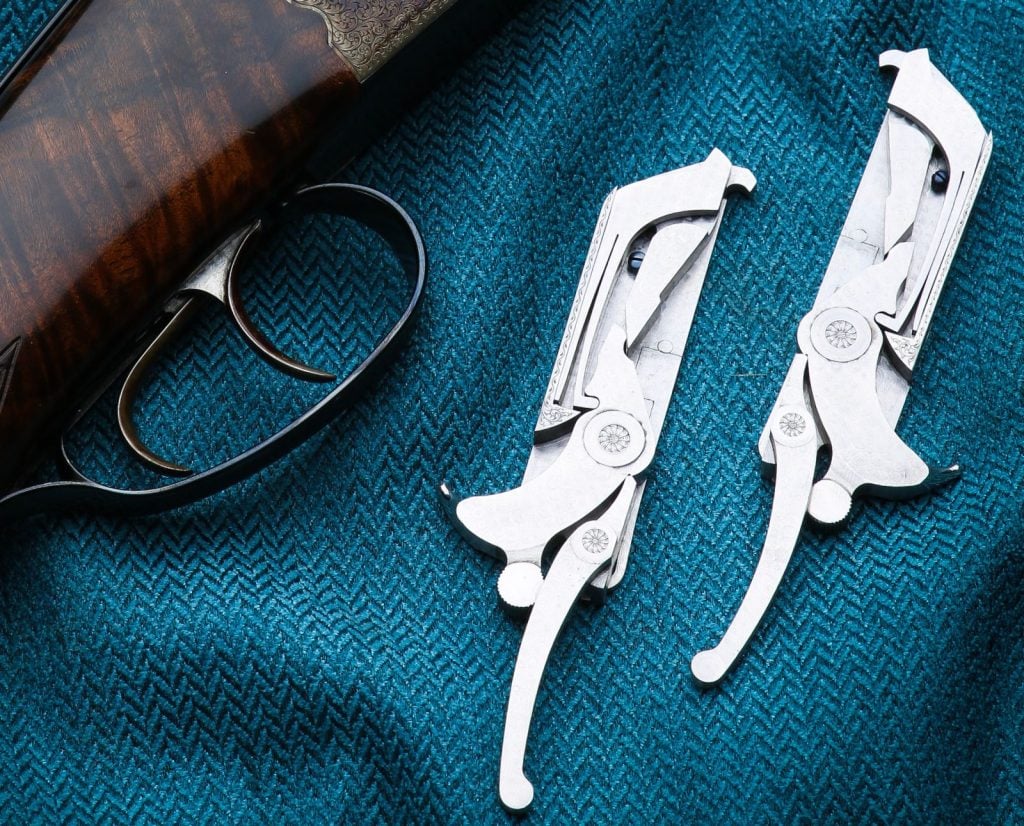
Westley Richards & Co. was already famous for the Anson & Deeley hammerless action of 1875, but in 1897, it took the action to what many consider the pinnacle of the boxlock design. By mounting the lock work to metal plates that fit inside longitudinal slots cut in the action body and a plate on the bottom of the action, which is opened by the push of a button, the lock work could be removed without the use of tools.
Officially known as a hammerless double barrel action with hand-detachable locks, it was the first double barrel action with this feature. It is colloquially known today as the “droplock.” Like the A&D boxlock with fixed locks, the droplock is a very simple design. But, unlike the fixed lock version, the droplock is very difficult and costly to manufacture. It has never been copied on any large scale.
Like Boss’ round body, Purdey’s self-opener, and Holland’s Royal, the droplock remains in production by Westley Richards & Co. today. It is one of the most desirable best quality guns made in the world.
In 1909, Holland & Holland introduced their own hand-detachable lock. It incorporated a lever in place of the pin that held the locks together with a dovetail on the front edge of the lock plate. The lever could be turned without the use of tools and allowed the removal of the lock plates for cleaning or servicing. Along with Westley Richards & Co.’s “droplock” of 1897, these two patents are landmarks for these firms and the gunmaking trade as a whole.
Boss & Co.’s 1909 Over/Under Design
The side-by-side hammerless ejector was perfected by the 1890s. Each design gave the shooting world some of the most elegant and enduring designs in firearms history. To offer something different, several makers experimented with stacking the barrels as opposed to having them side-by-side, but the superposed barrel arrangement is inherently tall, and these designs were gainly and could not compete with the slim, racy lines of the hammerless side-by-side.
Again, Boss & Co.’s talented Mr. Robertson solved the problem by effectively doing away with the protruding hooks usually found on the bottom of side-by-sides’ barrels, and using trunnions, a protrusion on the sides of the barrels that they could hinge upon, like a cannon. This created a very slim shape despite having one barrel on top of the other.
Robertson’s expert gunmaking skills combined with the gunmakers he employed, Boss & Co. 1909 O/U patent is among the most elegant and coveted of all the London-made guns.
Final Early Developments in Breechloading Shotguns
Following the success of the Boss & Co. over/under, James Woodward introduced his own over-and-under shotgun in 1913. With the same approach as Robertson, Woodward’s design used a trunnion system, but it was much simpler and was easier to manufacture.
The Woodward over/under rivaled the Boss & Co.’s in both quality and elegance, examples of either gun being extremely rare today. Sleek and low-profile but relatively simple to make, the Woodward pattern is the predominant design used by Italian gun makers who are famous for over/under shotguns.
At the end of World War II, James Woodward & Sons was sold to James Purdey & Sons. Never able to come up with their own answer to Boss & Co.’s over/under, Purdey’s version of the Woodward over/under is as iconic today as its predecessors.
The last patent of note in the development of the modern breechloading gun is dated May 18, 1922. It was granted to Holland & Holland for its self-opening mechanism. Comprised of only three pieces, the mechanism was attached to the bottom of the barrels, hidden under the forend, and worked whether the gun was fired or not. This was the final refinement in the perfection of Holland’s hammerless sidelock ejector, which has been a feature on the Royal ever since, as well as the self-opening mechanism most often copied by other makers.
These English gunmakers have a long history of innovation matched only by their reputation for superior quality. Although many of the concepts were born somewhere else or various attempts were previously made, it was the British makers who came up with solutions that could be patented and put into manufacturing practice. One way or another, all other double-barrel guns are based on the inventions and patents of England’s gunmaking trade.
While the English may not have invented the breechloading gun, they certainly perfected it.



Excellent article – thank you for sharing.
I had to go get my SXS gun and admire it…after this fine article. Its a WP Jones ….Birmingham boxlock with a great Greener side safety …that I just love…fully engraved with a highly figured French walnut stock….
Once you love a double trigger …English gun…all others just feel clumsy…
I wonder how many total hours went into these guns..back 100 years ago??
More articles ….please…!!