


.410 Shotgun – Origins, Evolution, and Popularity of the Outlier Gauge
A deep look at the .410 shotgun’s history, ballistics, and enduring appeal
This article originally appeared in the summer 2025 issue of Project Upland Magazine.
I have a confession to make. The first shotgun I ever used was a .410. My brother’s old New England Firearms single-shot bloodied my nose at the young age of six. It may sound like the .410 and I got off on the wrong foot, but we didn’t. I smiled and asked to shoot it again.
That moment perfectly summarizes my relationship with the .410—a novel moment, a novel use—before I graduated to the 20-gauge for the better part of my life.
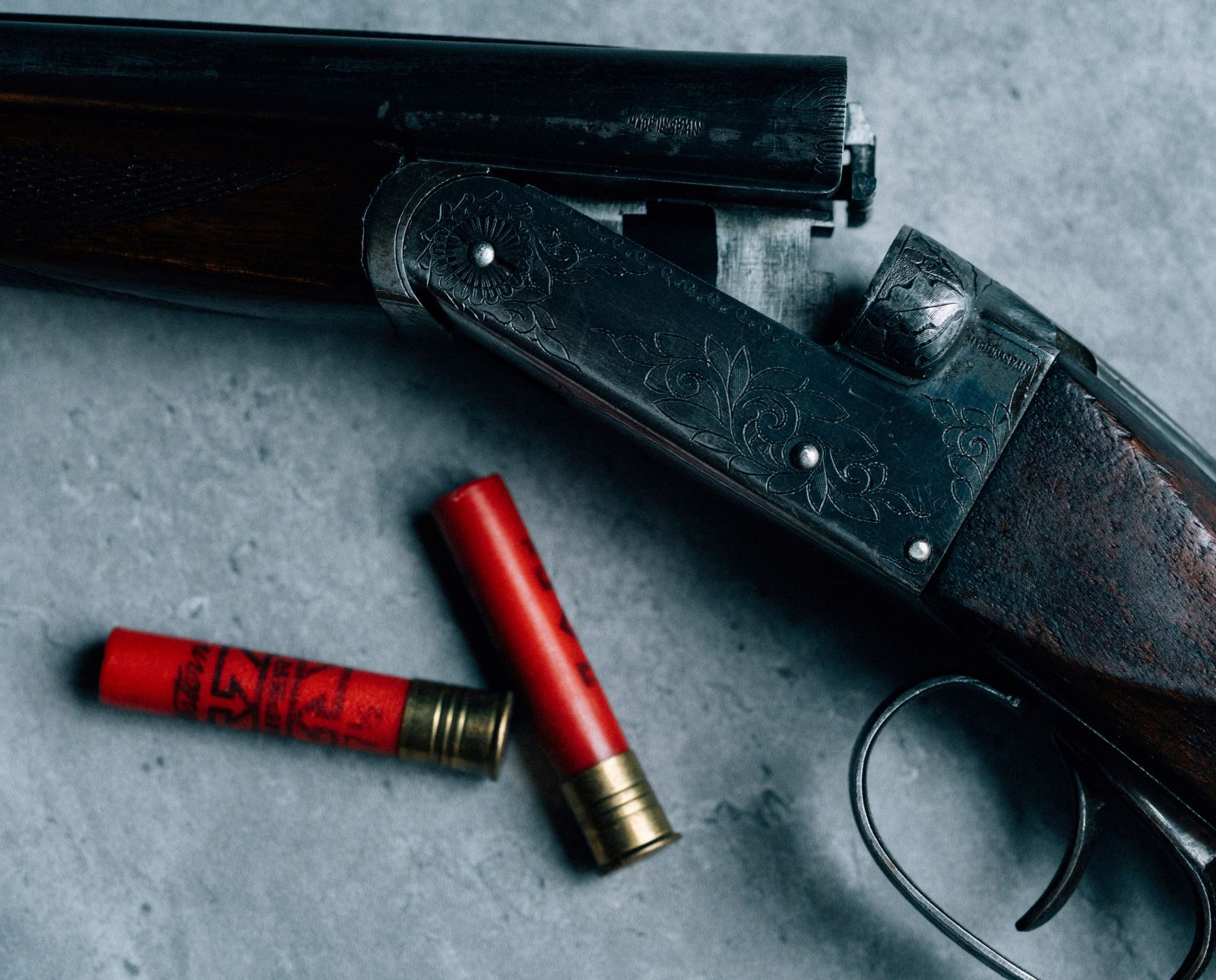
Years later, a gift brought the .410 back into my life and pushed me to reconsider its story, its mechanics, and its place in the greater shotgun landscape. The Spanish side-by-side was nothing fancy; it was from the days when, post–World War II, Spanish gunmakers had a bad reputation due to the use of poor metals. With it, I shot a few woodcock and a single grouse—mind you, it had a full choke—but it did nothing to change my opinion of the gauge. (For the sake of journalistic integrity, I will say that I am devoted to the 28-gauge, and if forced to change, I would return to the 20-gauge.)
That said, the .410 is no ordinary gauge—it’s an outlier by design. Even the way it’s measured defies convention. Unlike other shotgun sizes, the .410 is designated by caliber rather than gauge. Although it is commonly referred to as a gauge, and I will refer to it as such in this article, it roughly equates to a 67-gauge.
The .410 connotes a mix of reputations and strong opinions. Like many shotgun gauges, it was shaped by stigma before being refined by modern technology. Unfortunately, manufacturers were slow to apply these advancements to the .410, perhaps prolonging its misunderstood status.
In this article:
- The History of the .410
- The Evolution of Shotshell Technology and .410 Ballistics
- .410 Bore Diameters
- Forcing Cone Improvements
- Popularity of the .410
- Quality .410 Shotguns On the Market
The History of the .410
While the .410 appears in many iconic books on shotguns, it often receives only a fleeting mention, typically confined to a few paragraphs. Sometimes it is accompanied by less-than-favorable opinions. Oftentimes, it’s overshadowed by lengthy discussions of more popular gauges, even subgauges like the 28-gauge.
Finding evidence of the .410 in England in the 1870s is easy. By the 1920s, the gun was rather common. In the United States, specifically in New England’s “paht’idge” country, there is no shortage of the New Hampshire–born Thompson/Center Contender. The .45LC/.410GA version of this camp pot filler has been defying the physics of ruffed grouse on dirt roads since the 1970s. Truthfully, I never thought much about its history. More recently, the Taurus Judge, introduced in 2006, made an even bigger splash. But these strange modern combinations hold interesting clues to how the .410 came to be in the United States.
Jack O’Connor wrote in The Shotgun Book, “The .410 is the direct descendant of the .44/40 rifle cartridge. At first the standard .44/40 case was used, bottleneck and all, and the shot was in a paper container. Then 2-inch straight brass cases were used, then 2-inch paper cases, then 2½-inch cases. At one time the shell was known as the .44 XL. It was loaded with ⅜, then ½ ounce of shot in 2½-inch cases.”
In 2003’s American and British .410 Shotguns, author Ronald S. Gabriel wrote, “Circumstantial evidence for this recently surfaced in a possible Annie Oakley–pedigreed Harrington & Richardson smoothbore hammer gun marked ‘410-44 cal’ on a 26-inch barrel, made after 1900 and before 1903.”
Despite its presence in early twentieth-century American production, the .410 was not initially taken seriously. Writers like Charles Askins dismissed it as suitable only for “women and children,” unable to fathom its appeal to serious sportsmen.
America’s real mark on the gauge came in 1933, when Winchester introduced the 3-inch .410 shotshell and the pump-action Model 42. They produced 164,800 of them until discontinuing it in 1963. This advancement in the shotshell marked the first real step toward the .410’s future.
The Evolution of Shotshell Technology and .410 Ballistics
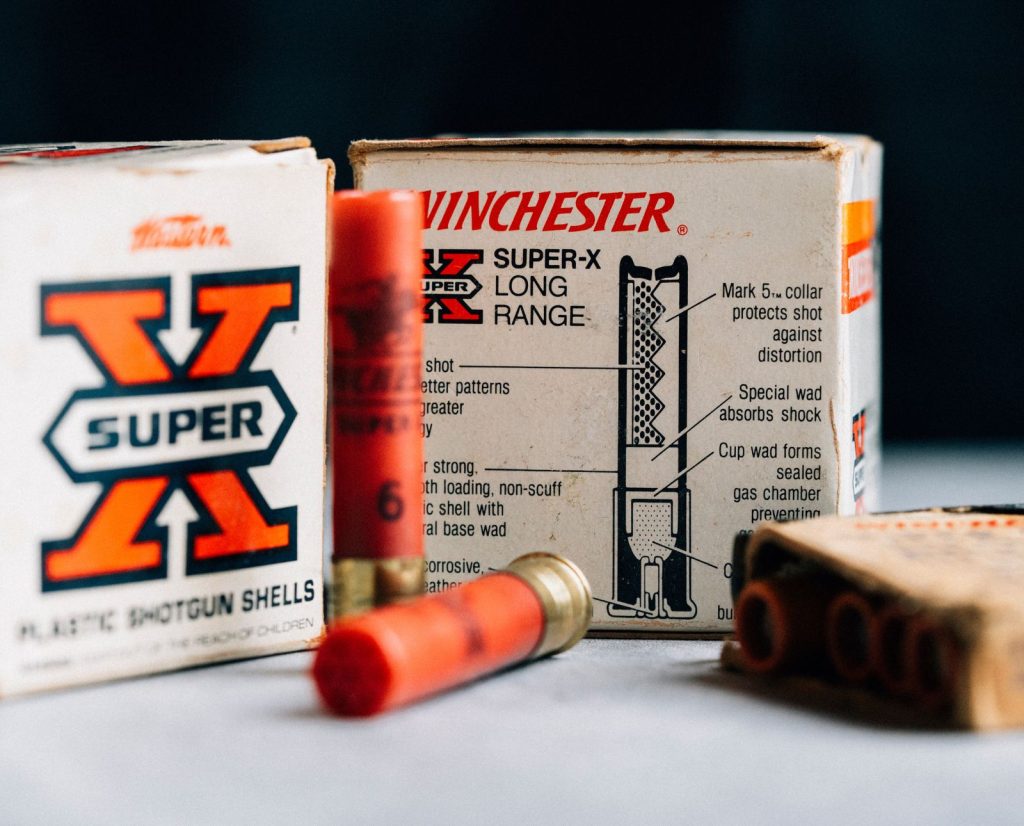
Still, to understand how the .410 evolved into the ballistic performer it is today, we need to look deeper into the science of shotshell construction. Better wad designs, buffered loads, and other improvements helped reduce the .410’s shot deformation. While tungsten pellets are not a particularly cost-effective material for everyday wingshooting, they contribute significantly to this gun’s performance. Barrel modifications and advancements, such as longer forcing cones, would further address shot deformation, which is the .410’s greatest challenge.
The .410 suffers from a major disadvantage compared to all other gauges: its shot column length. I first explored this topic years ago when researching the 28-gauge. It has everything to do with the length-to-diameter ratio.
The length-to-diameter ratio (L/D ratio) compares how tall the shot column is to the width of the bore. The taller and narrower the column, the worse it performs. That’s because more pellets are pressed tightly together and make contact with the barrel walls, causing them to flatten or scatter unpredictably as they exit the muzzle. Essentially, the smaller the gauge, the higher the L/D ratio, and the greater the chance of shot deformities.
To illustrate how extreme this ratio gets, here are the shot column lengths for a 1-ounce load: the .410 stacks pellets 2.175 inches high, while the 12-gauge needs only 0.69 inches. That means the .410’s shot column is more than three times as tall. This leads to more pellet deformation and wider, less predictable patterns.
In a controlled pattern test, Federal Ammunition found that the 16-gauge put more than 70 percent of its pellets inside a 30-inch circle at a standard distance. In contrast, the .410 averaged just 40 to 50 percent. This test highlights the challenge of maintaining pattern integrity with such a small bore and long shot column.
The wad has been one of the biggest factors in improving the .410’s performance. Over the course of the twentieth century, many advancements in wad design contributed to better pattern consistency. Modern wad technology reduces pellet friction against the barrel, provides a cushion to prevent deformation upon ignition, and even helps maintain pattern integrity for longer distances. To help minimize pellet damage, some modern shells pack in buffering materials, or plastic or polymer fillers nestled between the pellets to cushion impact.
Lead, particularly before shotshell design advancements, was highly susceptible to shot pattern deformation, especially when shot through .410s. This led to significantly inferior pattern performance compared to other gauges. When ballisticians first studied the use of steel shot, they found surprising performance enhancements due to steel’s resistance to deformation. The famous ballistician Ed Lowry wrote in the 1980s, after years of research into steel shot, that the real discovery was “not how well steel pellets do, but, instead, how badly lead pellets perform.” This unexpected finding drove further innovation in shotshell design, eventually leading to the introduction of other nontoxic materials. The most relevant to this discussion is Tungsten Super Shot (TSS).
While I certainly do not find it ethical to shoot a turkey at 90 yards with a .410 (or any gauge, for that matter), you can in the twenty-first century, thanks to TSS. This breakthrough is largely due to density, measured in grams per cubic centimeter (g/cc). Lead has a density of 11 g/cc, while tungsten measures 18 g/cc. This technology allows for the use of smaller shot sizes (such as no. 9) while maintaining higher velocities and greater range than larger shot sizes in other materials. Because no. 9 tungsten pellets are so small, more of them can fit into the .410 shot column, ultimately matching or even exceeding the pellet count of larger gauges using bigger shot sizes and results in higher pattern density.
.410 Bore Diameters
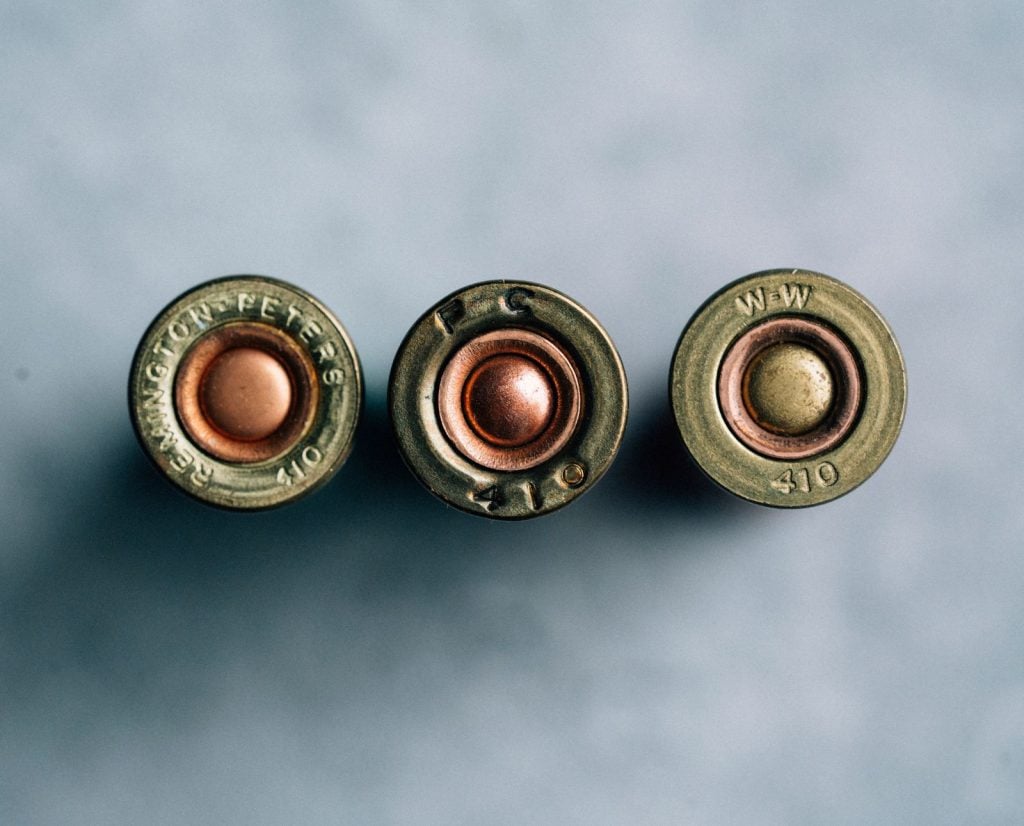
Below are representative muzzle/inside diameters rounded to three decimals. Manufacturers report either the final ID or the constriction amount (thousandths under bore). Nominal bores can vary slightly between guns; values may differ across spec sheets.
| Choke | Diameter in Inches |
| Cylinder (no choke) | 0.410 |
| Skeet | 0.409 |
| Improved Cylinder (IC) | 0.408 |
| Light Modified (LM) / Skeet II | 0.406 |
| Modified (MOD) | 0.403 |
| Improved Modified (IM) | 0.400 |
| Full | 0.396 |
Forcing Cone Improvements
But improving pellet material was only part of the equation. Just as crucial, and yet often overlooked, was how the barrel itself evolved, particularly regarding forcing cones.
The forcing cone is the taper between the chamber and the bore of the barrel. It’s a kind of funnel that guides the shot charge into the narrower tube. In older guns, this transition was steep and abrupt, usually around half an inch long, which caused more pellet deformation.
When gunsmiths and manufacturers began lengthening forcing cones, they provided a smoother transition for the shot charge. While the concept existed as early as the late nineteenth century, its widespread use in production shotguns took much longer, gaining traction in the mid-to-late twentieth century and becoming common in the 1990s.
In my research, I found a 2010 paper titled “Forcing Cone Alteration and Its Effect on Shotgun Pattern Performance” by Jim Eyster. He wrote, “If one is mindful of that junction between the chamber and the bore, [the data indicates] that one can increase the number of pellets delivered to the killing zone by 8 percent.” While this research primarily focused on 12-gauge shotguns, the principle applies to all gauges, including the .410.
In simple terms, a short forcing cone slams the shot charge into the barrel walls, flattening pellets and widening your pattern. A longer cone eases that transition, keeping pellets rounder and patterns tighter. Lengthening the forcing cone reduces both of these issues and often has the added benefit of lowering felt recoil due to a smoother transition. However, forcing cone modifications alone do not guarantee tighter patterns. Other factors like choke selection and wad design also play critical roles.
Because of the .410’s niche appeal, innovations like lengthened forcing cones arrived later than in larger gauges. Most did not appear in factory models until the 1990s. The theory behind longer forcing cones is similar to that of modern shot wads, which help preserve pellet integrity. Just as improved wads reduce deformation, a lengthened forcing cone allows for a smoother shot transition, leading to better patterns. Additionally, a longer forcing cone can help the wad maintain its structural integrity, further enhancing shot column stability.
This is something to keep in mind when shopping for a .410. While I would never discourage the purchase of vintage shotguns, not all older models necessarily require forcing cone modifications. Some perform well in their original state, and excessive alterations may impact collector value. That said, if the goal is to maximize performance with modern ammunition, a gunsmith can evaluate the shotgun to determine whether lengthening the forcing cone would be beneficial. They can also assess the gun’s ability to handle modern loads safely and provide recommendations for proper use and modifications.
Popularity of the .410
All of this leads to a bigger question: for all its quirks and challenges, why does the .410 endure? To answer that, we need to explore its cultural role and popularity through time.
“The classical double .410s—Parkers, Ithacas, and L.C. Smiths—made their appearance in the second half of the 1920s, a time of financial prosperity and social license,” Gabriel wrote in American and British .410 Shotguns. “In the immediate post–World War II era, the .410 shotgun made up 6 percent of annual sales of all shotguns in Great Britain. The large majority were single-barrel bolt-action guns built by such firms as B.S.A. and Webley & Scott.”
Back in the States, just about every major gun manufacturer was producing a .410 shotgun. According to Gabriel, sales representatives from Winchester believe that five percent of the shotguns they produced from 1936 to 1963 were .410s.
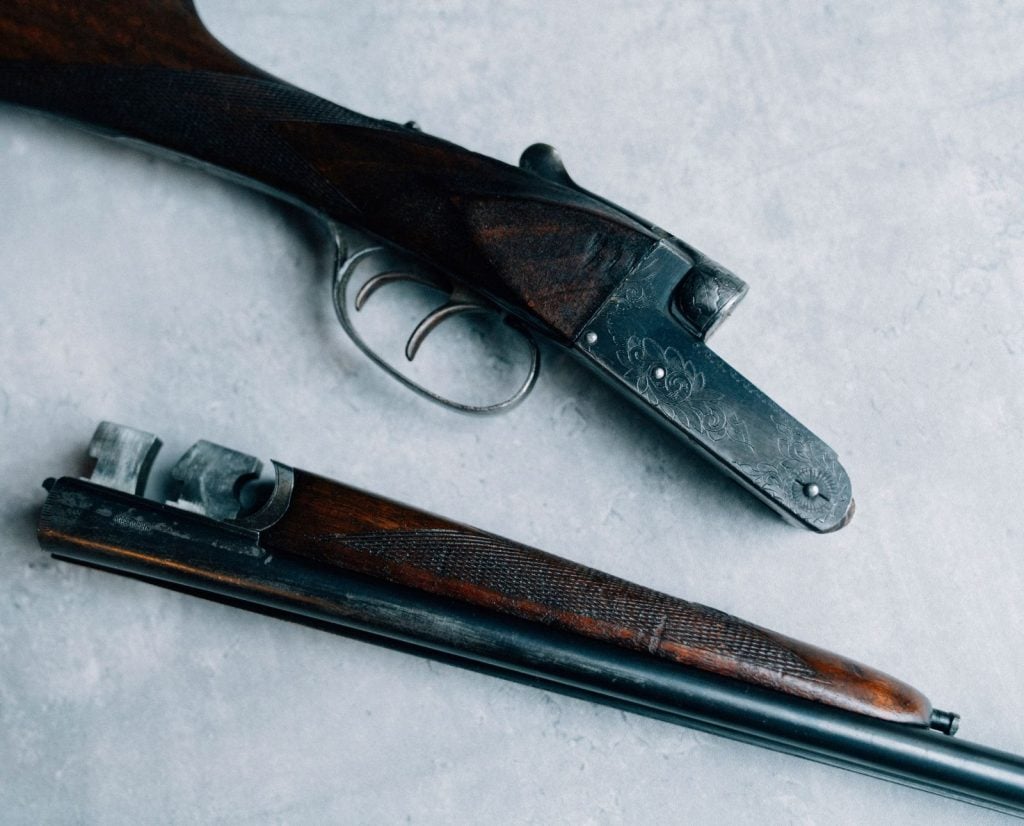
The single-shot .410 has been a staple for many youths growing up hunting—just like my brother’s New England Firearms .410 from back in the ’80s. I still have a sufficient supply of .410 shells in my ammo safe. Mind you, they’re also all from the ’80s. Today, however, the relevance of the single-shot .410 is bringing these affordable and extra-safe designs back to the youth of America, providing more positive experiences in performance.
According to Hunting Retailer, the overwhelming popularity of the Taurus Judge and Smith & Wesson Governor has led to increased demand for .410 ammunition: “That broader demand for .410 ammo spilled back upstream to .410 shotguns, with both Remington and Mossberg seeing big sales jumps from their small-bore shotguns again.” As demand surged, manufacturers responded: “Mossberg reportedly grew models available in .410, spanning their 500 and 590 defense, youth, turkey, and upland game break-open models in response to growing .410 shotgun sales.”
While I have no doubt that more people are turkey hunting with a .410 (seeing as it has only been legalized with the introduction of TSS loads), its popularity in the wingshooting space is stagnant. In truth, there is not much of an audience excited to see the .410 appear in print. In Project Upland’s 2024 North American Upland Hunting Survey, only 0.5 percent of respondents selected the .410 as their preferred gauge. Only the 12-gauge decreased in popularity from 2023 to 2024, dropping from 34 percent to 28 percent. Meanwhile, every other gauge saw a rise in popularity; the biggest rise was with the 20-gauge, which increased by three percent.
The .410 has endured more than a century of skepticism and evolution. Thanks to modern shotshell technology, it has carved out a lasting—if still unconventional—place in the shotgun world. Maybe I’ll pick one up again someday if the right one catches my eye. However, I think the only thing that could further propel its mainstream popularity would be making TSS loads the same price as bismuth. But perhaps the fate of the .410 is to remain an enduring oddity beloved by few, misunderstood by many, but undeniably here to stay.
Quality .410 Shotguns On the Market
The .410 shotgun has come a long way from its early reputation as a novelty or youth gun. Modern offerings reflect a century of refinement, with manufacturers producing reliable and well-crafted models that preserve the gauge’s unique place in shotgun history.
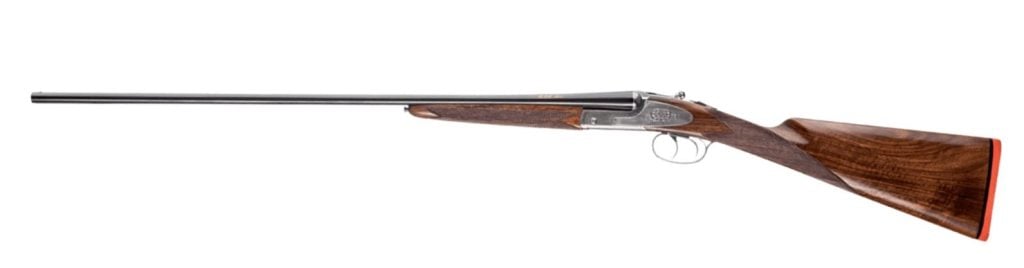
Best .410 Side-by-Side Shotgun: Upland Gun Company’s RFM Venus
The Italian-built RFM Venus is a scaled-frame, round-body boxlock side-by-side crafted for the American wingshooter. It combines classical details such as hand engraving, hand checkering, and demi-bloc barrels with practical features that include fixed chokes, double triggers, extractors, and an automatic safety. Offered in .410 as well as 12, 16, 20, and 28, the Venus is light and elegant, with typical .410 models weighing about 5.00 lbs.
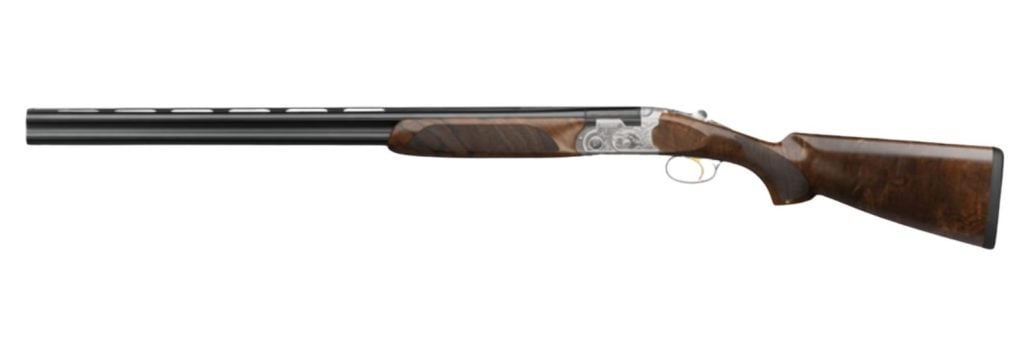
Best .410 Over/Under Shotgun: Beretta Silver Pigeon III
The Beretta 687 Silver Pigeon III in .410 is an elegant over/under built on the proven 680 platform. It ships with a 28-inch barrel and a 3-inch chamber, and the .410 version uses Mobil Choke 50 mm tubes for reliable patterning. Steelium Optima Bore HP barrels, an 80 mm double forcing cone, and a 6×6 windowed rib help the gun point naturally and deliver consistent patterns. The stock is crafted from class 2.5 walnut with a glossy finish and a pistol grip, and a 20 mm MicroCore recoil pad improves comfort on the shoulder. Finely detailed game-scene and floral engraving give the gun a classic look that suits both upland work and collectors.
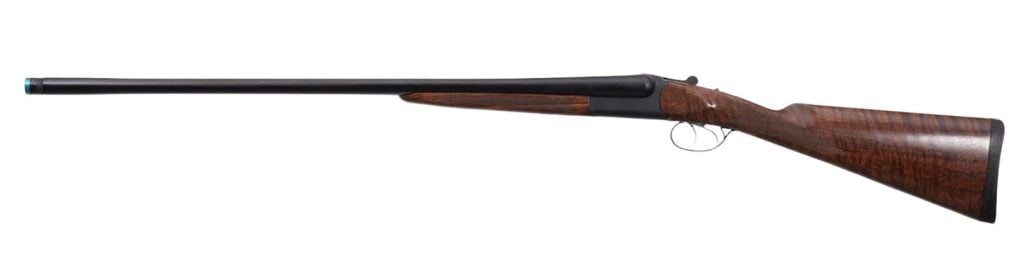
Best Entry-Level .410 Shotgun: Weatherby Orion SXS
The Weatherby Orion SxS in .410 is an approachable, classic-styled side-by-side built to do double duty on birds and clays. It comes with 28″ barrels, a straight English stock, and double triggers, all finished in matte blue with oil rubbed grade A walnut. The .410 version weighs about 6.1 pounds, has a 3″ chamber, and includes five Yildiz choke tubes from skeet to full for flexible patterning. Extractors keep empty shells out of the field, and the stock dimensions range from a 13.75″ to 14.75″ length of pull with a 1.5″ drop at the comb and a 2.375″ drop at the heel. For a new buyer, the Orion offers classic looks, sensible features, and dependable performance at an entry level price.
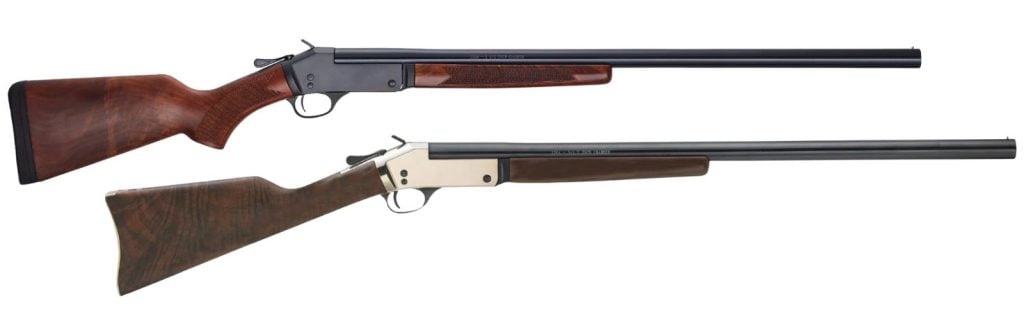
Best Modern Single Shot .410 Shotgun: Henry Single Shot Shotgun
The Henry Single Shot in .410 is a modern take on a timeless design. It features a polished brass receiver, American walnut stock, and a 26-inch round blued steel barrel that makes it both handsome and practical in the field. The gun weighs about 6.7 pounds, chambers 3-inch shells, and uses Invector-style removable chokes, shipping with a full choke included. Unlike older single-shots, the Henry fully ejects shells on opening, making follow-up shots quicker. For hunters or new shooters who value tradition, reliability, and simplicity, the Henry Single Shot .410 offers a dependable companion backed by Henry’s lifetime guarantee.
Best Vintage Single Shot .410 Shotgun: Winchester’s Model 37
Winchester’s Model 37 is a simple, dependable single-shot that earned its place at family hunting camps during the Depression and for decades after. Built around a break-action with a semi-hammerless style rebounding hammer and a reliable transfer bar, it is straightforward to operate and safe to carry in the field. Millions of examples were produced, and the later Canadian-made 37A kept the design alive into the 1970s with modest updates and the same hardworking character. The gun feels full-sized and surprisingly soft to shoot, which makes it an easy choice for new shooters and youngsters who want a comfortable first experience. Light, affordable, and low maintenance, the Model 37 remains a practical vintage option for hunters and collectors who value usefulness over flash.
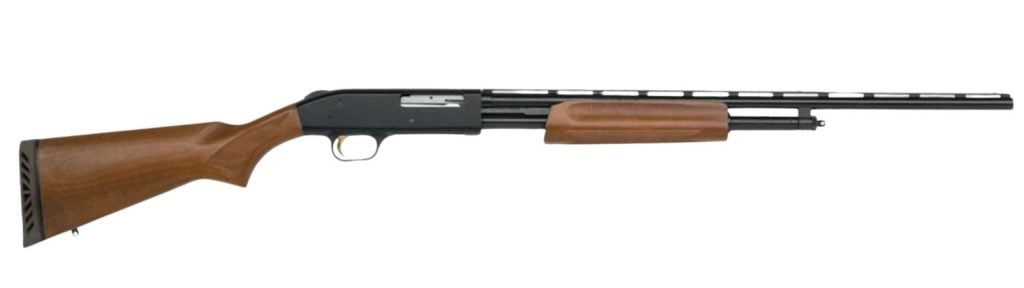
Best Pump Action .410 Shotgun: Mossberg 500
The Mossberg 500 in .410 is a rugged, no-nonsense pump shotgun. It pairs a stout 24 inch blued steel barrel and walnut furniture with a corrosion resistant aluminum receiver and Mossberg’s proven dual action bars for smooth, reliable cycling. The .410 model ships with a fixed full choke and a 5+1 capacity, and the ambidextrous tang safety makes it quick and natural to operate for left or right handed shooters. At roughly 6.25 pounds and a street price around $450, it offers dependable performance, easy maintenance, and strong value for hunters and shooters who want a simple, hard-working pump shotgun.







I have an inherited Mossberg 500 410 circa 1962. It is equipped with a plain bbl and full fixed choke. I bought some tss shells(#9shot) for turkey hunting. I have not jugged this pc yet! I have used my 870 3” mag 12 gauge for yrs. I have ported the bbl and extended the forcing cone on that gun. I was curious if your experience would recommend a forcing cone adjustment on my 410. I would hate to ruin any value of this prize( if it has any) but would like to try the gun for turkey. So your thoughts on the subject would be appreciated. Thanks- rw in Dallas