

Roasted Ruffed Grouse with Giblet and Lap Cheong Rice Stuffing
There’s something magical about Chinese-style sticky rice studded with little treasures.
The first time I tried it was at my local dim sum joint, which I discovered as a young teenager. The dim sum menu included a dish called lo mai gai, translated to English as something like sticky rice stuffed lotus leaves. Having never tried sticky rice before, or even heard of lotus leaves, I had to try it!
The dish came out as a parcel about the size of a burger, wrapped in some sort of sturdy leaf (which I could only assume was lotus) on a small plate. The leaf seemed too tough to eat, so I figured it must just be there to hold the rice. I partially unwrapped the leaves to expose a glistening interior of sticky rice, studded with unidentifiable (to me at the time) ingredients. The smell was intoxicating; I later learned that the lotus leaves act as a cooking vessel as well as lending their perfume to the steamed rice.
Digging into the rice with chopsticks, I encountered all sorts of fun stuff. There were sliced shiitake mushrooms, hunks of sweet lap cheong sausage, shredded chicken cooked in soy sauce, ground pork, and maybe some other little goodies.
I took some chili oil from the condiments on the table and doused the rice before hoovering it up. The owner had been watching me, probably wondering what this solo, white teenager was doing eating real Chinese food—he had obviously never seen anything like it. He came over and struck up a conversation in broken English, inquiring if I had lived in China.
“Nope,” I responded, “But I wish I had. I love this food!”
He then remarked on how much chili oil I had used and said he didn’t think white people liked spicy food.
“That’s not totally true,” I replied, “I LOVE spicy food.”
I came back the next weekend with a group of friends, and we ordered a round of lo mai gai, each drowning the dish in chili oil.
“Wow!” the owner, who once again came out to observe this strange phenomenon, “You boys really like chili!”
We continued visiting the restaurant and ordering sticky rice in lotus leaves—as well as steamed BBQ pork buns, congee, siu mai, and everything else on the dim sum menu—at least once a month. The owner would welcome our unruly adolescent group at the door by exclaiming, “Ohhh! It’s the chili boys!” and would bring over an extra jar of the spicy chili oil to our table. Those experiences left an indelible impression on me over the years and have certainly influenced my food preferences and cooking style.
Later in life, I had the opportunity to try Cajun dirty rice, a delicious rice dish from New Orleans that includes minced or ground liver and ground pork. Somehow, the spices and consistency of the rice worked together to incorporate the liver without actually tasting like liver. Without the liver, though, the dish falls flat.
My mind, as it is wont to do, ruminated on those two dishes until they kind of became one new dish—a dish I figured would be incredible.
The only problem to solve was what I’d wrap the rice in. Should I try to source lotus leaves? Use something wild like burdock leaves? Was there some other solution?
While staring in my freezer (as I am also wont to do), I noticed a few whole, plucked ruffed grouse that I needed to do something with… like stuffing with my sticky-dirty rice?
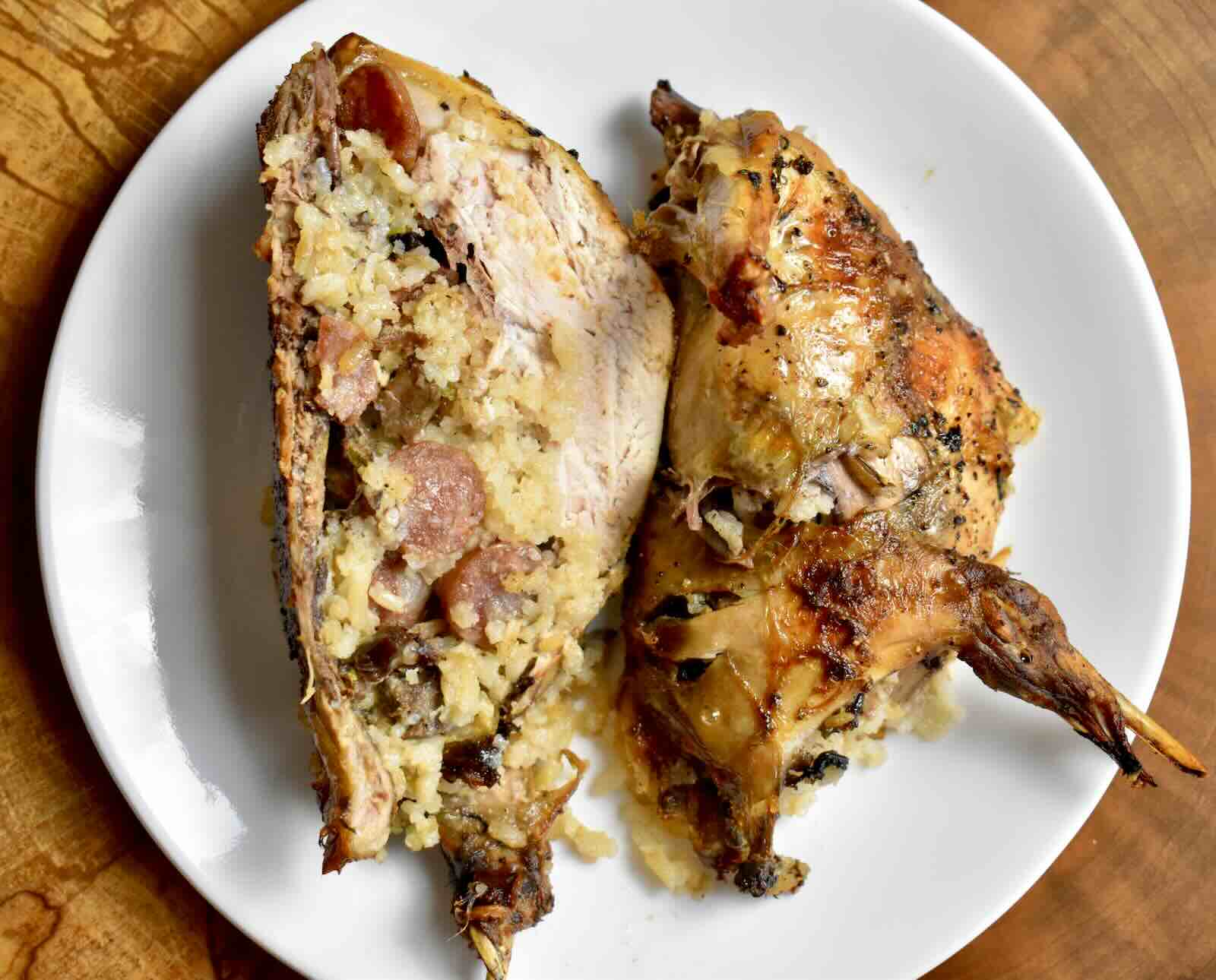
I brined the birds to provide some extra juiciness, then stuffed them with my rice mixture, made with finely chopped grouse offal, sweet and savory lap cheong sausage, scallions, garlic, and soy sauce before roasting them in the oven.
The result, as you will see if you make them, was sublime. If inclined, you could also add sliced shiitake or wild mushrooms to great effect.
Lap cheong is available in any Asian market, online, and in many large Western grocers. It comes in a vacuum-sealed bundle and the sausages must be cooked before being eaten. You’ll end up with some extra, which is fine, since they keep in the fridge for a long time. Try adding a whole sausage to a pot of cooking rice, slicing it thin and frying in a pan over low heat as a meal topper, or adding it to stir-fries.

Roasted Ruffed Grouse with Sticky Rice Stuffing
Ingredients
Method
- Heat up the water in a pot and add the salt and sugar. Stir until completely dissolved. Let the water cool down to at least room temperature, then add the whole grouse, ensuring they’re submerged in the water. Put the pot in the fridge and brine the grouse for 5-8 hours.
- Add the raw rice, 1 tablespoon of butter, sliced sausage, giblets, scallions, and garlic to a pot over medium heat. Cook, stirring very often, for 5-10 minutes, or until the rice smells toasty and has become opaquely white, and the sausage has begun to render its fat.
- Add the water and a pinch of salt, bring to a boil, cover, and reduce heat to low. Cook for 18 minutes without disturbing the lid, then let it rest off of the heat for 10 minutes.
- Fluff with a fork and stir in the soy sauce.
- Preheat oven to 475°F.
- Stuff the rice mixture into the cavities of the birds. Rub ¼ cup of butter all over each bird. If the skin is still intact, be sure to rub some butter in under the skin, especially over the breasts. Season the exterior of the birds generously with salt and pepper.
- Put the birds on a sheet pan fitted with a rack, or in an oven-proof skillet and put in the oven for 15 minutes. Turn the temperature down to 350°F and let the grouse cook for another 15-20 minutes, basting with any butter that has accumulated in the bottom of the skillet.
- Remove the grouse from the oven, cover with foil, and let rest for 10 minutes before serving. Enjoy!